Shekhawat inaugurates Italy-India art show at Humayun's Tomb
Synopsis
Union Culture Minister Gajendra Singh Shekhawat inaugurated 'One Mother, Many Mother Tongues', a joint India-Italy exhibition at New Delhi's Humayun's Tomb Museum on 22 June 2026. Organised by the Italian Embassy and its Cultural Centre, the show pairs ancient Indian sculpture with Italian artworks on motherhood and linguistic diversity, reinforcing bilateral cultural ties.
Key Takeaways
Union Culture and Tourism Minister Gajendra Singh Shekhawat inaugurated the exhibition 'One Mother, Many Mother Tongues' on 22 June 2026 .
The event was jointly organised by the Embassy of Italy and the Italian Embassy Cultural Centre in New Delhi.
The venue is the Humayun's Tomb Museum , a UNESCO World Heritage Site managed by the Archaeological Survey of India.
The exhibition juxtaposes ancient Indian sculpture with Italian artworks centred on motherhood and linguistic diversity.
Shekhawat called India's linguistic diversity 'one of our greatest cultural strengths' that reinforces national unity.
The initiative forms part of India's broader cultural diplomacy strategy with European partners at heritage sites.
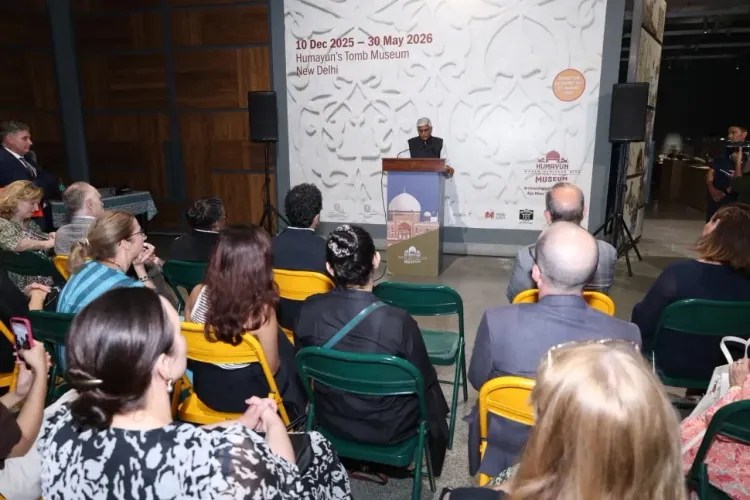
Union Culture and Tourism Minister Gajendra Singh Shekhawat on Monday, 22 June 2026 inaugurated the exhibition 'One Mother, Many Mother Tongues' at the Humayun's Tomb Museum in New Delhi, an event jointly organised by the Embassy of Italy and the Italian Embassy Cultural Centre. The show brings together ancient Indian sculpture and celebrated Italian artworks united by the theme of motherhood and linguistic diversity.
Context
Posting on X in Hindi, Minister Shekhawat described India's linguistic diversity as one of its greatest cultural strengths, writing: 'हमारी भाषाई विविधता हमारी सबसे बड़ी सांस्कृतिक शक्तियों में से एक है' ('Our linguistic diversity is one of our greatest cultural strengths, and this very diversity makes our unity stronger'). He said the exhibition 'establishes a dialogue that transcends the boundaries of time and geography', linking the cultural heritage of India and Italy.
The venue, Humayun's Tomb, is a 16th-century UNESCO World Heritage Site managed by the Archaeological Survey of India. Hosting diplomatic cultural events at such centrally protected monuments has become a deliberate practice to project India's soft power while underscoring the 'unity in diversity' theme.
Policy Backdrop
India and Italy have maintained long-standing cultural diplomacy built around shared civilisational motifs rather than formal treaty negotiations. The Ministry of Culture has increasingly partnered with European embassies to mount exhibitions at heritage sites, positioning India's monuments as living cultural spaces rather than static tourist attractions.
The exhibition's title, 'One Mother, Many Mother Tongues', resonates with India's constitutional recognition of 22 scheduled languages and the government's broader push under the National Education Policy to promote mother-tongue instruction. For Italy, a country with strong regional linguistic identities, the theme carries parallel resonance.
Stakeholders and Impact
The event draws together the diplomatic community, art historians, and cultural institutions from both countries. Visitors to the exhibition gain a rare opportunity to view ancient Indian sculpture alongside Italian artworks and historical symbols associated with motherhood — a curatorial pairing that highlights civilisational convergences rather than differences.
Minister Shekhawat extended congratulations to the Embassy of Italy, the Italian Embassy Cultural Centre, and all collaborating partners, signalling the Ministry of Culture's endorsement of the initiative as part of its people-to-people diplomacy agenda.
What's Next
Cultural observers will watch for any follow-up joint curatorial projects or memoranda of understanding between the Ministry of Culture and Italian institutions in the months ahead. If the exhibition draws strong public and academic engagement, it could serve as a template for similar India-Europe cultural collaborations at UNESCO heritage sites across the country.
Point of View
Projecting India's pluralist heritage as a bridge to the world. For the BJP-led government, championing a show themed on linguistic diversity at such a site allows it to simultaneously assert cultural nationalism and cosmopolitan openness, a balance it has sought in cultural policy. The 'One Mother, Many Mother Tongues' framing also dovetails with the government's mother-tongue promotion agenda under the National Education Policy, lending the event policy coherence beyond ceremonial diplomacy. How the Ministry of Culture converts such high-visibility moments into durable institutional partnerships with Italian cultural bodies will be the real measure of this engagement.
NationPress
21 Sept 2026
Frequently Asked Questions
What is the 'One Mother, Many Mother Tongues' exhibition in New Delhi?
It is an exhibition organised by the Embassy of Italy and the Italian Embassy Cultural Centre at Humayun's Tomb Museum in New Delhi, juxtaposing ancient Indian sculpture with Italian artworks on the themes of motherhood and linguistic diversity.
Who inaugurated the India-Italy exhibition at Humayun's Tomb?
Union Culture and Tourism Minister Gajendra Singh Shekhawat inaugurated the exhibition on 22 June 2026.
Where is Humayun's Tomb Museum located?
Humayun's Tomb Museum is located within the 16th-century Humayun's Tomb complex in New Delhi, a UNESCO World Heritage Site managed by the Archaeological Survey of India.
What is the significance of holding the exhibition at Humayun's Tomb?
Hosting diplomatic cultural events at centrally protected monuments like Humayun's Tomb is part of India's strategy to project soft power and position heritage sites as active spaces for international cultural exchange.
What did Gajendra Singh Shekhawat say about linguistic diversity at the event?
Shekhawat said India's linguistic diversity is one of its greatest cultural strengths and that this diversity makes national unity stronger, themes that align with the exhibition's central concept.