Shekhawat Pays Tribute to CV Raman on Birth Anniversary
Synopsis
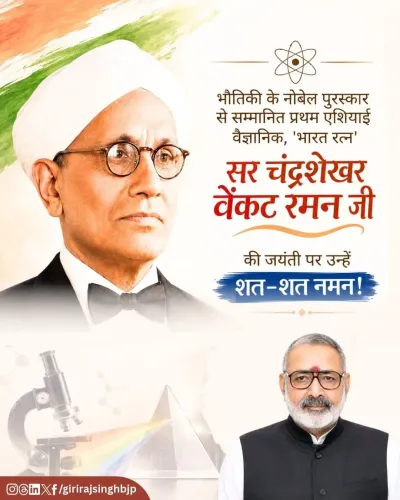
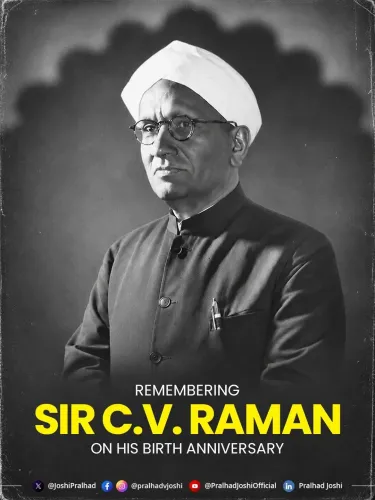
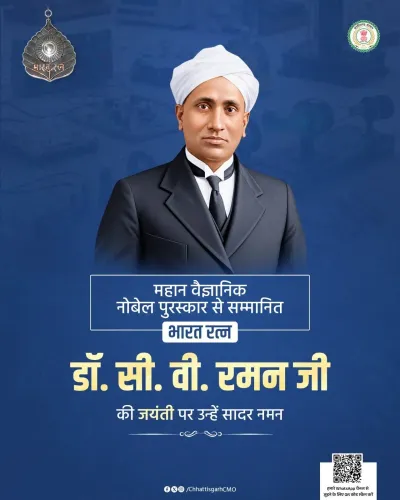
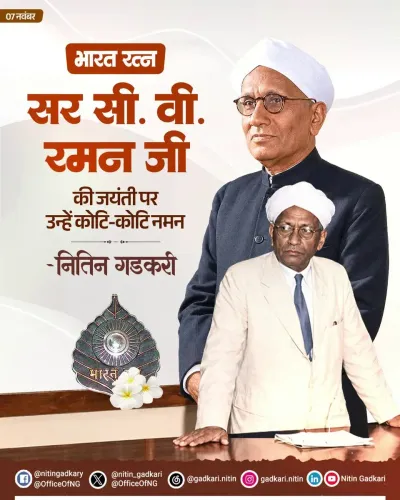
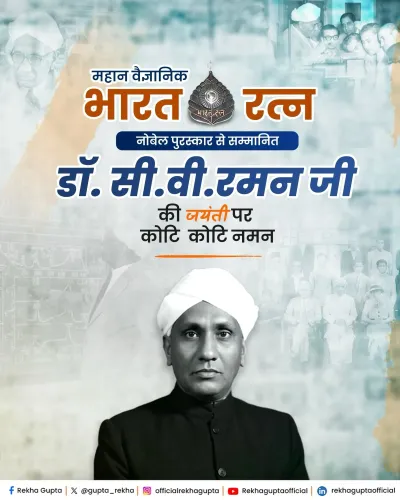
Union Culture and Tourism Minister Gajendra Singh Shekhawat paid tribute to Bharat Ratna Sir C.V. Raman on his birth anniversary, honouring the discoverer of the Raman Effect — the 1928 breakthrough that earned India its first Nobel Prize in Physics in 1930.
Key Takeaways
Union Minister Gajendra Singh Shekhawat paid tribute to Sir C.V.
Raman on his birth anniversary on 7 November 2026 .
Raman discovered the Raman Effect in 1928 , describing the inelastic scattering of light by molecules — foundational to modern spectroscopy.
He was awarded the Nobel Prize in Physics in 1930 , the first Asian and first non-white scientist to receive the honour.
Raman was conferred the Bharat Ratna in 1954 , India's highest civilian award.
India observes National Science Day on 28 February every year since 1987 to commemorate the Raman Effect discovery.
Shekhawat called Raman an 'eternal ideal' for scientists across the world, highlighting his achievements despite scarce resources.
A scientist who built a Nobel Prize-winning discovery on scarce resources and sheer curiosity — Union Culture and Tourism Minister Gajendra Singh Shekhawat honoured the legacy of Bharat Ratna Sir C.V. Raman on his birth anniversary on Saturday, 7 November 2026, calling him one of the greatest Indian scientists of all time.
Posting on X, Shekhawat wrote: 'सर्वकालिक महान भारतीय वैज्ञानिकों में एक भारत रत्न सर चंद्रशेखर वेंकटरमन जी की जयंती पर उन्हें सादर नमन!' — 'Respectful salutations to Bharat Ratna Sir Chandrashekhara Venkata Raman, one of the greatest Indian scientists of all time, on his birth anniversary!' He added that Raman tested his inner researcher against the touchstone of hardship and created a landmark like the Raman Effect, noting that he would remain an ideal for scientists not just in India but across the world.
The Man Behind the Raman Effect
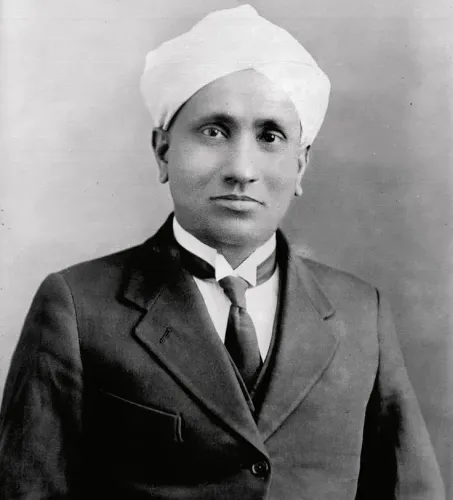
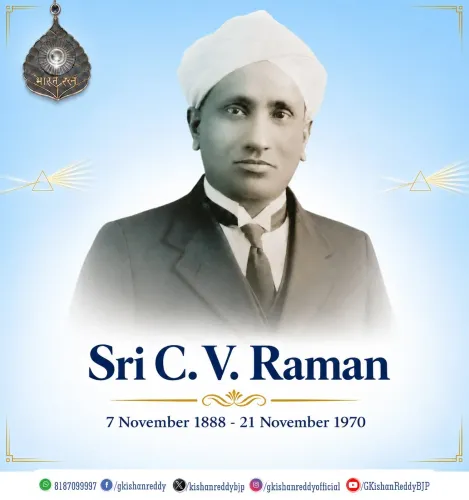
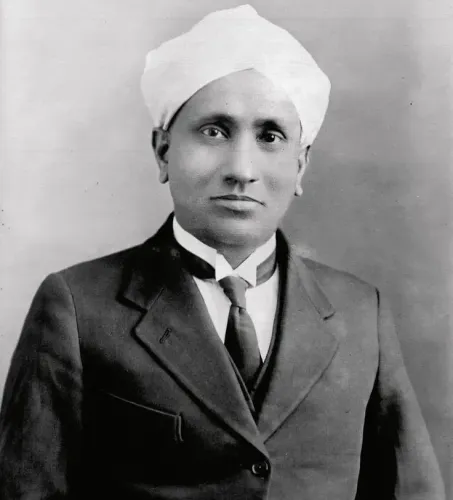
Sir Chandrashekhara Venkata Raman was born on 7 November 1888 in Tiruchirapalli, in present-day Tamil Nadu. Working with limited institutional resources, he pursued a deep curiosity about the behaviour of light — a pursuit that culminated in 1928 with the announcement of the Raman Effect: the phenomenon of inelastic scattering of light by molecules. The discovery revealed that when light passes through a transparent material, a small fraction of it scatters at different wavelengths, providing a unique molecular fingerprint.
The world took swift notice. In 1930, Raman became the first Asian and first non-white scientist to win the Nobel Prize in Physics. India recognised him with the Bharat Ratna in 1954, the country's highest civilian honour. The Raman Effect today underpins modern spectroscopy, with applications spanning pharmaceuticals, materials science, forensics, and astrophysics — a discovery whose reach grows with every decade.
National Science Day and Raman's Enduring Symbol
India institutionalised the memory of this breakthrough in 1987, designating 28 February — the date of the original discovery announcement — as National Science Day, observed annually to inspire scientific temper among students and researchers. The day has since become a touchstone for science communication, with exhibitions, lectures, and policy conversations held across universities and research institutions nationwide.
Shekhawat's tribute reflects a long-standing tradition among India's political leadership of publicly honouring pre-independence scientists on their birth anniversaries — a practice that keeps foundational scientific achievements visible in the national conversation. The sentiment is clear: in an era of large budgets and advanced instruments, Raman's story of discovery built on austerity and intellectual rigour remains a compelling argument for curiosity-driven science.
Point of View
Invoking Raman's story of discovery-under-austerity carries a pointed resonance at a time when debates about research funding and institutional autonomy remain live. The annual rhythm of such tributes — anchored to birth anniversaries and National Science Day — has become a soft-power instrument, projecting India's scientific identity both domestically and internationally. Whether they translate into substantive science-policy momentum is the question that researchers and educators continue to watch.
NationPress
7 Nov 2026
Frequently Asked Questions
When is C.V. Raman's birth anniversary?
C.V. Raman was born on 7 November 1888 in Tiruchirapalli, Tamil Nadu. His birth anniversary is observed on 7 November each year.
What is the Raman Effect?
The Raman Effect is the phenomenon of inelastic scattering of light when it passes through a transparent material — the scattered light shifts in wavelength, revealing the molecular composition of the substance. Announced in 1928 , it is the basis of modern Raman spectroscopy.
Did C.V. Raman win the Nobel Prize?
Yes. C.V. Raman won the Nobel Prize in Physics in 1930 for the discovery of the Raman Effect, becoming the first Asian and first non-white scientist to receive the prize.
What is National Science Day and why is it celebrated on 28 February?
National Science Day is observed on 28 February every year since 1987 to mark the anniversary of C.V. Raman's announcement of the Raman Effect discovery. It is dedicated to promoting scientific awareness across India.
What Bharat Ratna did C.V. Raman receive?
C.V. Raman was awarded the Bharat Ratna in 1954 — India's highest civilian honour — in recognition of his extraordinary contributions to science.