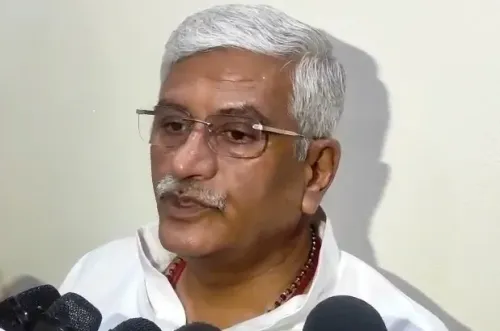
Shekhawat pens article on India seizing global uncertainty

Synopsis
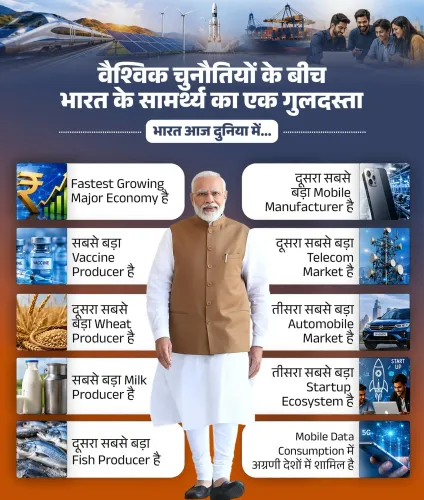
Union Minister Gajendra Singh Shekhawat has penned an opinion article in Rajasthan Patrika contending that the new India possesses the capacity to identify opportunity within global uncertainties, echoing the government's long-standing Atmanirbhar Bharat and Make in India narratives of economic resilience and self-reliance.
Key Takeaways
Gajendra Singh Shekhawat , Union Minister of Culture and Tourism, published an opinion article in Rajasthan Patrika on 21 July 2026 .
The article's central argument is that 'new India' has the ability to find opportunity amid global uncertainties.
The piece aligns with the government's Atmanirbhar Bharat initiative (launched 2020 ) and the Make in India programme (launched 2014 ).
The choice of Rajasthan Patrika , a major Hindi daily, targets a regional business and farming audience in Rajasthan and western India.
Key stakeholders include Indian industry and the MSME sector , which are central to both the policy vision and ground-level economic impact.
Union Culture and Tourism Minister Gajendra Singh Shekhawat shared an opinion article authored by him in Rajasthan Patrika, one of the most widely read Hindi dailies in western India, on Tuesday, 21 July 2026. The piece, written in Hindi, argues that the new India has the capacity to identify and seize opportunities even amid global uncertainties.
Sharing the article on X, Shekhawat wrote: 'वैश्विक अनिश्चितताओं में अवसर तलाशना नए भारत को आता है' ('The new India knows how to find opportunity in global uncertainties'), framing it as a defining characteristic of the country's current economic outlook.
Context
The article comes at a moment when global supply chains, trade flows, and currency markets are experiencing heightened volatility. Major economies are grappling with geopolitical tensions, shifting trade alliances, and post-pandemic structural adjustments that have created both disruption and opportunity for emerging markets like India.
Shekhawat, a senior BJP leader and Lok Sabha MP from Jodhpur, Rajasthan, has used the platform of a prominent regional publication to articulate the government's confidence in India's economic resilience — a message aimed squarely at readers in Rajasthan and western India.
Policy Backdrop
The argument in Shekhawat's article is consistent with the central government's economic narrative built around two flagship programmes. The Atmanirbhar Bharat initiative, launched in 2020, sought to promote domestic self-reliance in the face of global disruptions triggered by the Covid-19 pandemic. Before that, the Make in India programme, introduced in 2014, laid the groundwork for boosting manufacturing capacity and attracting foreign investment.
Together, these policy frameworks have shaped a government narrative that positions global disruption not as a threat to be weathered, but as a structural opening for India to accelerate industrial growth, diversify trade partnerships, and localise supply chains.
Stakeholders and Impact
The argument carries direct relevance for Indian industry and the country's vast MSME sector, which have been at the centre of both policy design and economic stress during successive global shocks. Small and medium enterprises in Rajasthan — spanning textiles, handicrafts, gems and jewellery, and agro-processing — are particularly sensitive to shifts in global demand and input costs.
By publishing in Rajasthan Patrika, Shekhawat ensures the message reaches a Hindi-speaking business and farming audience that may not engage with English-language policy discourse. The choice of platform signals an intent to build grassroots confidence in India's economic direction.
What's Next
Shekhawat's article may foreshadow similar messaging in upcoming central or state-level economic policy statements, particularly if global market volatility intensifies. Analysts will watch whether the themes he raises — trade diversification, supply-chain localisation, and domestic demand resilience — are reflected in forthcoming budget discussions or government white papers.
As India positions itself as an alternative manufacturing and services hub in a fragmented global order, senior ministers articulating this vision in regional media suggests the government is keen to build a broad domestic consensus around its economic strategy.
Point of View
And its repetition by a Cabinet minister in mid-2026 suggests the government is preparing its base for a period of continued external turbulence. By invoking 'new India' as the subject capable of this feat, the article also performs the dual function of policy advocacy and political branding. Whether the rhetoric translates into concrete measures for MSMEs and trade diversification will be the real test of the argument's durability.
NationPress
21 Jul 2026
Frequently Asked Questions
What did Gajendra Singh Shekhawat write in Rajasthan Patrika?
Shekhawat authored an opinion article in Rajasthan Patrika arguing that the new India has the ability to find and seize opportunities even in times of global uncertainty, consistent with the government's Atmanirbhar Bharat and Make in India frameworks.
What is Atmanirbhar Bharat and how does it relate to Shekhawat's article?
Atmanirbhar Bharat is a self-reliance initiative launched by the Indian government in 2020 in response to global disruptions caused by the Covid-19 pandemic. Shekhawat's article echoes its core argument that India can turn global challenges into domestic economic opportunities.
Why did Shekhawat publish in Rajasthan Patrika specifically?
Rajasthan Patrika is one of the most widely circulated Hindi dailies in Rajasthan and western India. Publishing there allows Shekhawat, who represents Jodhpur in the Lok Sabha, to reach a Hindi-speaking regional audience of farmers, small business owners, and traders.
Who is Gajendra Singh Shekhawat?
Gajendra Singh Shekhawat is a senior BJP leader, Union Minister of Culture and Tourism, and a Lok Sabha MP from Jodhpur, Rajasthan.
What global uncertainties is Shekhawat's article referring to?
The article appears to reference the broader environment of geopolitical tensions, shifting trade alliances, and global supply-chain disruptions that have affected major economies, presenting them as an opening for India to accelerate growth and diversify trade.