Why is Shivakumar Defending the Hate Speech Bill?
Click to start listening
Synopsis
Shivakumar's defense of the Karnataka Hate Speech Bill sparks controversy. Amid strong opposition from the BJP, he argues the law is crucial for safeguarding constitutional values and reducing public hostility. With potential penalties for hate crimes and speech, the legislation aims to address rising tensions in society.
Key Takeaways
- Legislation aims to curb hate speech and crimes.
- Strong opposition from the BJP highlights political tensions.
- Penalties include imprisonment and fines for offenders.
- Introduced in response to increased communal violence.
- Concerns raised about potential misuse of the law.
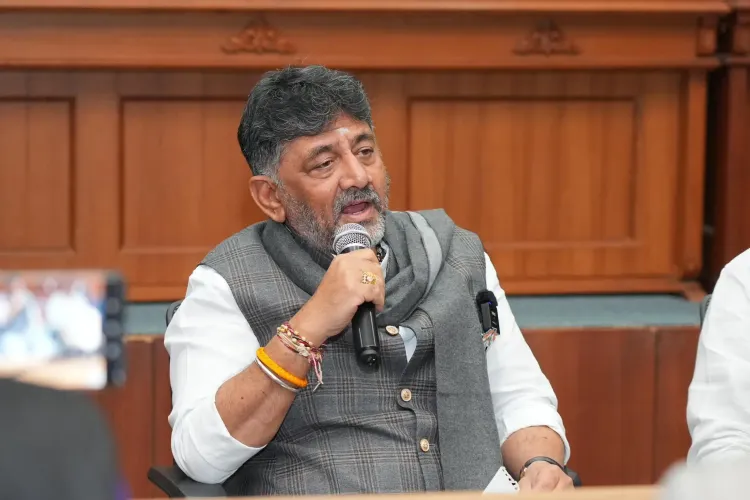
Belagavi (Karnataka), Dec 11 (NationPress) Deputy Chief Minister and state Congress leader D.K. Shivakumar has come forward to champion the Karnataka Hate Speech and Hate Crimes (Prevention and Control) Bill, 2025, asserting that the legislation is vital for upholding constitutional values and curbing hate speech.
Speaking to reporters outside Suvarna Vidhana Soudha in Belagavi on Thursday, he emphasized the Bill's necessity.
The Congress administration introduced the Bill in the Assembly on Wednesday, facing significant criticism from the Opposition Bharatiya Janata Party.
In response to questions regarding the Bill's opposition, Shivakumar remarked, “The BJP and its leaders are the architects of sowing discord among various castes and religions, as well as engaging in personal attacks. They ought to act in accordance with the Constitution's principles. If they genuinely respect the Constitution, they should adhere to it.”
The Deputy CM further indicated that the government's goal is to diminish hostility in public discourse.
“If they refrain from hate speech, there will be no issues whatsoever. We have initiated this measure to safeguard the Constitution,” he stated.
Shivakumar also addressed Union Home Minister Amit Shah’s recent claims that Jawaharlal Nehru and Indira Gandhi participated in vote theft, arguing that such allegations lack credibility.
“Amit Shah should at least possess basic understanding regarding this. During their tenure, the ballot paper system was operational. How could vote theft occur then?” he questioned.
The Bill was presented to the state Assembly by Law and Parliamentary Affairs Minister H.K. Patil. BJP members strongly opposed its introduction, contending that the government had not engaged in sufficient discussions on the matter. Many argued that the current legal framework is adequate, deeming the proposed law unnecessary.
As Speaker U.T. Khader called for a vote on the Bill's introduction, the BJP persisted in its protests, announcing it would not support the initiative. The Speaker had to briefly adjourn the House due to the ongoing uproar.
The proposed law defines a hate crime as any act that causes harm, incites harm, or promotes bias or intolerance against another individual.
This includes actual or perceived characteristics such as religion, race, caste, community, sex, gender, sexual orientation, place of birth, residence, language, disability, tribe, or traits of family members or associated groups.
Under the Bill, individuals convicted of a hate crime could face imprisonment of up to three years, or a fine of up to Rs 5,000, or both. The offense is categorized as non-cognizable and non-bailable, to be tried by a First Class Magistrate.
For hate speech, the Bill stipulates a similar penalty of imprisonment for up to three years or a fine of up to Rs 5,000, or both. This offense is also non-cognizable and non-bailable.
BJP leaders claimed that the legislation specifically targets leaders associated with Hindutva organizations, particularly in coastal regions where communal tensions have escalated.
The Congress-led government crafted the Bill following a series of revenge killings in Mangaluru that garnered national attention. A special task force has been established to avert further violence, with dedicated units monitoring social media activity that could incite unrest.
Point of View
It's crucial to recognize the complexities surrounding the Karnataka Hate Speech Bill. This legislation has the potential to significantly impact public discourse and societal harmony. While it aims to uphold constitutional values, the opposition from the BJP raises valid concerns about its implementation and potential abuse. A balanced approach is necessary to ensure that the rights of individuals are protected while also addressing the urgent need to combat hate speech and violence.
NationPress
13/12/2025
Frequently Asked Questions
What is the Karnataka Hate Speech Bill?
The Karnataka Hate Speech and Hate Crimes (Prevention and Control) Bill, 2025, aims to define and penalize hate crimes and hate speech to protect constitutional values.
What are the penalties under the Bill?
Convictions for hate crimes may result in up to three years of imprisonment and/or a fine of up to Rs 5,000. Hate speech carries similar penalties.
Why is the BJP opposing the Bill?
The BJP claims that the Bill targets leaders associated with Hindutva organizations and argues that the current legal framework is sufficient.
What sparked the introduction of this Bill?
The Bill was introduced in response to a series of revenge killings in Mangaluru that raised national concerns over communal violence.
Who presented the Bill in the Assembly?
The Bill was presented by Law and Parliamentary Affairs Minister H.K. Patil.