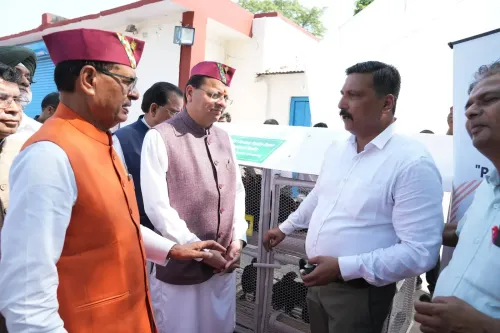
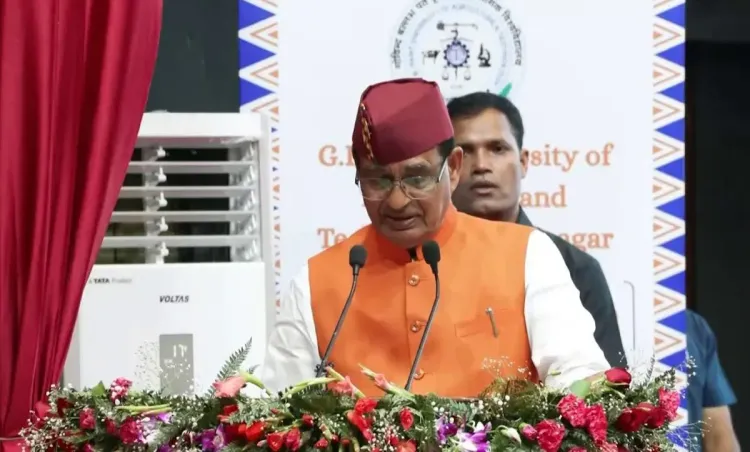
Shivraj Singh Chouhan hails Pantnagar as idea, not just university
Synopsis
Union Agriculture Minister Shivraj Singh Chouhan on 26 June 2026 described Pantnagar — India's first agricultural university — as 'not merely a university but an idea,' asserting that agriculture is the foundation of nation-building and that science must serve humanity's welfare.
Key Takeaways
Union Agriculture Minister Shivraj Singh Chouhan posted on X on 26 June 2026 invoking Pantnagar's founding philosophy.
Govind Ballabh Pant University of Agriculture and Technology, Pantnagar , established in 1960 , is India's first agricultural university.
The university was built on the US land-grant model, integrating teaching, research, and extension services.
Chouhan framed agriculture as 'not merely a livelihood but the foundation of nation-building.' The statement aligns with the ministry's broader push to modernise agricultural education and strengthen university-to-farm extension services.
Possible policy announcements on agricultural university curricula or research collaborations may follow.
Union Agriculture Minister Shivraj Singh Chouhan on Friday, 26 June 2026, invoked the founding philosophy of Govind Ballabh Pant University of Agriculture and Technology, Pantnagar, calling it not merely an institution but an enduring idea — one that positions agriculture as the bedrock of nation-building.
Posting in Hindi on X, the minister wrote: 'Pantnagar keval ek vishwavidyalaya nahin, ek vichar hai' — 'Pantnagar is not merely a university, it is an idea.' He elaborated that the idea holds knowledge must serve society, science must serve humanity's welfare, and agriculture is not merely a livelihood but the foundation of nation-building.
Context
Pantnagar, located in Uttarakhand, is home to India's first agricultural university, established in 1960 on the American land-grant model. The model was designed to integrate teaching, research, and extension services — bringing scientific knowledge directly to farming communities rather than confining it to classrooms.
The university was named after Govind Ballabh Pant, the veteran statesman and former Chief Minister of Uttar Pradesh, and has since trained generations of agricultural scientists and rural development professionals. Its founding represented post-independence India's conviction that food security required institutional scientific investment at scale.
Policy Backdrop
Chouhan's remarks echo a long-standing policy thread in Indian agriculture: that universities like Pantnagar are not peripheral academic bodies but instruments of national food security. The Indian Council of Agricultural Research (ICAR) network, built alongside state agricultural universities, has been the institutional spine of successive Green Revolution-era and post-Green Revolution programmes.
Under the current dispensation, the Ministry of Agriculture and Farmers Welfare has emphasised modernising agricultural education, strengthening research collaboration between universities and farmers, and aligning curricula with emerging challenges such as climate-resilient farming and natural agriculture. Chouhan, a senior BJP leader and former four-term Chief Minister of Madhya Pradesh, has frequently underscored the role of scientific institutions in realising the government's goal of doubling farmers' incomes.
Stakeholders and Impact
The statement carries direct relevance for agricultural students, researchers, and farming communities across India. For students enrolled in agricultural universities, the minister's framing elevates their field of study as a matter of national purpose rather than vocational choice — a message with both motivational and policy weight.
For rural communities, particularly smallholder farmers, the invocation of Pantnagar's extension-service model signals continued political emphasis on translating laboratory research into field-level outcomes. Extension services — the bridge between university research and actual farm practice — have historically been underfunded, and any renewed ministerial attention could foreshadow budget or programme announcements.
What's Next
The ministry is expected to watch for possible announcements on strengthening agricultural university curricula, new research tie-ups, or enhanced extension service frameworks. Chouhan's philosophical framing of Pantnagar's mission may presage a broader policy communication around agricultural education reform or an event linked to the university's institutional calendar.
As India navigates the dual imperatives of food security and farmer welfare, statements that re-anchor the public discourse around the foundational role of agricultural science carry the potential to shape budget priorities and inter-ministerial coordination in the months ahead.
Point of View
The invocation of India's first agricultural university signals continuity with the land-grant philosophy while leaving room for a fresh policy announcement. The post also reflects the BJP government's broader effort to position scientific institutions as expressions of national purpose, reinforcing the narrative of 'Viksit Bharat' through rural and agricultural modernisation. Observers will watch whether this philosophical statement translates into concrete budgetary or programmatic action for India's network of state agricultural universities.
NationPress
25 Sept 2026
Frequently Asked Questions
What is Pantnagar university and why is it significant?
Pantnagar, formally known as Govind Ballabh Pant University of Agriculture and Technology , is India's first agricultural university, established in 1960 in Uttarakhand . It was modelled on the US land-grant university system, combining teaching, research, and extension services to modernise Indian farming.
What did Shivraj Singh Chouhan say about Pantnagar?
Chouhan said 'Pantnagar is not merely a university, it is an idea' — an idea that knowledge must serve society, science must serve humanity's welfare, and agriculture is the foundation of nation-building, not just a livelihood.
What is the land-grant model in Indian agriculture?
The land-grant model, borrowed from the United States, links a university's teaching, research, and extension functions so that scientific findings are directly transferred to farming communities. Pantnagar was the first Indian institution built on this model in 1960 .
What is Shivraj Singh Chouhan's role in Indian agriculture?
Shivraj Singh Chouhan is the Union Minister of Agriculture and Farmers Welfare and Rural Development. A senior BJP leader, he previously served four terms as Chief Minister of Madhya Pradesh .
Could this post signal a new policy for agricultural universities in India?
The ministry has indicated possible announcements on strengthening agricultural university curricula and new research collaborations. Chouhan's philosophical framing of Pantnagar's mission may precede a broader policy initiative, though no specific announcement has been made yet.