Shivraj Singh Chouhan backs MSP cover for Uttarakhand millets
Synopsis
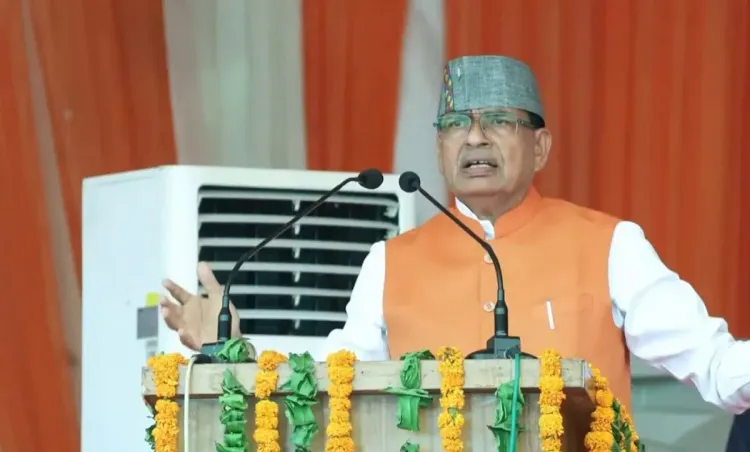
Union Agriculture Minister Shivraj Singh Chouhan on June 26 called for preserving Uttarakhand's traditional millets, announcing that jhangora and sanwa would be procured at the MSP rate set for ragi, while personally endorsing mandua over rice as part of a broader push for climate-resilient, nutrient-dense indigenous crops.
Key Takeaways
Union Agriculture Minister Shivraj Singh Chouhan announced on June 26, 2026 that jhangora and sanwa from Uttarakhand will be eligible for procurement at the MSP rate applicable to ragi .
Chouhan disclosed he has personally replaced rice with mandua (finger millet) in his daily diet, framing the appeal as both nutritional and cultural.
The move, if formalised, would extend India's millet-MSP framework — historically limited to ragi procurement in Karnataka, Odisha , and Tamil Nadu — to Himalayan minor millets for the first time.
The announcement aligns with India's International Year of Millets (2023) legacy and the broader national goal of diversifying cropping patterns toward climate-resilient grains.
Implementation will require new procurement logistics in Uttarakhand's mountainous terrain, with formal orders and CACP recommendations still awaited.
A successful rollout could set a precedent for other hill states including Himachal Pradesh, Sikkim , and Manipur .
Union Agriculture Minister Shivraj Singh Chouhan on Friday, June 26, 2026, called on the people of Uttarakhand to take pride in their traditional millets and announced that procurement of jhangora (barnyard millet) and sanwa (little millet) would be made available at the Minimum Support Price (MSP) currently applicable to ragi, signalling a potential expansion of the government's millet-support framework to lesser-known Himalayan grains.
Context
Posting in Hindi on X, the Minister addressed 'mere bhaion-bahnon' ('my brothers and sisters') of Uttarakhand and made a personal disclosure: 'Maine chawal khana chhod diya' — 'I have given up eating rice' — in favour of mandua (finger millet), which he now consumes daily alongside rotis. The statement was framed as a direct appeal to hill farmers and consumers to rediscover indigenous crops that he described as nutritionally superior.
Chouhan went on to say that jhangora and sanwa — grains grown on the rainfed, terraced slopes of the Himalayan hills — would be eligible for procurement at the MSP rate fixed for ragi, urging that 'such traditional grains and crops must also be saved.' The announcement, made via social media, carries the weight of his ministerial office even as a formal government order is yet to be confirmed.
Policy Backdrop
India's MSP mechanism for millets has historically been centred on ragi, with procurement operations running in states such as Karnataka, Odisha, and Tamil Nadu. Extending a similar price floor to jhangora and sanwa — crops that have no established central procurement history — would mark a meaningful widening of the scheme's geographic and crop coverage.
The policy push fits within a broader arc that gained momentum during 2023, when India spearheaded the International Year of Millets under a United Nations mandate, promoting production, consumption, and value-addition of coarse cereals. Successive administrations have sought to diversify cropping patterns away from the rice-wheat belt toward climate-resilient, nutrient-dense alternatives suited to marginal and rain-fed lands.
Millets have also been progressively incorporated into government nutrition programmes, including mid-day meal schemes and the public distribution system in select states, as part of efforts to link farmer income support with public health goals.
Stakeholders and Impact
Uttarakhand's hill farmers, who cultivate mandua, jhangora, and sanwa on small, terraced holdings largely outside the reach of irrigation infrastructure, stand to gain most directly if procurement at MSP rates is operationalised. These crops have faced steady decline as younger populations migrate to urban centres and as cheaper, subsidised rice and wheat displace traditional diets.
Nutritionists and food-security advocates have long argued that millets offer advantages over polished rice in terms of fibre, micronutrients, and glycaemic index — a case the Minister appeared to make personally by citing his own dietary shift. Wider MSP coverage could also incentivise organic and natural-farming practitioners in the hills, where chemical-input use is already low.
For state agencies and the Food Corporation of India, operationalising procurement of grains with thin, dispersed markets will require new logistics, storage protocols, and farmer registration drives — challenges that will test implementation capacity in a mountainous terrain.
What's Next
Attention will now turn to whether the 2026-27 marketing season sees formal state-level procurement orders for jhangora and sanwa, and whether the Commission for Agricultural Costs and Prices (CACP) recommends a standalone MSP for these crops or pegs them formally to the ragi rate. Any revision of MSP rates ahead of the rabi procurement window will be closely watched by farmer organisations in Uttarakhand.
If the announcement translates into policy, it could set a precedent for other Himalayan and north-eastern states — such as Himachal Pradesh, Sikkim, and Manipur — where indigenous minor millets face similar market neglect, potentially reshaping India's millet-support architecture well beyond the traditional southern and central belt.
Point of View
The Minister is choosing the path of least bureaucratic resistance, but the real test lies in whether state procurement machinery in a mountainous state can actually deliver. The announcement also carries electoral undertones: Uttarakhand's hill constituencies have historically felt underserved by mainstream agricultural policy, and a credible millet-support programme could resonate with a farming base that has watched traditional crops lose ground to subsidised staples. More broadly, it extends the International Year of Millets momentum into a tangible price-support commitment, reinforcing India's positioning as a global champion of coarse-cereal agriculture.
NationPress
26 Jun 2026
Frequently Asked Questions
What did Agriculture Minister Shivraj Singh Chouhan announce about jhangora and sanwa?
Chouhan announced on June 26, 2026 that jhangora (barnyard millet) and sanwa (little millet) grown in Uttarakhand would be eligible for procurement at the Minimum Support Price currently fixed for ragi, aiming to provide market assurance to hill farmers growing these traditional crops.
What is mandua and why is it significant for Uttarakhand?
Mandua is the local name for finger millet (ragi), a traditional grain grown on rainfed terraced fields in Uttarakhand's hills. It is valued for its high nutritional content — including calcium, iron, and dietary fibre — and its resilience to drought and poor soils, making it well-suited to the Himalayan farming environment.
What is the MSP for ragi in India?
The Minimum Support Price for ragi is set annually by the central government on the recommendation of the Commission for Agricultural Costs and Prices (CACP). Chouhan's announcement proposes using this existing ragi MSP as the price floor for jhangora and sanwa procurement, though a formal order is yet to be issued.
Which states currently benefit from ragi MSP procurement?
Ragi MSP procurement has historically been operational in Karnataka, Odisha, and Tamil Nadu, which are the major ragi-producing states. Extending a similar mechanism to Uttarakhand for jhangora and sanwa would represent a significant geographic expansion of the programme.
How does this announcement connect to India's millet promotion policy?
India led the global push for the United Nations-designated International Year of Millets in 2023, promoting production, consumption, and export of coarse cereals. Chouhan's announcement builds on that legacy by seeking to bring lesser-known Himalayan millets under a formal price-support framework, deepening the policy's reach beyond mainstream millet crops.