Shivraj Singh Chouhan cites IMF's 7% GDP forecast for India

Synopsis
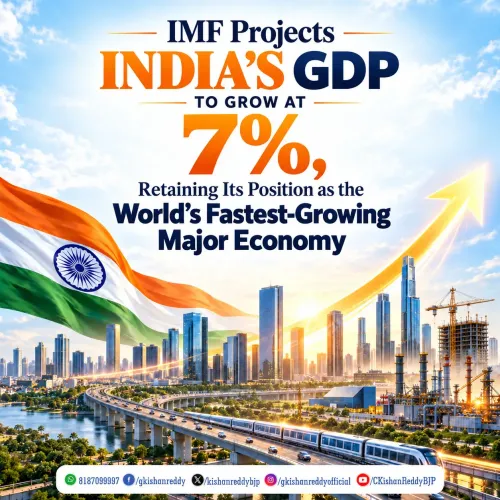
Union Agriculture Minister Shivraj Singh Chouhan cited the IMF's 7% GDP growth projection for India in 2027, calling it a reflection of global confidence in India's economic potential under PM Modi and linking the forecast to expanding trade partnerships and opportunities for farmers and exporters.
Key Takeaways
The IMF projected 7% GDP growth for India in 2027 , cited by Agriculture Minister Shivraj Singh Chouhan on October 13, 2026.
Chouhan linked the forecast to expanding global trade partnerships under PM Narendra Modi's leadership.
The growth outlook is expected to create new opportunities for Indian businesses, farmers, and exporters .
India signed Comprehensive Economic Partnership Agreements with the UAE and Australia in 2022 , broadening export channels.
The Atmanirbhar Bharat package (2020) combined domestic manufacturing resilience with new export corridors as a structural growth driver.
The next IMF World Economic Outlook update and progress on EU free-trade negotiations are the key near-term watch-points.
When the International Monetary Fund projects 7% GDP growth for a country, the world takes notice — and Union Agriculture Minister Shivraj Singh Chouhan made sure India did too, on Tuesday, October 13, 2026, citing the forecast as proof of the economy's structural strength under Prime Minister Narendra Modi.
The IMF number and what it signals
The IMF's projection of 7% GDP growth for India in 2027 — flagged in its regular World Economic Outlook cycle — places India firmly among the fastest-expanding major economies on the planet. Chouhan framed the number not as a bureaucratic data point but as a confidence signal: 'This growth outlook reflects the confidence the world has in India's economic potential,' he wrote. For a country of 1.4 billion people navigating a shifting global trade order, a 7% trajectory is a political as much as an economic statement.
The IMF has repeatedly identified India as a bright spot in an otherwise uneven global recovery, citing favourable demographics, policy continuity on trade openness, and a deepening domestic manufacturing base.
Trade partnerships, farmers, and the export pipeline
Chouhan's post connects the macro forecast directly to ground-level beneficiaries — 'Indian businesses, farmers and exporters' — a framing that carries particular weight given his portfolio. As Union Minister of Agriculture and Farmers Welfare, he oversees the segment of the economy most directly affected by export market access. India signed Comprehensive Economic Partnership Agreements with the UAE and Australia in 2022, diversifying agricultural and goods export channels beyond traditional partners.
The broader trade push sits alongside the Atmanirbhar Bharat package of 2020, which sought to build domestic manufacturing resilience while simultaneously opening export corridors — a dual-track strategy that international forecasters have pointed to as a structural driver of sustained growth.
What the 7% figure means for the next watch-point
The next IMF World Economic Outlook update will be closely tracked to see whether the 7% projection holds, rises, or faces downside revision given global headwinds. Equally watched: the progress of ongoing or concluded free-trade negotiations with the European Union and other partners, which could further widen the export pipeline that Chouhan's ministry is directly invested in expanding.
For Indian farmers and agri-exporters, a sustained 7% growth environment — backed by new bilateral trade agreements — is the difference between a bumper crop that finds a global market and one that doesn't.
Point of View
Credible multilateral validation (the IMF) to reinforce the BJP government's narrative of economic competence ahead of any electoral or policy cycle. By specifically naming farmers and exporters alongside businesses, he aligns a macro statistic with his own ministerial brief, amplifying its relevance to his core constituency. The move also signals that the government views international forecasts as legitimising tools for domestic policy storytelling, a pattern seen consistently since 2014. Watch whether the 7% number gets woven into the government's budget and trade-agreement communications in the months ahead.
NationPress
13 Oct 2026
Frequently Asked Questions
What is the IMF's GDP growth projection for India in 2027?
The IMF has projected 7% GDP growth for India in 2027 , as cited by Union Agriculture Minister Shivraj Singh Chouhan in an October 2026 post. The IMF issues these forecasts through its regular World Economic Outlook reports.
What did Shivraj Singh Chouhan say about India's economy?
Chouhan said the IMF's 7% growth projection 'underscores the strength and resilience' of India's economy and reflects 'the confidence the world has in India's economic potential,' crediting PM Modi's leadership for expanding global trade partnerships.
How does the IMF growth forecast affect Indian farmers and exporters?
A sustained 7% growth environment, combined with trade agreements such as those signed with the UAE and Australia in 2022 , is expected to widen export markets for Indian agricultural produce and goods, directly benefiting farmers and exporters.
What trade agreements has India signed to boost exports?
India signed Comprehensive Economic Partnership Agreements with the UAE and Australia in 2022 , diversifying export channels. Negotiations with the European Union are also being tracked as a potential major trade expansion.
What is Atmanirbhar Bharat and how is it linked to India's growth story?
Atmanirbhar Bharat , announced in 2020 , is a policy package aimed at strengthening domestic manufacturing and agricultural exports simultaneously — a dual-track approach that international forecasters have cited as a structural driver of India's sustained high-growth trajectory.