Shekhawat: IMF sees India growing at 7% as world slows
Synopsis
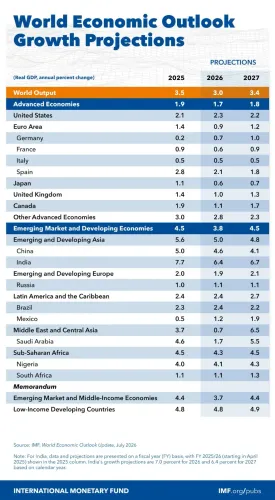
Union Minister Gajendra Singh Shekhawat highlighted IMF projections placing India's GDP growth at 7.0% for 2026 and 2027, more than double the 3.1% global forecast, framing it as evidence of India's economic resilience under PM Modi and progress toward Viksit Bharat.
Key Takeaways
The IMF projects India's GDP to grow at 7.0% in both 2026 and 2027 , as cited by Minister Shekhawat.
Global growth is projected at just 3.1% in 2026 , amid rising inflationary pressures, making India's figure more than double the world average.
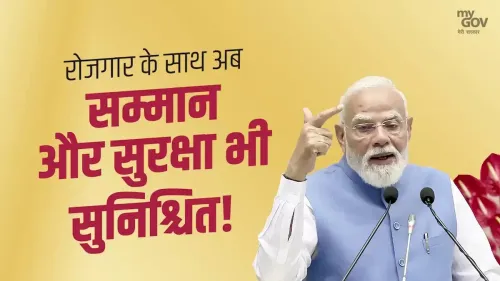
Minister Gajendra Singh Shekhawat credited the performance to PM Narendra Modi's reform agenda, citing 'reforms, investment and sustained economic growth'.
The Viksit Bharat vision — targeting developed-economy status by 2047 — is the long-term policy framework the minister situates these forecasts within.
India's structural reform milestones include Make in India (September 2014) and the Goods and Services Tax (July 2017).
The next key data points to watch are the IMF's World Economic Outlook update and India's Q2 2026-27 advance GDP estimates .
While much of the world braces for a sluggish stretch, India is being singled out as a rare bright spot — and Union Culture and Tourism Minister Gajendra Singh Shekhawat made sure to put that contrast front and centre on Tuesday, 13 October 2026. Citing the International Monetary Fund's latest projections, the senior BJP leader flagged that India is on course to grow at 7.0% in both 2026 and 2027, even as global growth is forecast at a tepid 3.1% in 2026 amid rising inflationary pressures.
A 7% headline in a 3.1% world
The IMF's biannual World Economic Outlook is the closest thing global economics has to a report card, and India's projected 7.0% GDP growth — more than double the world average — is the number Shekhawat anchors his post around. He frames it explicitly as a vindication of Prime Minister Narendra Modi's reform agenda, pointing to 'reforms, investment and sustained economic growth' as the three engines keeping India ahead of the curve. The gap between India's trajectory and the global average, if the projections hold, would be among the widest on record for a major economy.
Viksit Bharat: the destination behind the data
The Viksit Bharat vision — the government's stated goal of achieving developed-economy status by 2047, the centenary of Indian independence — gives the growth numbers their political and policy weight. Shekhawat invokes it directly, positioning the IMF forecast as a measurable waypoint on that longer journey. The vision has been built on a scaffolding of structural moves: the Make in India initiative launched in September 2014 to attract manufacturing investment, and the rollout of the Goods and Services Tax in July 2017 to knit together a unified national market. Those foundational reforms, the argument goes, are now compounding into the resilience visible in the headline number.
India's post-pandemic pattern of outperformance
This is not the first time India has leaned on IMF validation to make a point about relative strength. In the post-pandemic years, India's growth has consistently outpaced most major economies, supported by robust domestic demand, a capital-expenditure push, and fiscal consolidation that kept sovereign risk in check. The government's repeated use of external benchmarks — rather than domestic data alone — reflects a deliberate strategy of anchoring its economic narrative in multilateral credibility, harder for domestic critics to directly dispute. Global headwinds, from inflation to supply-chain disruption, form the backdrop against which 7.0% is meant to read as exceptional, not merely good.
The next IMF World Economic Outlook update and India's advance GDP estimates for Q2 2026-27 will be the tests that tell whether the projection is becoming a reality — or a number that needs revising.
Point of View
He makes the relative outperformance the story, not the absolute number. The invocation of Viksit Bharat also does double duty: it links a quarterly data point to a three-decade civilisational ambition, keeping the government's biggest branding exercise alive in the public conversation. With Q2 GDP data and an IMF update both on the horizon, the minister's post sets a benchmark his own party will be measured against.
NationPress
13 Oct 2026
Frequently Asked Questions
What is the IMF's GDP growth forecast for India in 2026?
The IMF projects India's GDP to grow at 7.0% in 2026 , according to Minister Gajendra Singh Shekhawat's post citing the fund's latest projections.
How does India's projected growth compare to global growth in 2026?
India's projected growth of 7.0% is more than double the global growth forecast of 3.1% for 2026 , underscoring India's relative economic resilience.
What is Viksit Bharat?
Viksit Bharat is the Indian government's national vision to achieve developed-economy status by 2047 , the centenary of independence, driven by sustained reforms and investment.
Which economic reforms does the government credit for India's strong growth?
Key reforms cited include the Make in India initiative launched in September 2014 and the Goods and Services Tax introduced in July 2017 , alongside sustained capital expenditure.
When will India's next GDP growth data be available?
The key data points to watch are India's advance GDP estimates for Q2 2026-27 and the next IMF World Economic Outlook update.