Shivraj Singh Chouhan pays tribute to CV Raman on death anniversary
Synopsis
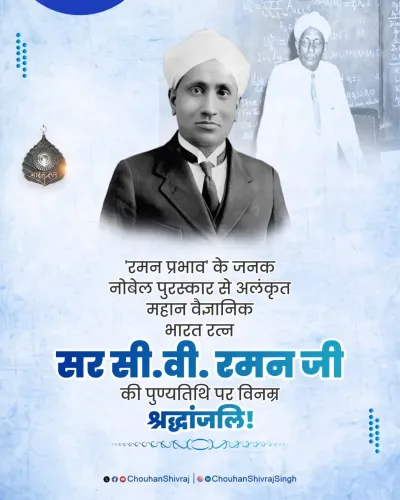
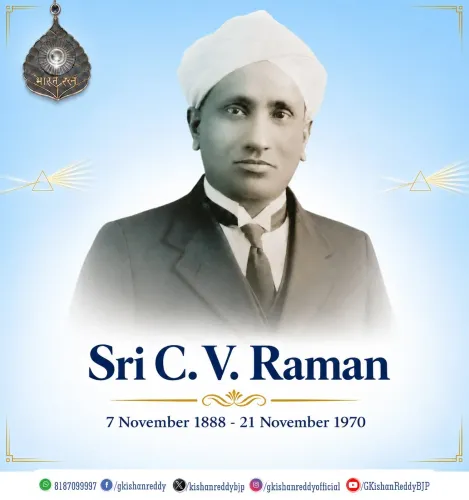
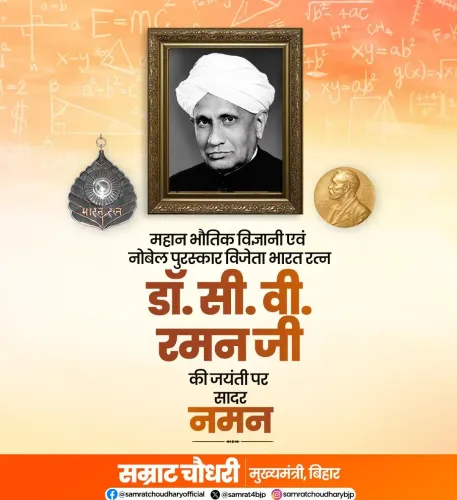
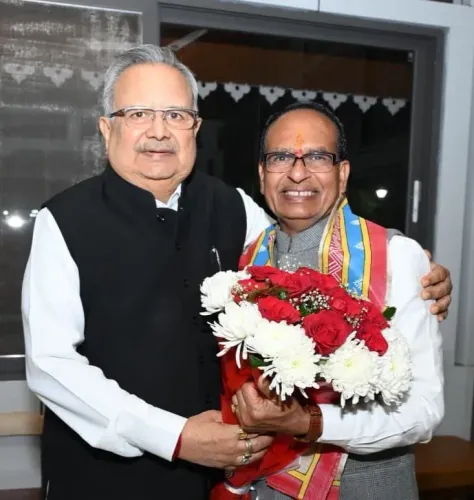
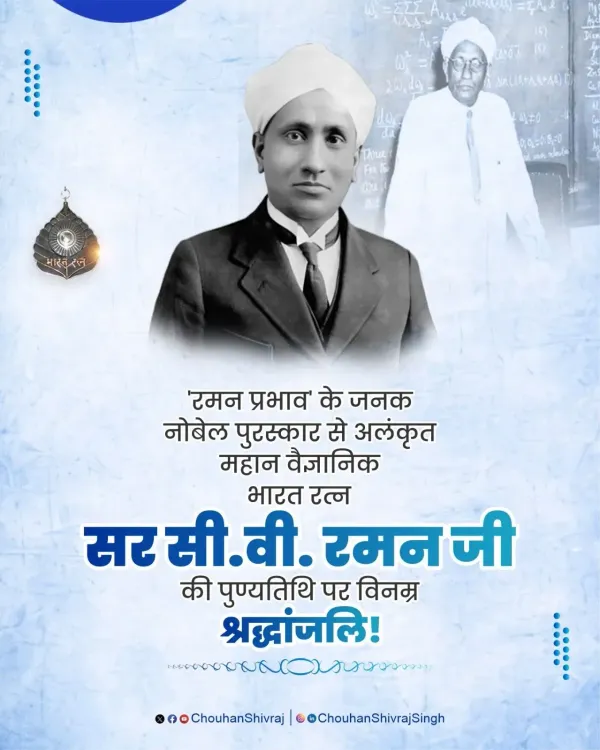
On Sir C.V. Raman's death anniversary, Union Agriculture Minister Shivraj Singh Chouhan paid tribute to the Nobel laureate and discoverer of the Raman Effect, calling his contribution to Indian science and technology 'incomparable and unforgettable.'
Key Takeaways
Union Agriculture Minister Shivraj Singh Chouhan posted a tribute to Sir C.V.
Raman on his death anniversary, 21 November 2026 .
Raman discovered the Raman Effect on 28 February 1928 , earning the Nobel Prize in Physics in 1930 — the first Asian to win a science Nobel.
Raman was awarded the Bharat Ratna in 1954 and served as director of the Indian Institute of Science, Bengaluru .
The Raman Effect underpins modern Raman spectroscopy , widely used in medicine, materials science, and planetary research.
India has observed National Science Day on 28 February since 1986 to mark the anniversary of the discovery.
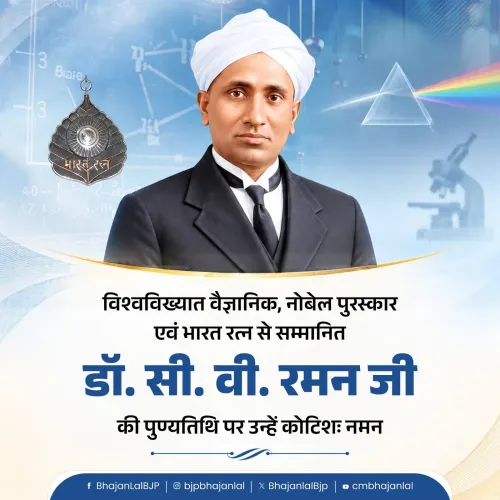
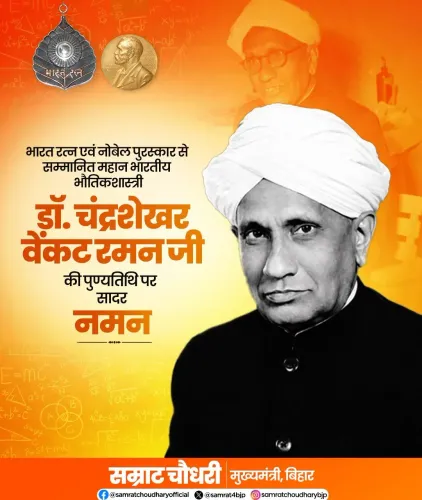
A century after he bent a beam of light and rewrote the laws of physics, Sir C.V. Raman is still commanding the attention of the nation's most senior leaders. On 21 November 2026 — the death anniversary of India's first Nobel laureate in science — Union Agriculture Minister Shivraj Singh Chouhan offered a formal tribute on X, saluting the man whose discovery continues to underpin modern science.
Posting in Hindi, Chouhan wrote: 'Raman Prabhav ke janak, Nobel Puraskar se sammanit, mahan vaigyanik, Bharat Ratna sir C.V. Raman ji ki punyatithi par vinamra shraddhanjali arpit karta hoon!' — 'I humbly pay tribute to the father of the Raman Effect, Nobel laureate, great scientist and Bharat Ratna, Sir C.V. Raman, on his death anniversary.' He added that Raman's 'incomparable contribution to making India strong in science and technology will always be unforgettable.'
Who was Sir C.V. Raman — and why the discovery still matters
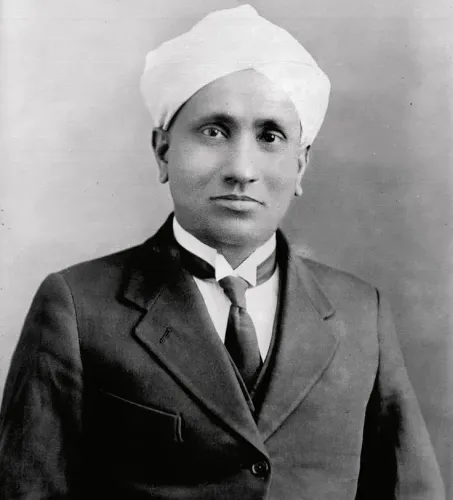
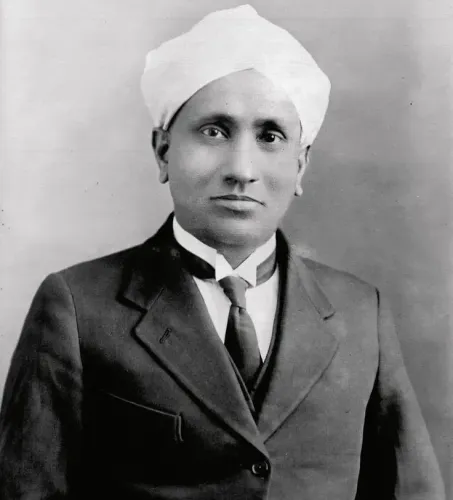
Chandrasekhara Venkata Raman made his landmark discovery on 28 February 1928: when light passes through a transparent medium, a small fraction of it scatters at different wavelengths, revealing the molecular fingerprint of the substance it passed through. The phenomenon, now universally known as the Raman Effect, earned him the Nobel Prize in Physics in 1930 — making him the first Asian and first non-white scientist to receive a Nobel in science. The discovery was not merely an academic curiosity. It became the bedrock of Raman spectroscopy, a technique today used in drug authentication, cancer detection, materials science, and even the analysis of planetary surfaces by space probes. In that sense, every time a pharmacist verifies a tablet's composition or a geologist reads a rock sample without destroying it, the Raman Effect is at work. Raman later served as director of the Indian Institute of Science, Bengaluru, and was awarded the Bharat Ratna in 1954 — independent India's highest civilian honour. He passed away on 21 November 1970.28 February and the science heritage calendar
India institutionalised Raman's memory in a concrete way: since 1986, 28 February — the date of the original discovery — has been observed as National Science Day across the country, with events at schools, universities, and research institutions marking the occasion. The 21 November death anniversary, by contrast, draws quieter but steady acknowledgement from public figures, particularly those in government, who invoke Raman as a symbol of India's capacity for world-class fundamental research. Senior political leaders paying tribute on this date is a long-standing pattern — a way of anchoring national identity to achievement in pure science at a time when research funding, STEM education, and global competitiveness in technology remain live policy debates. Sir C.V. Raman left behind not just a law of physics but a standing challenge: the question of whether the country that produced him is building the conditions to produce the next one.Point of View
Linking present-day policy ambitions to a verified moment of indigenous genius. For a government that has repeatedly emphasised 'Viksit Bharat' and research-led growth, tributes like this do more than honour a legacy — they frame the historical warrant for continued public investment in fundamental science. The question the tribute quietly raises is whether institutional conditions today match the rhetoric of honouring the past.
NationPress
21 Nov 2026
Frequently Asked Questions
When did Sir C.V. Raman die?
Sir C.V. Raman passed away on 21 November 1970 . His death anniversary is observed each year by scientists, educators, and public figures across India.
What is the Raman Effect?
The Raman Effect, discovered on 28 February 1928 , is the inelastic scattering of light by molecules — meaning light changes wavelength as it passes through a substance, revealing that substance's molecular identity. It is the foundation of modern Raman spectroscopy.
What Nobel Prize did C.V. Raman win?
Sir C.V. Raman won the Nobel Prize in Physics in 1930 for the discovery of the Raman Effect, becoming the first Asian and first non-white scientist to receive a Nobel in a science category.
What is National Science Day and why is it on 28 February?
National Science Day is observed in India every year on 28 February since 1986, marking the date in 1928 when C.V. Raman discovered the Raman Effect. It celebrates India's scientific heritage and promotes science education.
What awards did C.V. Raman receive from India?
C.V. Raman received the Bharat Ratna — India's highest civilian honour — in 1954 . He also served as director of the Indian Institute of Science in Bengaluru.