Shivraj Singh Chouhan visits ICAR-NBSS & LUP, discusses AI in farming
Synopsis
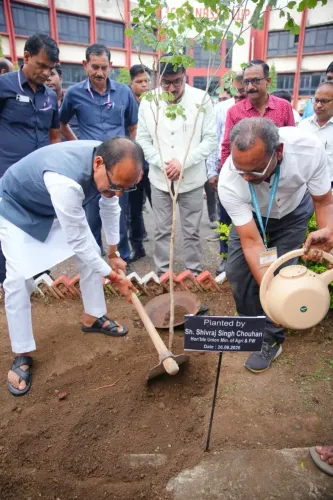
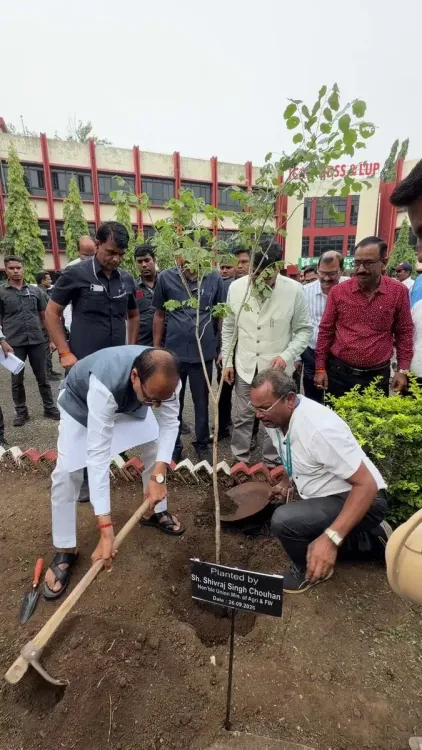
Union Agriculture Minister Shivraj Singh Chouhan visited ICAR-NBSS & LUP in Nagpur on September 27, 2026, holding discussions with scientists on deploying AI and new technology to advance soil understanding and precision farming in India.
Key Takeaways
Shivraj Singh Chouhan visited ICAR-NBSS & LUP, Nagpur on September 27, 2026 .
Discussions focused on AI and new technology for soil analysis and improving agricultural practices.
ICAR-NBSS & LUP is India's primary institute for soil resource mapping and land use planning.
The visit builds on the Soil Health Card Scheme launched in 2015 , which promotes data-driven fertiliser management for farmers.
AI-assisted soil mapping could accelerate precision farming outreach to India's 140 million-plus farm households .
No specific programme announcements were made; the visit signals growing ministry interest in AI applications within agricultural science.
At a soil research institute in the heart of India's agricultural science belt, Union Agriculture Minister Shivraj Singh Chouhan sat down with scientists on Sunday, September 27, 2026, to talk about something that could quietly reshape how India feeds itself — the role of artificial intelligence in understanding the ground beneath farmers' feet.
Chouhan visited the ICAR-National Bureau of Soil Survey and Land Use Planning (NBSS & LUP) in Nagpur, one of India's premier soil-science institutions under the Indian Council of Agricultural Research (ICAR). The minister posted on X that the discussions ranged from 'understanding soil to making farming even better' — covering new technology and the role of AI in the process.
What NBSS & LUP does — and why it matters now
The ICAR-NBSS & LUP is India's nodal body for soil resource mapping and land use planning. Its scientists generate the granular, district-level soil data that underpins decisions from crop-variety selection to fertiliser dosing. That data pipeline, historically slow and manual, is precisely where AI could compress timelines dramatically — turning months of field survey into near-real-time insight.
The visit places Chouhan directly at the intersection of two long-running government priorities: precision agriculture and soil health. Since the Soil Health Card Scheme, launched in 2015, the Centre has been pushing to move Indian farming away from blanket fertiliser application toward data-driven, field-specific nutrition management. AI-assisted soil mapping would be a logical next step in that chain.
AI and soil — the next frontier for precision farming
Successive central governments have invested in digital agriculture through ICAR's network of institutes, building on frameworks like the National Mission on Sustainable Agriculture. What makes this conversation distinct is the explicit focus on AI as a tool — not just data collection, but machine-driven interpretation of soil variability, land-use risk, and crop suitability at scale.
For India's 140 million-plus farm households, that ambition translates to a concrete question: can a smallholder in Vidarbha or Bundelkhand — regions whose soils are among the most stressed in the country — get hyper-local, actionable soil advice without waiting for a government survey team? That is the promise on the table.
No specific policy commitments or programme launches were announced from the visit; what the minister shared was a conversation in progress. But ministerial visits to research institutes rarely happen without a follow-up. India's soil-science community now has a direct line to the agriculture ministry's attention — and a clear signal that AI in agri-science is moving from pilot talk to policy interest.
Point of View
Rather than generic 'technology', is deliberate signalling: it frames agriculture ministry as aligned with India's wider tech ambitions. Politically, soil health has long been a rural-welfare talking point, and tying it to AI gives the ministry a forward-looking, rather than merely welfare-oriented, identity. The question is whether the conversation in Nagpur catalyses actual budget allocation or integration with live schemes like the Soil Health Card — or remains, for now, inspirational outreach.
NationPress
27 Sept 2026
Frequently Asked Questions
What is ICAR-NBSS & LUP in Nagpur?
ICAR-NBSS & LUP stands for the National Bureau of Soil Survey and Land Use Planning, an institute under the Indian Council of Agricultural Research based in Nagpur. It is India's nodal body for generating soil resource maps and land use data used in agricultural planning.
Why did Shivraj Singh Chouhan visit ICAR Nagpur?
Union Agriculture Minister Shivraj Singh Chouhan visited ICAR-NBSS & LUP on September 27, 2026, to meet scientists and discuss how new technologies — including artificial intelligence — can improve soil understanding and make farming more productive for Indian farmers.
How is AI being used in Indian agriculture?
AI is increasingly being explored for soil mapping, crop-suitability analysis, and precision farming in India. When applied to soil science, AI can process large volumes of field-survey data faster and generate hyper-local recommendations for fertiliser use and land management.
What is the Soil Health Card Scheme?
The Soil Health Card Scheme was launched by the central government in 2015 to provide farmers with a report card on their soil's nutrient status and tailored fertiliser recommendations, aiming to reduce input costs and improve crop yields.
What announcements came out of Chouhan's ICAR visit?
No specific policy announcements or programme launches were made following the September 27, 2026 visit. The minister described it as a discussion with scientists on AI and technology for soil and farming improvement; further announcements, if any, are expected in subsequent weeks.