Singapennu Task Force marks 100 days: 4,231 complaints acted on across Tamil Nadu

Synopsis
In its first 100 days, Tamil Nadu's Singapennu Special Task Force acted on over 4,231 complaints, rescued 152 missing or vulnerable individuals, and halted 54 child marriages — a concrete early scorecard for the TVK government's flagship women and children's safety initiative launched in June 2026.
Key Takeaways
The Singapennu Special Task Force completed its first 100 days of operations as of 20 September 2026 .
Task force personnel took on-the-spot action on 4,231 complaints from across Tamil Nadu .
58 women and 94 children were traced and rescued; 111 additional people were moved to safe locations.
The force stopped 54 child marriages during the period.
The 1091 Singapennu helpline has been integrated with the 112 emergency helpline for faster multi-agency response.
The TVK government plans to expand surveillance, boost public awareness, and strengthen inter-departmental coordination.
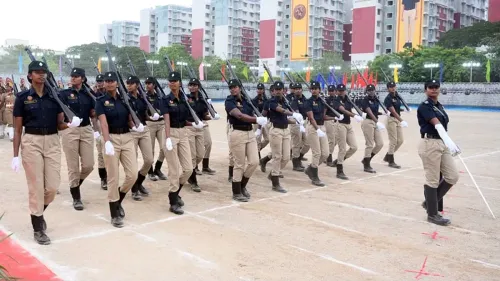
Tamil Nadu's Singapennu Special Task Force, launched by the TVK government to bolster the safety of women and children across the state, has completed its first 100 days of operations, with personnel taking on-the-spot action on 4,231 complaints received from different parts of Tamil Nadu, Social Welfare and Women's Rights Minister Jagatheeswari said on 20 September 2026.
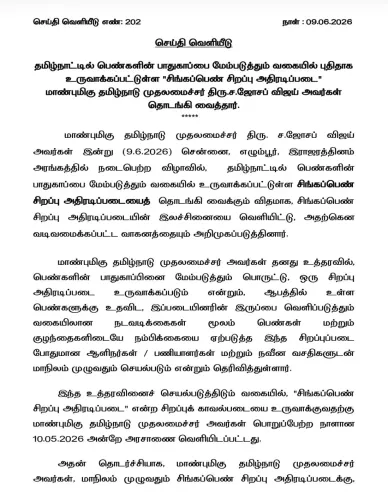
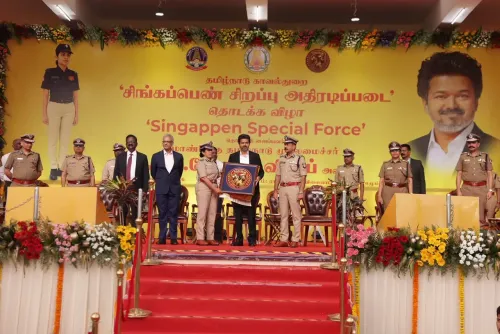
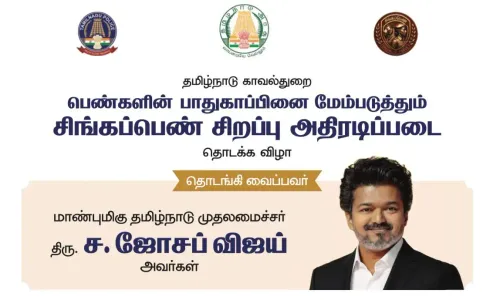
Chief Minister C. Joseph Vijay formally launched the task force in Chennai on 9 June 2026, shortly after the TVK government assumed office, as part of a broader institutional push to improve the state's response to crimes against women and children.
Key Operations in the First 100 Days
Over its first 100 days, the Singapennu Task Force conducted targeted operations to prevent crimes, respond promptly to complaints, monitor vulnerable areas, and extend immediate protection to those at risk. Beyond handling the 4,231 complaints, the force traced and rescued 58 women and 94 children who had been reported missing or found in vulnerable circumstances. An additional 111 people requiring immediate care were rescued and transferred to safe locations, with support coordinated across police, district administrations, and social welfare agencies.
Child Marriages Stopped, Helpline Integrated
Preventing child marriages emerged as another critical area of intervention. The task force succeeded in stopping 54 child marriages during this period, ensuring that the minors involved received appropriate counselling and support. Minister Jagatheeswari also highlighted the round-the-clock 1091 Singapennu helpline, which has been integrated with the 112 emergency helpline to reduce response time and route complaints instantly to the appropriate authorities — including police, social welfare officers, and child protection teams.
How the Response System Works
Under the integrated framework, complaints involving imminent danger are prioritised for immediate dispatch, while cases requiring counselling, shelter, or legal support receive structured follow-up. The convergence of helpline infrastructure means a single call can trigger a coordinated multi-agency response — a departure from the siloed approach that had historically slowed intervention in women and children's safety cases in the state.
What Comes Next
The government has outlined plans to strengthen the force further, including improved surveillance in vulnerable locations, greater public awareness campaigns around the helplines, and tighter inter-departmental coordination. Minister Jagatheeswari described the task force's first-100-day performance as 'encouraging', saying its interventions had reaffirmed the TVK government's commitment to creating a safer environment for women and children throughout Tamil Nadu. With the framework now operationally tested, the focus shifts to scaling both reach and response quality across the state's districts.
Point of View
Which addresses a longstanding coordination gap between police and social welfare agencies. What the data does not yet tell us is recidivism: whether rescued individuals stay protected, whether stopped child marriages are simply deferred, and whether the 4,231 complaints include duplicate or trivial filings. The TVK government's challenge now is to build an independent audit trail that converts early momentum into a verifiable, sustained improvement in safety outcomes for Tamil Nadu's women and children.
NationPress
20 Sept 2026
Frequently Asked Questions
What is the Singapennu Special Task Force in Tamil Nadu?
The Singapennu Special Task Force is a dedicated unit formed by the TVK government to strengthen the safety of women and children across Tamil Nadu. It was formally launched by Chief Minister C. Joseph Vijay in Chennai on 9 June 2026.
How many complaints did the Singapennu Task Force handle in its first 100 days?
The task force took on-the-spot action on 4,231 complaints received from different parts of Tamil Nadu during its first 100 days of operations. It also rescued 58 women and 94 children who were missing or in vulnerable circumstances.
How many child marriages did the Singapennu Task Force stop?
The task force prevented 54 child marriages during its first 100 days, protecting minors from illegal unions and ensuring they received appropriate counselling and support.
What is the 1091 Singapennu helpline and how does it work?
The 1091 Singapennu helpline is a round-the-clock emergency line for women facing danger or requiring protection. It has been integrated with the 112 emergency helpline so that complaints are instantly routed to police, social welfare officers, and child protection teams for a coordinated response.
What are the Tamil Nadu government's next steps for the Singapennu Task Force?
The government plans to expand surveillance in vulnerable locations, increase public awareness about available helplines, and improve coordination among departments responsible for women's and children's safety. The aim is to scale both the reach and response quality of the task force across all districts.