FM Sitharaman: 12 Years of Infra as Inclusive Growth Catalyst
Synopsis
Union Finance Minister Nirmala Sitharaman marked twelve years of NDA governance on 16 June 2026 by calling infrastructure development a catalyst for inclusive growth, pointing to programmes like Bharatmala, PM Gati Shakti, and the Rs 111 lakh crore National Infrastructure Pipeline as pillars of the government's economic record.
Key Takeaways
Nirmala Sitharaman posted on 16 June 2026 framing 12 years of infrastructure investment as a driver of inclusive growth under the hashtag #12YearsOfNayaBharatNirman .
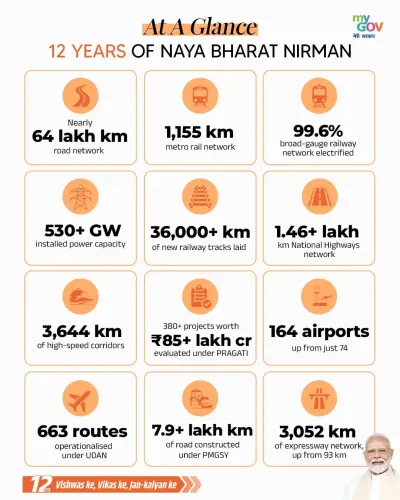
The Bharatmala Pariyojana , approved in 2015 , targets over 83,000 km of national highways focused on economic corridors.
The National Infrastructure Pipeline announced in 2019-20 set an investment target of Rs 111 lakh crore across roads, railways, ports, and airports.
The PM Gati Shakti National Master Plan , launched in October 2021 , integrates multimodal connectivity planning across ministries to cut logistics costs.
Key beneficiaries identified by the government include rural communities , the logistics sector , and MSME exporters .
The next Union Budget's capital expenditure allocations will be the primary indicator of whether the infrastructure push continues at scale.
Union Finance Minister Nirmala Sitharaman on Tuesday, 16 June 2026 credited twelve years of infrastructure development under the current government with transforming lives and creating economic opportunities across India, marking the occasion with the hashtag #12YearsOfNayaBharatNirman.
Context
Sitharaman's post — 'Over the last 12 years, infrastructure development has become a catalyst for inclusive growth, creating opportunities and transforming lives' — coincides with the BJP-led NDA government's twelfth year in office, which began in May 2014 under Prime Minister Narendra Modi. The message frames physical connectivity not merely as an economic input but as an instrument of social equity, a framing that has been central to the government's public communication on capital spending.
Policy Backdrop
The infrastructure push Sitharaman references spans a series of landmark programmes. The Bharatmala Pariyojana, approved by the Union Cabinet in 2015, set out to develop over 83,000 km of national highways with an emphasis on economic corridors linking lagging regions to major markets. It built on earlier connectivity drives such as the Golden Quadrilateral while adding dedicated freight and ring-road corridors.
The National Infrastructure Pipeline, announced in the 2019-20 Union Budget, projected an investment target of Rs 111 lakh crore across social and economic infrastructure over five years, spanning roads, railways, ports, airports, and urban utilities. That was followed in October 2021 by the PM Gati Shakti National Master Plan, a multimodal coordination platform designed to eliminate siloed planning across ministries and reduce the logistics costs that have historically burdened exporters and manufacturers.
Sitharaman, as Finance Minister since 2019, has been the architect of successive Union Budgets that steadily raised capital expenditure allocations for infrastructure. Each Budget under her tenure has foregrounded capex as the primary lever for crowding in private investment and sustaining post-pandemic economic recovery.
Stakeholders and Impact
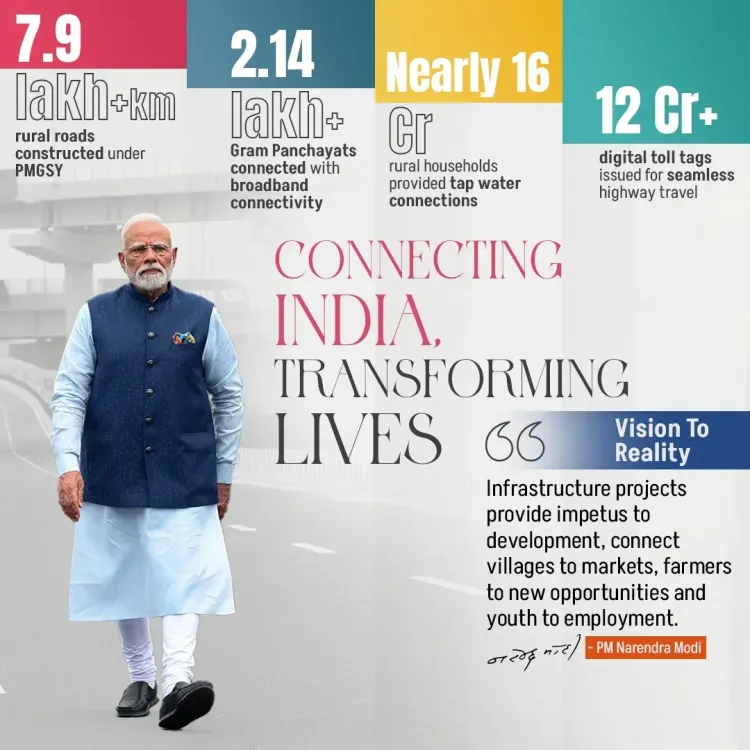
The government's stated beneficiaries of this infrastructure drive are broad: rural populations who gain road and digital connectivity, the logistics sector which benefits from reduced transit times and multimodal options, and MSME exporters who depend on port and highway efficiency to compete in global markets. Improved connectivity has also been linked to better access to healthcare and education facilities in remote districts.
Critics and opposition parties have periodically questioned whether the gains from infrastructure spending have reached the most marginalised communities at the pace the government claims, and whether project timelines and cost overruns have been adequately managed. These debates are expected to resurface as the government marks this milestone.
What's Next
Attention will now turn to the forthcoming Union Budget, where capital expenditure outlays and any new project announcements will be closely watched as a measure of the government's continued commitment to infrastructure-led growth. Parliamentary clearance for fresh infrastructure financing legislation, if any is proposed, will also be a key indicator. Sitharaman's post signals that infrastructure will remain a centrepiece of the ruling coalition's political and economic narrative as it enters its thirteenth year in government.
Point of View
Anchoring the government's economic credibility to a tangible, visible output — roads, railways, and ports — on the eve of what is likely to be an electorally sensitive budget cycle. By linking infrastructure to 'inclusive growth,' she attempts to pre-empt criticism that capital spending has favoured large contractors over ordinary citizens. The invocation of a twelve-year arc also serves to consolidate the Modi government's economic narrative into a single, legible story of national transformation. Whether that story holds up to scrutiny on delivery timelines and equity of access will define the terms of the debate going into the next Budget.
NationPress
19 Sept 2026
Frequently Asked Questions
What is #12YearsOfNayaBharatNirman?
#12YearsOfNayaBharatNirman is a hashtag used by BJP leaders and the Union government in June 2026 to mark twelve years of the NDA government led by Prime Minister Narendra Modi, which began in May 2014, highlighting achievements in infrastructure, governance, and economic development.
What has India spent on infrastructure in the last 12 years?
The government announced the National Infrastructure Pipeline in the 2019-20 Union Budget with a target of Rs 111 lakh crore in investment across roads, railways, ports, airports, and social infrastructure over five years. Successive Union Budgets under Finance Minister Nirmala Sitharaman have also progressively raised capital expenditure allocations.
What is Bharatmala Pariyojana?
Bharatmala Pariyojana is a national highways development programme approved by the Union Cabinet in 2015, targeting the construction of over 83,000 km of roads with a focus on economic corridors, ring roads, and connectivity to ports and border areas.
What is PM Gati Shakti?
PM Gati Shakti is a multimodal national master plan launched in October 2021 to coordinate infrastructure planning across central ministries and state governments, aiming to reduce logistics costs and speed up project execution for roads, railways, ports, and airports.
How has infrastructure development helped rural India?
The government's infrastructure programmes have aimed to connect rural populations to markets, healthcare, and education through road and digital connectivity. The logistics improvements under schemes like Bharatmala and PM Gati Shakti are also intended to help MSME exporters and farmers access wider markets more efficiently.