Sitharaman Hails 12 Years of Northeast Progress Under Modi
Synopsis
Union Finance Minister Nirmala Sitharaman marked twelve years of the Modi government by crediting PM Narendra Modi's leadership for historic progress in connectivity, infrastructure, peace and prosperity across Northeast India, citing the Act East Policy, peace accords and dedicated development schemes as pillars of the transformation.
Key Takeaways
Finance Minister Nirmala Sitharaman posted on 20 June 2026 hailing 12 years of Northeast India's progress under PM Narendra Modi .
The Act East Policy (2014) repositioned the Northeast as India's gateway to ASEAN nations through road, rail and trade links.
A Framework Agreement with NSCN-IM was signed in 2015 to address the long-running Naga insurgency.
The PM-DevINE scheme (2022) created a dedicated fund for infrastructure and livelihood projects in the eight Northeastern states .
Increased Union Budget capital outlays for highways, railways and waterways in the Northeast have run alongside peace-building efforts since 2014.
The next Union Budget's Northeast allocations and fresh talks with armed groups in Manipur and Nagaland are the key indicators to watch.
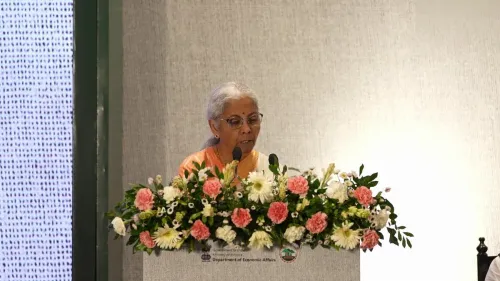
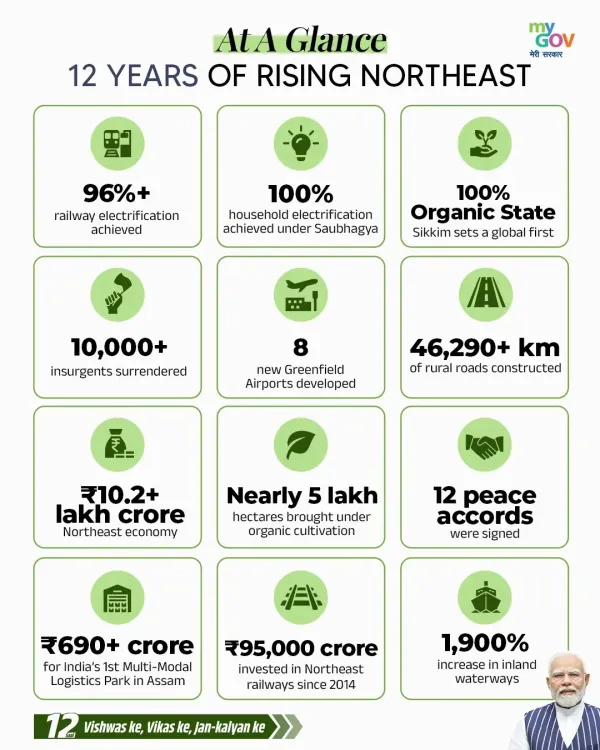
Union Finance Minister Nirmala Sitharaman on Saturday, 20 June 2026 credited Prime Minister Narendra Modi's leadership for what she described as historic gains in connectivity, infrastructure, peace and prosperity across Northeast India over the past twelve years, marking the occasion with the hashtag #12YearsOfRisingNorthEast.
Context
Sitharaman's post comes on the twelfth anniversary of the Modi government's assumption of office in May 2014, a milestone the ruling Bharatiya Janata Party has been marking across social media with tributes to the administration's record. The Finance Minister's remarks specifically spotlight the eight-state Northeastern region, which has historically been cited by successive governments as a priority zone for catch-up development.
In her post, Sitharaman wrote: 'Under the visionary leadership of Hon'ble PM Shri @narendramodi, the Northeast has seen historic progress in connectivity, infrastructure, peace and prosperity.' The framing positions the region's development as a signature achievement of the current dispensation.
Policy Backdrop
The Act East Policy, announced in 2014, repositioned the Northeast as India's strategic gateway to Southeast Asia, anchoring investment in roads, rail corridors and trade links with ASEAN nations. The policy marked a conceptual shift from treating the region primarily as a security challenge to treating it as an economic frontier.
On the peace front, a Framework Agreement was signed with the NSCN-IM in 2015, aimed at resolving the long-running Naga insurgency. More recently, the PM-DevINE scheme, launched in 2022, created a dedicated fund for infrastructure and livelihood projects exclusively across the eight Northeastern states, supplementing general capital outlays from the Union Budget.
Since 2014, the Union government has steadily raised capital expenditure on highways, railways and inland waterways in the Northeast, running parallel to diplomatic and security efforts to reduce armed conflict — a dual-track approach also applied to other strategically sensitive border zones such as the Andaman and Nicobar Islands and Himalayan border districts.
Stakeholders and Impact
Residents of the eight Northeastern states — Assam, Arunachal Pradesh, Manipur, Meghalaya, Mizoram, Nagaland, Sikkim and Tripura — stand as the primary stakeholders in any assessment of the region's trajectory. Infrastructure developers and contractors have also seen increased project flows from Union Budget allocations directed at the region.
The broader strategic dimension involves India's economic integration with Southeast Asia: improved road and rail links through the Northeast are central to operationalising trade corridors with Myanmar, Bangladesh and beyond. Progress on peace accords, particularly in Nagaland and Manipur, directly affects the viability of these corridors.
What's Next
Attention will now turn to the next Union Budget and its specific allocations for Northeastern highways and railways, which will serve as a concrete measure of the government's continued commitment to the region. Fresh talks with remaining armed groups in Manipur and Nagaland will also be closely watched as indicators of whether the peace track is advancing.
As the ruling party marks twelve years in office, the Northeast's development record is set to remain a central plank in the BJP's political narrative heading into future electoral cycles — making Sitharaman's post as much a political statement as a policy one.
Point of View
Arriving as the BJP marks twelve years in office and seeks to consolidate its gains in a region where it has dramatically expanded its electoral footprint since 2014. By bundling connectivity, peace and prosperity into a single frame, the Finance Minister reinforces the government's preferred narrative that physical integration and conflict resolution are two sides of the same policy coin. The Northeast has evolved from a peripheral security concern into a showcase for the ruling party's 'Viksit Bharat' ambitions, and statements like this are designed to cement that image ahead of future state elections in the region. The absence of specific metrics, however, leaves the claims open to scrutiny from opposition parties and civil society groups who point to unresolved conflicts in Manipur and pending infrastructure timelines.
NationPress
18 Sept 2026
Frequently Asked Questions
What is the Act East Policy and how does it affect Northeast India?
The Act East Policy, launched in 2014, positions Northeast India as the country's strategic and economic gateway to Southeast Asia, driving investment in roads, railways and trade corridors linking the region to ASEAN nations.
What is the PM-DevINE scheme for the Northeast?
PM-DevINE, launched in 2022, is a Union government scheme that provides dedicated funding for infrastructure and livelihood projects exclusively across the eight Northeastern states, supplementing regular Budget allocations.
Why did Nirmala Sitharaman post about Northeast India in June 2026?
The post marked the twelfth anniversary of the Modi government, with the BJP highlighting development achievements across policy areas; the Northeast's transformation is one of the party's flagship narratives.
What is the NSCN-IM Framework Agreement?
The Framework Agreement, signed in 2015 between the Union government and the National Socialist Council of Nagaland (Isak-Muivah), is a peace accord aimed at resolving the decades-old Naga insurgency and bringing stability to Nagaland and neighbouring states.
What should I watch for next on Northeast India development?
Key indicators include the next Union Budget's specific allocations for Northeastern highways and railways, and the status of peace talks with armed groups in Manipur and Nagaland.