Sitharaman Marks 12 Years of India-First Foreign Policy
Synopsis
Finance Minister Nirmala Sitharaman marked 12 years of NDA governance on June 19, 2026, citing stronger global partnerships, expanded international presence, record investment, and robust support for Indian citizens abroad as hallmarks of India's assertive foreign-policy decade.
Key Takeaways
Union Finance Minister Nirmala Sitharaman posted on June 19, 2026 , marking 12 years of the NDA government's foreign-policy record under the hashtag #12YearsOfIndiaFirst .
The government rebranded the Look East Policy as the Act East Policy in 2014 to deepen ties with ASEAN and East Asian nations.
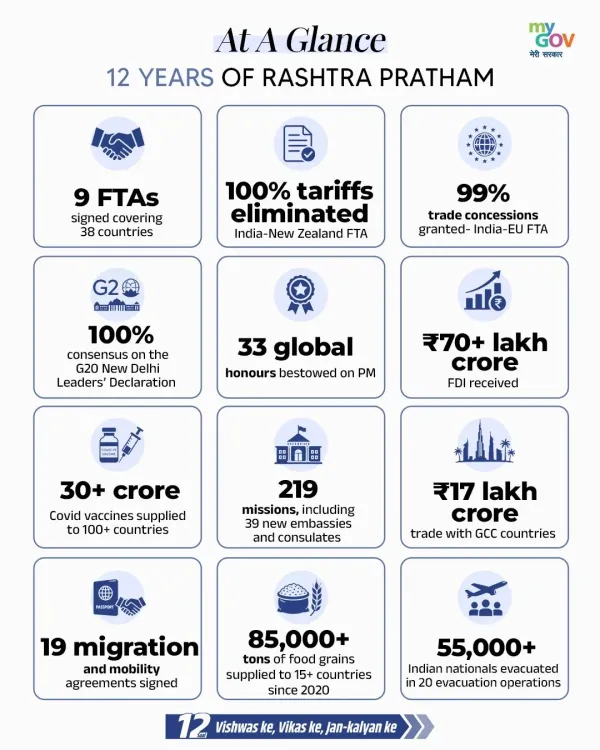
The Vaccine Maitri initiative supplied COVID-19 vaccines to over 100 countries between 2020 and 2022 .
Operation Ganga in 2022 evacuated Indian nationals from Ukraine , one of several citizen-support missions in the period.
India hosted the G20 Summit in New Delhi in September 2023 , a milestone in expanded multilateral leadership.
India has pursued multi-alignment through the Quad , BRICS , and SCO while positioning itself as a preferred destination for foreign investment.
Union Finance Minister Nirmala Sitharaman on Friday, June 19, 2026, reflected on 12 years of India's foreign policy under the NDA government, citing stronger global partnerships, expanded international presence, and a firm commitment to Indian citizens abroad as defining achievements of the period.
Posting under the hashtag #12YearsOfIndiaFirst, Sitharaman wrote: 'Stronger partnerships, record investment, expanded global presence, support to partner nations and firm commitment to Indian citizens abroad — the last 12 years have been about putting national interest at the heart of India's engagement with the world.'
Context
The post marks the 12th anniversary of the Narendra Modi-led NDA government, which assumed office in May 2014. Senior ministers across the government have been marking the occasion by highlighting the administration's record across policy domains. Sitharaman's framing centres on foreign policy and economic diplomacy as pillars of the government's tenure.
As Union Finance Minister, Sitharaman has played a role in shaping the economic dimensions of India's external engagement — from bilateral investment frameworks to budget provisions supporting the diaspora and overseas missions.
Policy Backdrop
The 12-year period referenced by Sitharaman spans several landmark foreign-policy initiatives. In 2014, the government rebranded the Look East Policy as the Act East Policy, accelerating economic, security, and cultural ties with ASEAN and East Asian nations. The following year, 2015, saw the launch of the International Solar Alliance, a treaty-based body promoting renewable-energy cooperation with partner countries.
On citizen welfare abroad, the government conducted Operation Ganga in 2022 to evacuate Indian nationals from Ukraine, one of several large-scale evacuation missions across the period. Earlier, the Vaccine Maitri initiative between 2020 and 2022 supplied COVID-19 vaccines to over 100 countries, positioning India as a global health partner. India's hosting of the G20 Summit in New Delhi in September 2023 under the theme Vasudhaiva Kutumbakam ('the world is one family') was widely cited as a high point of expanded multilateral engagement.
India has also deepened participation in plurilateral groupings including the Quad, BRICS, and the Shanghai Cooperation Organisation (SCO), pursuing a strategy of multi-alignment with major powers rather than exclusive bloc membership.
Stakeholders and Impact
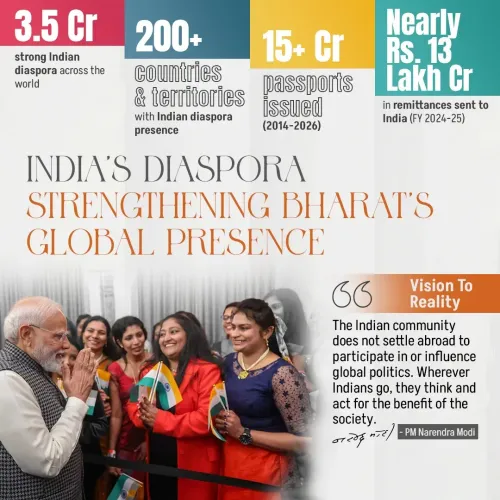
The constituencies most directly referenced in Sitharaman's post are overseas Indians, foreign investors, and partner nations. Diaspora welfare — ranging from consular support to crisis evacuations — has been a recurring theme in government communications, reflecting both humanitarian imperatives and the political salience of the roughly 32 million-strong Indian diaspora worldwide.
For foreign investors, the government has consistently positioned India as a preferred destination, linking inbound capital flows to domestic job creation and economic growth. Partner nations, particularly in the Global South, have been engaged through development assistance, vaccine supply, and technical cooperation programmes.
What's Next
Attention will turn to upcoming BRICS and SCO summits, where India may announce expanded trade or investment mechanisms. On the domestic policy front, any new diaspora-welfare provisions in the forthcoming Union Budget or statements from the Ministry of External Affairs will be watched as indicators of how the government plans to build on the foreign-policy record it is now publicly celebrating.
Point of View
Using the language of economic diplomacy — 'record investment,' 'expanded global presence' — to claim ownership of a foreign-policy narrative that has traditionally belonged to the Prime Minister's Office and the External Affairs Ministry. By foregrounding citizen welfare and partner-nation support alongside investment, the BJP is deliberately broadening the appeal of its foreign-policy record beyond strategic elites to ordinary voters with family abroad. The post fits a consistent pattern in which Budget-day economics and diplomatic achievements are increasingly presented as a unified 'India First' brand. As the government enters its thirteenth year, the challenge will be translating anniversary rhetoric into concrete deliverables at the next round of multilateral summits and in the forthcoming Union Budget.
NationPress
18 Sept 2026
Frequently Asked Questions
What is the '12 Years of India First' campaign about?
'12 Years of India First' is a BJP government communication marking 12 years since the NDA came to power in May 2014, highlighting achievements in foreign policy, investment attraction, and support for Indian citizens abroad.
What is the Act East Policy and when was it launched?
The Act East Policy was launched in 2014 by the Modi government as an upgrade of the earlier Look East Policy, aimed at deepening economic, security, and cultural ties with ASEAN and East Asian nations.
What was Vaccine Maitri?
Vaccine Maitri was India's initiative between 2020 and 2022 to supply COVID-19 vaccines to over 100 countries, positioning India as a global health partner and a leader in South-South cooperation.
What was Operation Ganga?
Operation Ganga was a 2022 government mission to evacuate Indian nationals stranded in Ukraine during the Russia-Ukraine conflict, one of several large-scale citizen-support operations conducted by India abroad.
Why is Nirmala Sitharaman posting about foreign policy?
As a senior BJP leader and Union Finance Minister, Sitharaman is participating in the party's broader anniversary communications marking 12 years of NDA governance, connecting economic diplomacy and investment to the government's overall foreign-policy record.