FM Sitharaman: Capex Multiplier Working, Fiscal Prudence Stays

Synopsis
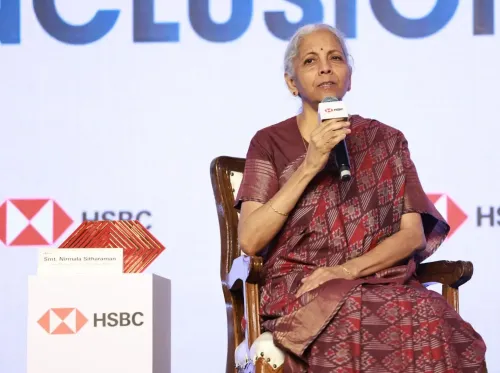
At HSBC India's Mumbai event on 2 November 2026, Finance Minister Nirmala Sitharaman reaffirmed that capital expenditure remains central to India's growth strategy while stressing that fiscal prudence under PM Modi will stay non-negotiable.
Key Takeaways
Nirmala Sitharaman called capex 'a very important component' of India's growth strategy at an HSBC India event in Mumbai on 2 November 2026 .
She cited the 'multiplier effect' of capital expenditure as having 'delivered good results over the last few years.' The Finance Minister stressed: 'We need to spend, but with responsibility,' signalling no intention to abandon fiscal consolidation.
Fiscal prudence under PM Narendra Modi was explicitly named as a 'top priority' alongside sustained growth momentum.
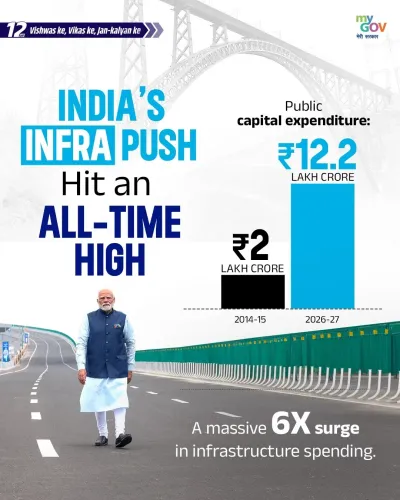
Successive Union Budgets since 2020-21 have raised capex allocations, directing funds to roads, railways, and urban infrastructure.
The next Union Budget will be the concrete test of whether the capex-vs-prudence balance holds in practice.
Public investment has delivered — and India is not about to let go of the wheel. Addressing a high-profile financial sector gathering in Mumbai, Maharashtra on Monday, 2 November 2026, Union Finance Minister Nirmala Sitharaman made the clearest articulation yet of the government's dual-track growth philosophy: keep capital expenditure as the engine, keep fiscal discipline as the guardrail.
Speaking at HSBC India's 'Algorithm of Inclusion — Bharat ka Next Click' ('Algorithm of Inclusion — India's Next Click') event, Sitharaman said, 'Capex is a very important component of our growth strategy. Its multiplier effect has delivered good results over the last few years and we shall continue to ensure that India's growth momentum is not lost.' She was unambiguous on the limits, adding: 'We need to spend, but with responsibility. Under Hon'ble PM Shri Narendra Modi, fiscal prudence will remain a top priority.'
Capex as India's primary growth driver since 2021
The philosophy Sitharaman articulated in Mumbai has a clear lineage in successive Union Budgets since 2020-21. Each year, the central government has raised its capital expenditure allocation — spending channelled into roads, railways, and urban infrastructure — treating front-loaded public investment as the fastest lever to crowd in private capital and sustain GDP momentum. The approach picked up urgency after the pandemic, when Budget 2021-22 marked a sharp step-up in capex to kick-start recovery.
The logic of the 'multiplier effect' she referenced is well-established in Indian fiscal policy circles: every rupee of public infrastructure spending generates downstream demand across construction, materials, logistics, and finance — sectors that employ millions and underpin corporate earnings cycles. Invoking this multiplier publicly signals that the government views capex-led growth not as a temporary post-pandemic measure but as a structural commitment.
Balancing the spend with the glide path
Yet the second half of Sitharaman's statement carries equal weight for bond markets and credit-rating analysts. 'Fiscal prudence will remain a top priority' is a phrase that does specific work: it signals that higher capex will not come at the cost of runaway deficits. The Fiscal Responsibility and Budget Management Act, amended in 2016 and 2021, enshrines a glide path for deficit reduction — and the Finance Minister's remarks reaffirm that the government intends to walk it even as spending scales up.
For infrastructure developers and private investors in the audience at HSBC India's event, the message was a familiar but reassuring one: the public investment pipeline stays open, and the sovereign's balance sheet will not be strained to the point of crowding out private borrowers. The calibration between ambition and discipline is, in effect, the government's pitch to every category of capital — domestic and foreign.
What the next Budget will tell us
The real test of Sitharaman's words will arrive when the next Union Budget is presented. Revised capex numbers and the medium-term fiscal deficit trajectory will confirm whether the government's stated balance holds in practice. Markets and multilateral institutions will be watching those figures closely — and today's statement in Mumbai sets the benchmark against which they will measure it.
India's growth story has increasingly been told through the infrastructure projects it finances. The Finance Minister just committed — publicly, at a bank's flagship macro forum — that the story is not changing course.
Point of View
Not merely a technocratic target, making it harder to walk back in pre-election budget cycles. With the next Budget approaching, the Finance Minister is effectively anchoring market expectations early — any significant deviation from the capex-plus-consolidation formula will now be measured against this public benchmark. The challenge ahead is whether buoyant tax revenues continue to provide the headroom to do both.
NationPress
2 Nov 2026
Frequently Asked Questions
What did Nirmala Sitharaman say about capex at the HSBC India event?
She said capex is a very important component of India's growth strategy and that its multiplier effect has delivered good results over the last few years, while adding that spending must be done with responsibility.
What is the multiplier effect of capital expenditure in India?
The capex multiplier refers to the downstream economic activity generated by each rupee of public infrastructure spending — stimulating demand in construction, materials, logistics, and finance, and helping crowd in private investment.
What is India's fiscal prudence policy under PM Modi?
The government follows a fiscal consolidation glide path under the Fiscal Responsibility and Budget Management Act, aiming to reduce the fiscal deficit over time while protecting capital expenditure allocations.
What was the HSBC India 'Algorithm of Inclusion' event?
It was a financial sector gathering hosted by HSBC India in Mumbai focused on India's macroeconomic outlook and inclusion themes, where Finance Minister Sitharaman delivered remarks on growth strategy.
How has India's capital expenditure changed since 2020?
Successive Union Budgets from 2020-21 onwards have progressively raised central government capex allocations, prioritising spending on roads, railways, and urban infrastructure as the primary driver of economic growth.