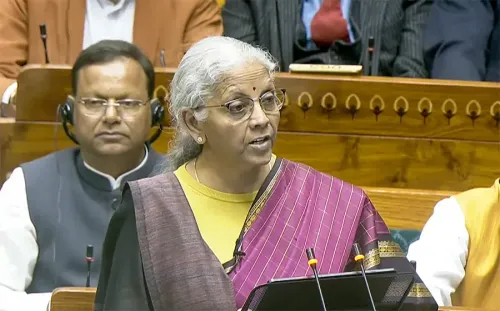
Sitharaman: Infra capex hits all-time high of ₹12.2 lakh crore in FY27
Synopsis
Union Finance Minister Nirmala Sitharaman announced on June 16, 2026, that public capex allocation for infrastructure has reached an all-time high of ₹12.2 lakh crore in FY 2026-27, marking the peak of a multi-year upward spending trajectory under the Modi government's 12-year tenure.
Key Takeaways
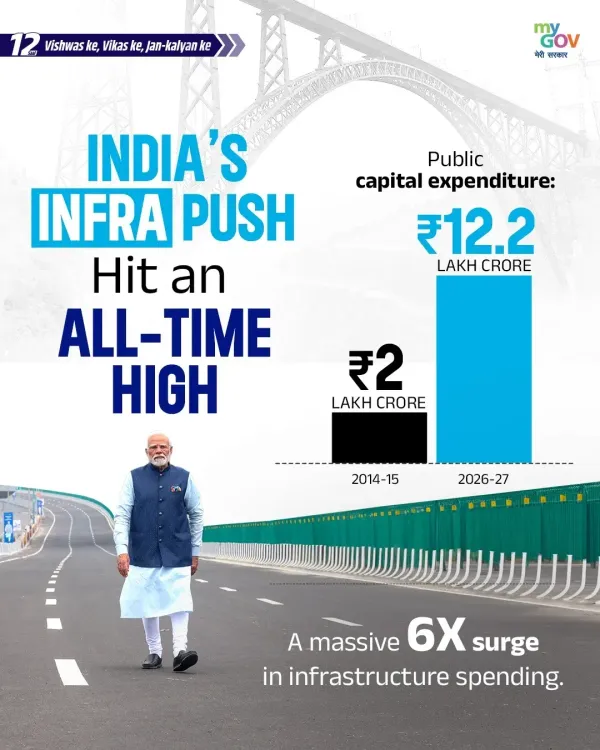
Public capital expenditure allocation for infrastructure has reached an all-time high of ₹12.2 lakh crore in FY 2026-27 , as announced by Finance Minister Nirmala Sitharaman .
The announcement was made on June 16, 2026 , under the hashtag #12YearsOfNayaBharatNirman , marking twelve years of the Modi government .
The allocation continues a multi-year upward trajectory in public infrastructure spending; the Union Budget 2023-24 had set a then-high of ₹10 lakh crore in capital expenditure.
The government states the increase reflects a commitment to 'world-class infrastructure' and improving 'ease of living' for citizens.
Key beneficiaries include infrastructure developers, construction sector workers, and citizens in underserved regions awaiting connectivity projects.
Actual impact will hinge on project execution rates and fund utilisation, which will be tracked through parliamentary and quarterly reviews.
Union Finance Minister Nirmala Sitharaman announced on Tuesday, June 16, 2026, that public capital expenditure allocation for infrastructure has reached an all-time high of ₹12.2 lakh crore in FY 2026-27, describing the milestone as a reflection of the government's commitment to world-class infrastructure and improved ease of living for citizens.
Context
Sitharaman posted on X, stating: 'Public capex allocation for infrastructure has reached an all-time high of ₹12.2 lakh crore in FY 2026-27. The increase in allocation reflects a commitment to building world-class infrastructure and improving ease of living for our citizens.' The post was tagged under #12YearsOfNayaBharatNirman, marking what the ruling BJP-led government frames as twelve years of nation-building under Prime Minister Narendra Modi, who has been in office since 2014.
The announcement positions FY 2026-27 as the peak year in a multi-year upward trajectory of infrastructure spending by the central government. Capital expenditure on infrastructure is a key lever in the Union Budget, channelling public funds into roads, railways, ports, airports, and urban infrastructure.
Policy Backdrop
The central government has steadily raised its capital expenditure allocations since 2014, treating public infrastructure investment as a driver of economic growth, logistics efficiency, and long-term asset creation. A significant step in this trajectory came in the Union Budget 2023-24, which allocated ₹10 lakh crore for capital expenditure — a figure that itself was described at the time as a substantial leap.
The latest figure of ₹12.2 lakh crore for FY 2026-27 represents a continued scaling of this approach, reinforcing the government's stated priority of building physical infrastructure as a foundation for broader economic development. The allocation spans sectors including transport, energy, and urban development, with the objective of reducing logistics costs and improving connectivity across the country.
Stakeholders and Impact
Infrastructure developers and construction companies stand to be among the most direct beneficiaries of the heightened allocation, as increased public capex translates into a larger pipeline of government-funded projects. Employment in the construction and allied sectors is also expected to see a positive impact, given the labour-intensive nature of infrastructure work.
For ordinary citizens, the government frames the investment in terms of 'ease of living' — faster commutes, better connectivity to markets and services, and improved urban amenities. Rural communities, in particular, stand to benefit from road and connectivity projects that link them to economic centres. The scale of actual on-ground delivery, however, will depend on project execution rates and fund utilisation across ministries and states.
What's Next
Parliamentary scrutiny of the full Union Budget for FY 2026-27 and subsequent quarterly reports on project execution and fund utilisation will be the key markers to watch. The government's ability to translate the record allocation into completed infrastructure assets will determine whether the headline figure delivers its intended economic and social dividends.
As the BJP-led government marks twelve years in power, the infrastructure capex milestone is likely to feature prominently in its political messaging, even as opposition parties and independent analysts will look to utilisation data to assess the real-world impact of the spending commitment.
Point of View
The Finance Ministry is clearly linking fiscal policy to political messaging ahead of what remains a competitive electoral environment. The headline number is significant, but analysts and opposition voices will focus on utilisation rates, since large allocations have historically faced absorption constraints at the state and project-execution levels. Whether this record capex translates into visible infrastructure on the ground will be the real test of the government's claim.
NationPress
19 Sept 2026
Frequently Asked Questions
What is the infrastructure capex allocation for FY 2026-27?
The public capital expenditure allocation for infrastructure in FY 2026-27 is ₹12.2 lakh crore, which Finance Minister Nirmala Sitharaman has described as an all-time high.
What was India's infrastructure capex in the Union Budget 2023-24?
The Union Budget 2023-24 allocated ₹10 lakh crore for capital expenditure, which was itself a significant milestone in the government's multi-year upward spending trajectory.
What does #12YearsOfNayaBharatNirman mean?
#12YearsOfNayaBharatNirman is a hashtag used by the BJP-led government to mark twelve years of the Narendra Modi administration since 2014, framing the period as one of nation-building and infrastructure development.
Who announced the record infrastructure capex for FY 2026-27?
Union Finance Minister and Minister of Corporate Affairs Nirmala Sitharaman announced the record allocation of ₹12.2 lakh crore on June 16, 2026, via a post on X.
How does higher infrastructure capex benefit ordinary citizens?
The government says higher infrastructure capex improves 'ease of living' through better roads, connectivity, and urban amenities, though the actual benefit depends on how efficiently the allocated funds are spent and projects are completed.