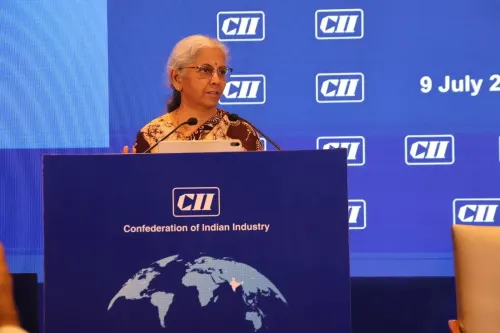
FM Sitharaman: Data Centres, GCCs Expanding to Tier-2 Cities

Synopsis
Union Finance Minister Nirmala Sitharaman told the Mindmine Summit 2026 that India's data centre and GCC ecosystem is rapidly decentralising from Bengaluru, Hyderabad and Delhi NCR into Tier-2 cities such as Tumakuru and Mangaluru, promising more jobs, stronger data security and a boost for local economies.
Key Takeaways
Finance Minister Nirmala Sitharaman made the remarks at the Mindmine Summit 2026 on June 15, 2026 .
India's data centre and GCC ecosystem is expanding beyond Bengaluru , Hyderabad , and Delhi NCR .
Tumakuru and Mangaluru — both Tier-2 cities in Karnataka — were cited as emerging investment destinations.
The expansion is attributed to proactive state policies and Finance Ministry engagement with state governments.
Expected outcomes include more technology jobs, stronger data security, and economic growth in smaller cities.
State budget announcements for 2026-27 and data-protection legislation are the key policy developments to watch.
Union Finance Minister Nirmala Sitharaman on Monday, June 15, 2026, said India's data centre and Global Capability Centre (GCC) ecosystem is expanding rapidly, crediting proactive government policies and strong state-level engagement for the growth. Speaking at the Mindmine Summit 2026, she noted that investment is now moving beyond the traditional technology hubs into smaller cities.
Context
Sitharaman observed that what was once concentrated in Bengaluru, Hyderabad, and Delhi NCR is now spreading to Tier-2 cities such as Tumakuru and Mangaluru. She said this geographic diversification would translate into 'more jobs, stronger data security and a boost for local economies.' The remarks signal the Finance Ministry's active interest in shaping the spatial distribution of digital infrastructure investment across India.
Policy Backdrop
India's data infrastructure push draws on a policy lineage stretching back to the Digital India programme launched in 2015, which established foundational digital infrastructure and early data-protection frameworks. From 2020 onward, states including Karnataka introduced dedicated data-centre policies and incentive packages designed to attract investment beyond the primary metros. The Finance Ministry's sustained engagement with state governments has been a key accelerant, aligning central fiscal signals with state-level industrial policy.
Global Capability Centres — offshore delivery arms of multinational firms handling IT, analytics, and research and development — have become a significant contributor to India's services exports. Their expansion into secondary cities is seen as a natural next step as talent pools deepen outside the major metros and real-estate and operational costs in Tier-1 cities rise.
Stakeholders and Impact
The most direct beneficiaries are IT professionals and job-seekers in cities like Tumakuru and Mangaluru, which stand to gain formal technology employment that was previously available only in larger urban centres. Local supply chains — from construction and power infrastructure to facility management — also stand to benefit as data-centre campuses require sustained on-ground investment. Sitharaman's framing of 'stronger data security' also points to a national-interest dimension: domestic data centres reduce dependence on overseas infrastructure, reinforcing India's data sovereignty objectives.
For multinational companies operating GCCs, the policy environment signals continued government support for geographic expansion, potentially lowering risk perceptions for investments in non-metro locations. State governments that have already announced incentive packages are likely to see renewed interest from investors following a signal of this visibility from the Union Finance Minister.
What's Next
Attention will now turn to state budget announcements for 2026-27 and whether they include fresh data-centre incentive packages or expansions of existing schemes. Any follow-up legislative action on data-protection frameworks at the parliamentary level will also be closely watched, as clearer legal guardrails are considered essential for deepening enterprise confidence in domestic data infrastructure. Sitharaman's remarks at a high-profile policy summit are likely to reinforce momentum among states competing to attract the next wave of GCC and data-centre investment.
Point of View
She is effectively signalling to state governments and multinational investors where the Centre wants capital to flow next. This fits a broader pattern in which the Finance Ministry uses high-profile public platforms to shape investment sentiment ahead of budget cycles. The framing around 'data security' also hints at a sovereignty argument that could underpin future regulatory or fiscal action on domestic data localisation.
NationPress
15 Sept 2026
Frequently Asked Questions
What did Nirmala Sitharaman say at the Mindmine Summit 2026?
Sitharaman said India's data centre and GCC ecosystem is expanding rapidly, driven by proactive policies and state engagement, and is now moving beyond Bengaluru, Hyderabad and Delhi NCR into Tier-2 cities like Tumakuru and Mangaluru.
Which Tier-2 cities are emerging as data centre hubs in India?
Tumakuru and Mangaluru in Karnataka were specifically cited by Finance Minister Sitharaman as examples of Tier-2 cities attracting data centre and GCC investments.
What is a Global Capability Centre (GCC) in India?
A Global Capability Centre is an offshore delivery unit set up by a multinational company in India to handle IT, analytics, research and development, and other functions. India hosts a large number of GCCs that contribute significantly to its services exports.
Why are data centres moving to Tier-2 cities in India?
State-level incentive policies, improving digital connectivity, lower real-estate costs, and deepening talent pools outside major metros have made Tier-2 cities increasingly attractive for data centre and GCC investments.
What is the Mindmine Summit?
The Mindmine Summit is an annual business and policy conference where senior government ministers and industry leaders discuss economic trends, including digital infrastructure and technology policy.