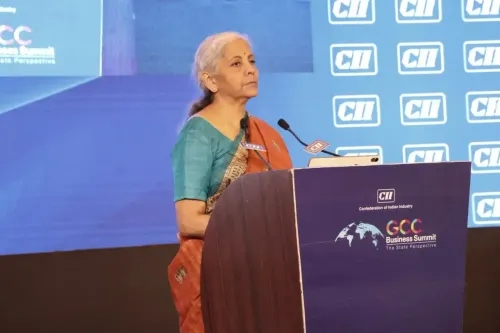
Sitharaman Unveils GCC Tax Reforms at CII Summit 2026
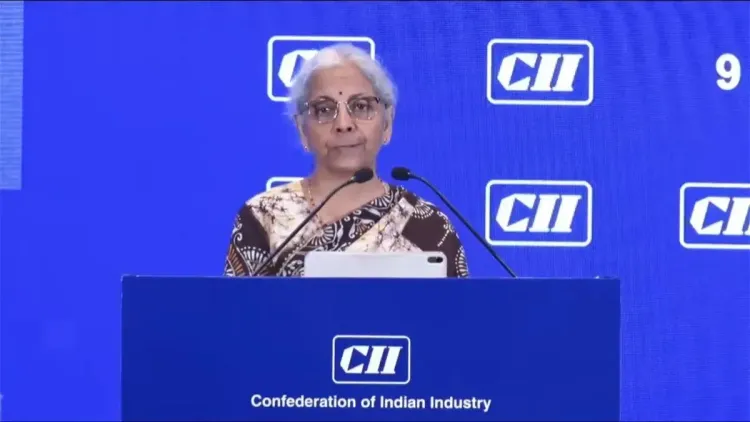
Synopsis
Finance Minister Nirmala Sitharaman addressed the CII National GCC Business Summit 2026, detailing Union Budget 2026–27 measures: a unified safe harbour regime for IT/ITES, a threshold hike from ₹300 crore to ₹2,000 crore, and a fast-track APA mechanism to boost tax certainty for Global Capability Centres in India.
Key Takeaways
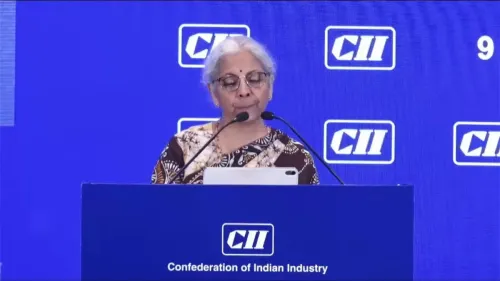
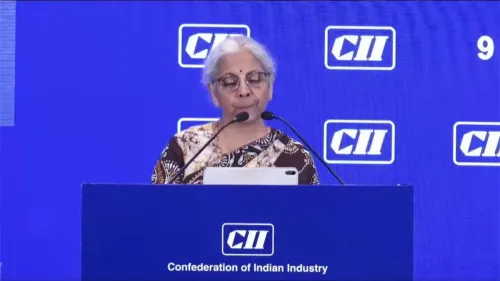
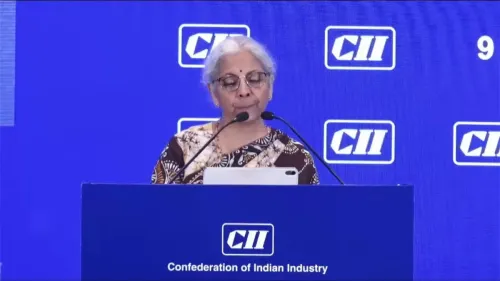
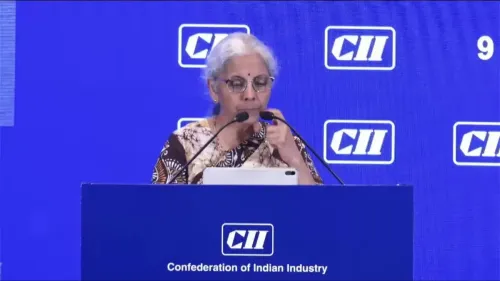
Union Finance Minister Nirmala Sitharaman addressed the CII National GCC Business Summit 2026 on 9 July 2026 .
Union Budget 2026–27 introduces a Unified Safe Harbour Regime for IT and IT-enabled services to simplify transfer pricing compliance for GCCs.
The Safe Harbour Threshold has been raised more than six-fold, from ₹300 crore to ₹2,000 crore , extending simplified compliance to a larger set of enterprises.
A Fast-track Advance Pricing Agreement (APA) mechanism will provide greater tax certainty for multinational companies operating in India.
Implementation details will follow CBDT notifications once the Finance Bill 2026 receives Presidential assent.
The measures build on Safe Harbour Rules first introduced in 2013 and the APA programme launched in 2012 .
Union Finance Minister Nirmala Sitharaman addressed the CII National GCC Business Summit 2026 on Thursday, 9 July 2026, outlining a suite of tax and compliance measures announced in Union Budget 2026–27 aimed at accelerating India's emergence as a premier destination for Global Capability Centres.
Context
Speaking at the summit organised by the Confederation of Indian Industry (CII), Sitharaman said the government recognises that 'India's next phase of GCC growth requires an enabling policy ecosystem that reduces friction, improves certainty and supports long-term investments.' The address signals a deliberate push to position India as the default global hub for multinational capability operations.
Global Capability Centres — offshore units set up by multinationals for technology, analytics, finance, and other specialised functions — have grown rapidly in India over the past decade, drawn by talent availability and cost advantages. The government's latest moves are designed to remove the compliance uncertainty that has long been cited as a drag on deeper investment.
Policy Backdrop
The centrepiece of the announcements is a Unified Safe Harbour Regime for IT and IT-enabled services, which consolidates existing rules to simplify transfer pricing compliance for GCCs. Safe Harbour Rules were first introduced in 2013 under the Income Tax Act to cap transfer-pricing disputes for specified international transactions, and successive budgets have refined them since.
Critically, the Enhanced Safe Harbour Threshold has been raised from ₹300 crore to ₹2,000 crore — a more than six-fold increase — bringing a significantly larger pool of enterprises under a simplified compliance framework and reducing the need for costly arm's-length analyses. Alongside this, a Fast-track Advance Pricing Agreement (APA) mechanism has been announced to provide greater tax certainty to multinationals. The APA programme, introduced in 2012 under the Income Tax Act, allows companies to agree in advance with tax authorities on the pricing of related-party transactions, cutting the risk of prolonged litigation.
India has pursued a consistent strategy of raising safe-harbour thresholds and expanding APA options across successive Finance Acts, each iteration aimed at reducing transfer-pricing disputes in the IT and ITES sectors as part of broader ease-of-doing-business reforms.
Stakeholders and Impact
The primary beneficiaries are multinational corporations operating or planning to set up GCCs in India, along with IT and ITES firms and the tax professionals who advise them. The threshold hike to ₹2,000 crore is particularly significant: enterprises that previously fell outside the safe harbour net — and therefore faced full transfer-pricing scrutiny — can now opt for a simplified route, reducing compliance costs and audit exposure.
For the broader economy, a more predictable tax environment strengthens India's competitiveness against rival GCC destinations. The measures align with India's long-standing ambition to improve its standing in global ease-of-doing-business metrics for services exports.
What's Next
Implementation will hinge on Central Board of Direct Taxes (CBDT) notifications that will detail the operational contours of the unified safe-harbour regime and specify timelines for the fast-track APA mechanism, both contingent on the Finance Bill 2026 receiving Presidential assent. Industry bodies and multinational tax teams are expected to engage closely with the CBDT during the rule-drafting phase to ensure the framework delivers on its stated promise of certainty and speed.
If the regime is operationalised as announced, India's GCC ecosystem — already one of the largest in the world — could see an acceleration in new centre formations and expansions, particularly from enterprises that had previously held back due to transfer-pricing uncertainty.
Point of View
With the threshold jump to ₹2,000 crore signalling a deliberate effort to move beyond incremental tweaks. By pairing the threshold hike with a unified regime and a fast-track APA, the government is addressing both the cost and the time dimensions of compliance uncertainty — the two factors most frequently cited by multinationals when choosing between GCC locations. The timing, at a high-profile industry summit, also serves a signalling purpose: it tells global CFOs and tax heads that India's policy stance on GCCs is stable and proactive. If CBDT operationalises these rules swiftly and with minimal carve-outs, the measures could materially shift the calculus for multinationals currently weighing India against competing destinations in Southeast Asia and Eastern Europe.
NationPress
8 Oct 2026
Frequently Asked Questions
What is the new Safe Harbour Threshold announced in Union Budget 2026-27?
The Safe Harbour Threshold for IT and IT-enabled services has been raised from ₹300 crore to ₹2,000 crore in Union Budget 2026–27, allowing many more enterprises to opt for simplified transfer pricing compliance instead of a full arm's-length analysis.
What is a Unified Safe Harbour Regime for GCCs in India?
The Unified Safe Harbour Regime consolidates existing safe harbour rules under the Income Tax Act into a single, streamlined framework for IT and IT-enabled services, reducing the compliance burden for Global Capability Centres operating in India.
What is a Fast-track Advance Pricing Agreement (APA) and how does it help GCCs?
An Advance Pricing Agreement is a mechanism under the Income Tax Act where a company agrees in advance with tax authorities on the pricing of related-party transactions, avoiding future disputes. The fast-track version announced in Budget 2026–27 aims to shorten the time taken to conclude these agreements, giving multinationals quicker tax certainty.
What did Nirmala Sitharaman say at the CII GCC Summit 2026?
Finance Minister Nirmala Sitharaman said the government recognises that 'India's next phase of GCC growth requires an enabling policy ecosystem that reduces friction, improves certainty and supports long-term investments,' and outlined the Budget 2026–27 tax measures designed to achieve that.
When will the new GCC safe harbour rules come into effect?
The new rules will be operationalised through CBDT notifications after the Finance Bill 2026 receives Presidential assent. The exact timelines for the unified safe harbour regime and the fast-track APA mechanism are yet to be specified by the CBDT.