FM Sitharaman backs 5,000 GCC target by 2030 at CII Summit
Synopsis
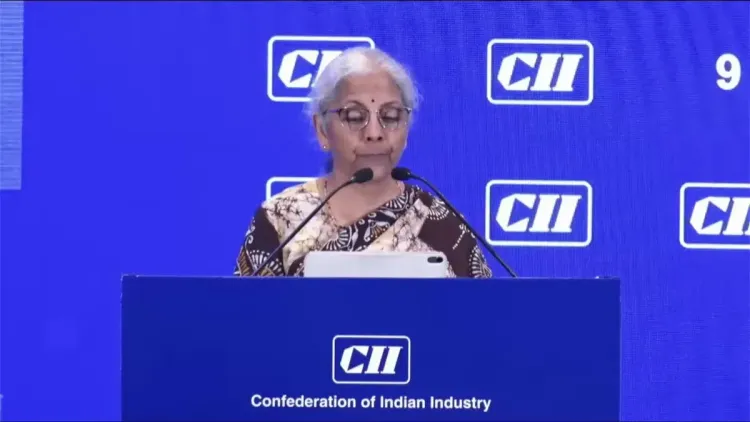
Finance Minister Nirmala Sitharaman told the CII National GCC Business Summit on 9 July 2026 that India's goal of hosting 5,000 Global Capability Centres by 2030 is realistic, framing it as a milestone in a larger innovation-partnership journey with global markets.
Key Takeaways
Finance Minister Nirmala Sitharaman addressed the CII National GCC Business Summit, 2026 on 9 July 2026 .
She described the target of 5,000 GCCs by 2030 as 'both realistic and achievable.' She positioned the target as 'a milestone on a much larger journey,' signalling a long-term policy commitment beyond the single number.
Global markets, she said, are seeking 'trusted partners capable of supporting advanced innovation' — India's core pitch to multinationals.
The GCC growth agenda builds on policy groundwork laid since 2014 , including Make in India and successive FDI liberalisation rounds.
Future Union Budgets and Economic Surveys will be watched for concrete incentives and progress benchmarks.
Union Finance Minister Nirmala Sitharaman on Thursday, 9 July 2026, declared that India's ambition of building an ecosystem capable of supporting around 5,000 Global Capability Centres (GCCs) by 2030 is 'both realistic and achievable,' addressing delegates at the CII National GCC Business Summit, 2026. Speaking in her capacity as the country's top economic policymaker, she framed the target not as a ceiling but as 'a milestone on a much larger journey.'
Context
Sitharaman told the summit that global markets are actively seeking 'trusted partners capable of supporting advanced innovation' — a direct pitch for India's positioning as the preferred destination for multinational corporations looking to offshore high-value functions. Her remarks, shared as part of a thread on the official handle @nsitharamanoffc, signal the government's intent to anchor India's services-export strategy around the GCC ecosystem.
GCCs — also called captive centres or offshore delivery units — are established by multinational firms to consolidate IT, research and development, finance, analytics and other corporate functions in a single offshore location. India has emerged as the world's leading GCC destination, leveraging its large English-speaking engineering talent pool and competitive operating costs.
Policy Backdrop
The 5,000-GCC-by-2030 ambition extends a trajectory that gained momentum after the launch of the Make in India initiative in 2014, which explicitly included services and technology sectors alongside manufacturing. Successive rounds of foreign direct investment policy relaxations between 2016 and 2020 further eased norms for multinational firms setting up captive units, reducing regulatory friction and shortening the time-to-operate for new centres.
India's GCC base expanded rapidly through this period as multinationals shifted higher-value functions — including global R&D leadership, product engineering and enterprise analytics — away from traditional hubs. The government has consistently positioned GCC growth as a pillar of its services-export strategy and its broader goal of raising India's share in global innovation value chains.
The Confederation of Indian Industry (CII), founded in 1895 and one of India's most influential industry bodies, convenes the National GCC Business Summit as a platform to align industry expectations with policy direction. The summit series has become a key venue where government signals on investment climate, tax treatment and infrastructure support are closely tracked by multinational decision-makers.
Stakeholders and Impact
The primary stakeholders in this ecosystem are multinational corporations across sectors — technology, banking, pharmaceuticals and engineering — that operate or plan to establish GCCs in Indian cities including Bengaluru, Hyderabad, Pune, Chennai and Gurugram. For these firms, the Finance Minister's public endorsement of the 2030 target functions as a policy assurance, reducing uncertainty around the regulatory and fiscal environment.
IT and R&D professionals represent the other critical stakeholder group. Scaling to 5,000 GCCs would require sustained expansion of high-skill employment, putting pressure on universities, technical institutes and upskilling programmes to supply adequately trained talent. Industry observers note that talent availability — more than policy — will be the binding constraint on achieving the target.
What's Next
Analysts will watch subsequent Economic Surveys and Reserve Bank of India reports for incremental GCC registration and employment data that can benchmark progress against the 2030 milestone. The more immediate question is whether the government will back Sitharaman's public confidence with concrete measures — infrastructure support, tax incentives or streamlined compliance frameworks — in the next Union Budget.
If India sustains the pace of GCC additions seen in recent years, the 5,000-centre target is within reach. The Finance Minister's framing of it as a waypoint rather than a destination suggests the government sees GCC-led innovation as a long-term structural pillar of the Indian economy, not a short-cycle policy bet.
Point of View
000-GCC milestone at a high-profile industry summit is a deliberate confidence signal to multinational decision-makers weighing long-term India commitments. By framing the target as a waypoint rather than a destination, the government is managing expectations upward — implying that policy support will outlast any single budget cycle. This fits a broader pattern in which the BJP-led administration has used services-sector milestones to complement its manufacturing-first Make in India narrative, diversifying the investment story it tells global capital. The real test will come when the rhetoric is matched by specific fiscal or regulatory measures in the next budget.
NationPress
8 Oct 2026
Frequently Asked Questions
What is India's GCC target for 2030?
India is targeting an ecosystem capable of supporting around 5,000 Global Capability Centres by 2030, a goal Finance Minister Nirmala Sitharaman described as 'realistic and achievable' at the CII National GCC Business Summit on 9 July 2026.
What is a Global Capability Centre (GCC)?
A Global Capability Centre is an offshore unit set up by a multinational corporation to consolidate functions such as IT, R&D, finance and analytics. India is the world's leading GCC destination, with centres concentrated in cities like Bengaluru, Hyderabad and Pune.
What did Nirmala Sitharaman say at the CII GCC Summit 2026?
Sitharaman said the 5,000-GCC-by-2030 ambition is 'both realistic and achievable' and that it represents 'a milestone on a much larger journey,' adding that global markets are looking for 'trusted partners capable of supporting advanced innovation.'
What is the CII National GCC Business Summit?
The CII National GCC Business Summit is an industry event organised by the Confederation of Indian Industry to align policy direction with the growth of Global Capability Centres in India. It serves as a key platform for government signals on investment climate and regulatory frameworks.
How does India's GCC growth connect to Make in India?
The Make in India initiative launched in 2014 explicitly included services and technology sectors, laying the policy foundation for GCC expansion. Subsequent FDI liberalisation between 2016 and 2020 further reduced barriers for multinationals setting up captive units, accelerating India's rise as a global GCC hub.