Sitharaman: India's Next Decade Defined by Global Leadership
Synopsis
Finance Minister Nirmala Sitharaman told the CII National GCC Business Summit 2026 that around two-thirds of Fortune Global 2000 companies have yet to set up a Global Capability Centre in India, calling it one of the largest untapped investment opportunities and framing the next decade as India's shift from capability to global leadership.
Key Takeaways
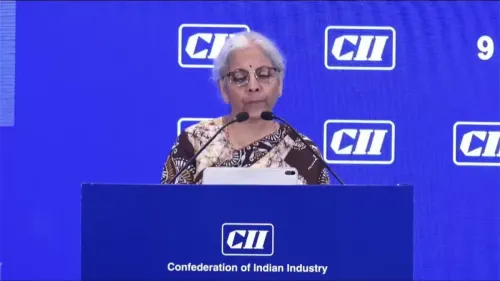
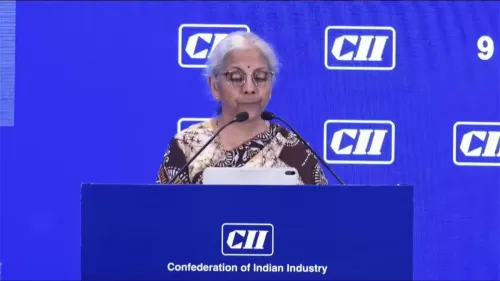
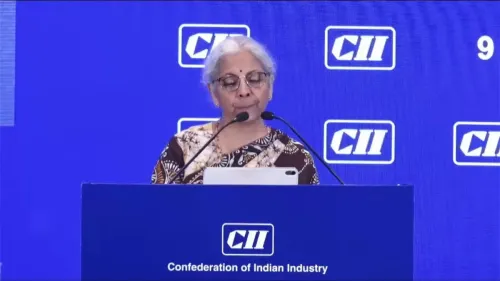
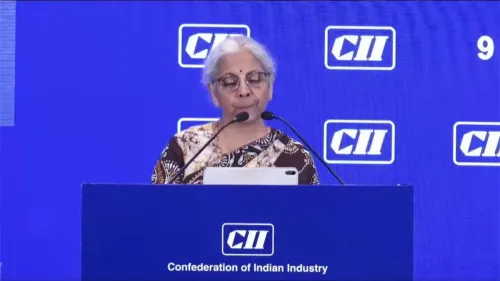
Union Finance Minister Nirmala Sitharaman addressed the CII National GCC Business Summit, 2026 on 9 July 2026 .
She described India's next decade as a shift 'from capability to global leadership' in the global economy.
Around two-thirds of Fortune Global 2000 companies have yet to establish a Global Capability Centre (GCC) in India, which she called one of the largest untapped investment opportunities.
The remarks build on a long policy arc from 1990s liberalisation through Make in India (2014) and PLI schemes (2020 onward) .
Further remarks from the Finance Minister are expected, as the post was marked 1/n .
Follow-up policy signals on tax incentives and regulatory reforms for GCCs are being closely watched by industry and MNC investors.
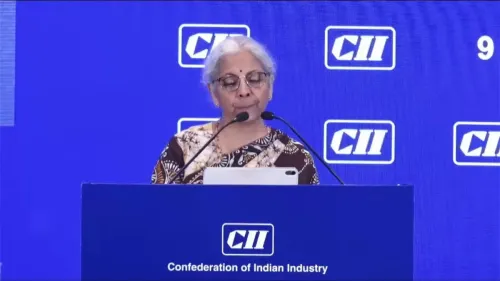
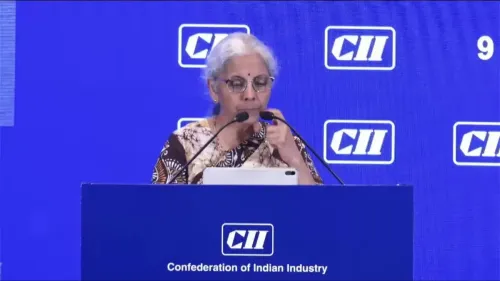
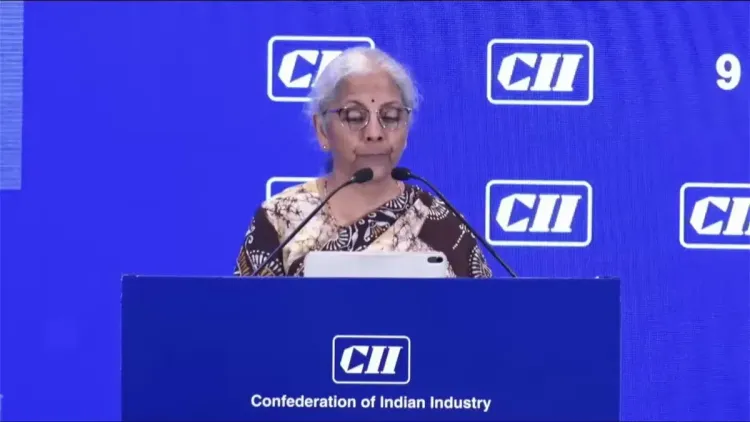
Union Finance Minister Nirmala Sitharaman on Thursday, 9 July 2026 called on India to redefine its place in the global economy, asserting that the country's next decade would be defined by a shift 'from capability to global leadership.' She made these remarks at the CII National GCC Business Summit, 2026, organised by the Confederation of Indian Industry.
Context
Addressing industry leaders at the summit, Sitharaman highlighted what she described as one of the largest untapped investment opportunities before India: the fact that around two-thirds of the Fortune Global 2000 companies have yet to establish a Global Capability Centre (GCC) in the country. GCCs are offshore units set up by multinationals to deliver knowledge-intensive services — from technology and analytics to finance and legal operations — leveraging India's deep talent pool.
The Finance Minister framed this gap not as a shortcoming but as an open runway. 'The opportunity before India is to redefine our place in the global economy,' she said, signalling that attracting these centres is now a strategic national priority, not merely an incremental FDI target.
Policy Backdrop
India's pursuit of high-value services investment stretches back to the economic liberalisation of the 1990s, when the country first positioned itself as a destination for multinational back-office and technology operations. The Make in India initiative, launched in 2014, broadened that ambition to manufacturing and services alike, while Production Linked Incentive (PLI) schemes introduced from 2020 onward have added fiscal muscle to attract global value chains across multiple sectors.
GCCs represent the knowledge-services dimension of this long arc. India's advantages — a large English-speaking graduate workforce, competitive operating costs, and an established technology ecosystem — have already made it a preferred destination for hundreds of multinationals. The Finance Minister's remarks suggest the government sees the next wave of GCC expansion as a defining economic lever for the decade ahead.
Stakeholders and Impact
The primary audience for Sitharaman's message is the global multinational community, particularly the roughly two-thirds of Fortune Global 2000 firms that have not yet entered the Indian GCC market. For the domestic economy, each new centre translates into high-quality jobs, technology transfer, and foreign exchange earnings that strengthen the services export account.
The IT services sector and domestic industry bodies such as CII and NASSCOM are closely watching for any follow-up policy signals — particularly on tax treatment, regulatory ease, and talent availability — that could accelerate new centre openings. MNC investors evaluating India against competing destinations such as Poland, Mexico, and the Philippines will weigh these signals against operational cost and risk factors.
What's Next
The Finance Minister's address at the CII National GCC Business Summit is the first in a series of remarks flagged as 1/n, indicating that further details or policy positions are expected to follow. Observers will watch for concrete announcements — on tax incentives, regulatory reforms, or skilling programmes — either in subsequent summit sessions or in the next Union Budget.
If the government translates the ambition outlined by Sitharaman into actionable policy, India could substantially accelerate its share of global services delivery, deepening its integration into the knowledge economy and reinforcing its bid for a larger role in shaping global business infrastructure over the coming decade.
Point of View
Suggesting the administration wants to reposition the country as a headquarters for global decision-making functions, not merely execution. With two-thirds of the Fortune Global 2000 still absent from India's GCC landscape, the political incentive to announce concrete policy follow-through — ahead of the next Union Budget — is considerable. How quickly that ambition is backed by specific fiscal and regulatory action will determine whether the summit address becomes a policy turning point or remains an aspirational statement.
NationPress
8 Oct 2026
Frequently Asked Questions
What is a Global Capability Centre and why does India want more of them?
A Global Capability Centre (GCC) is an offshore unit set up by a multinational company to deliver knowledge-intensive services such as technology, analytics, finance, and legal operations. India wants more GCCs because they create high-quality jobs, bring in foreign exchange, and deepen the country's integration into global value chains.
What did Nirmala Sitharaman say at the CII GCC Summit 2026?
Finance Minister Nirmala Sitharaman said India's next decade would be defined by a shift 'from capability to global leadership' and highlighted that around two-thirds of Fortune Global 2000 companies have yet to set up a GCC in India, calling it one of the largest untapped investment opportunities.
How many Fortune Global 2000 companies have a GCC in India?
According to Finance Minister Sitharaman's remarks at the CII National GCC Business Summit 2026, roughly one-third of Fortune Global 2000 companies have established a GCC in India, meaning around two-thirds have yet to do so.
What is the CII National GCC Business Summit?
The CII National GCC Business Summit is an industry event organised by the Confederation of Indian Industry (CII) that brings together multinational companies, policymakers, and industry leaders to discuss the growth and policy environment for Global Capability Centres in India.
What policy steps could follow Sitharaman's GCC remarks?
Observers are watching for announcements on tax incentives, regulatory reforms, and skilling programmes for GCCs, either in follow-up sessions at the CII summit or in the next Union Budget, which would translate the Finance Minister's stated ambition into actionable policy.