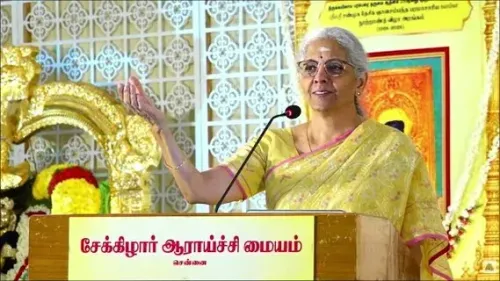
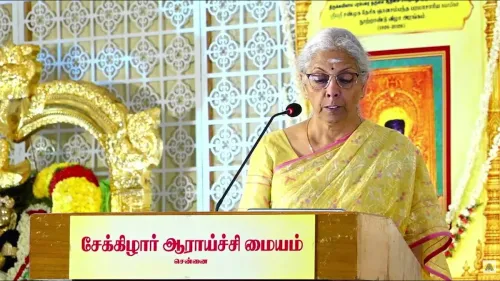
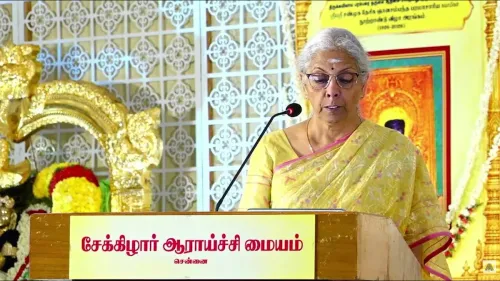
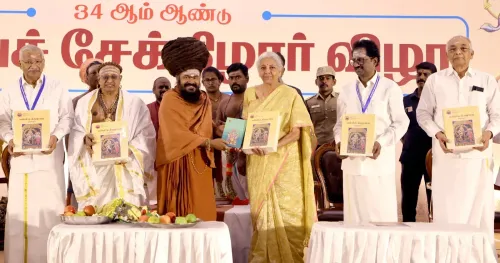
FM Sitharaman hails Saiva Thirumurais as Tamil's great equaliser
Synopsis
Union Finance Minister Nirmala Sitharaman, speaking in Chennai, praised the Saiva Thirumurais — a twelve-volume canon of Tamil Shaiva devotional poetry — for democratising Tamil literature by enabling ordinary people to understand and sing in the language, moving it beyond elite scholarly circles.
Key Takeaways
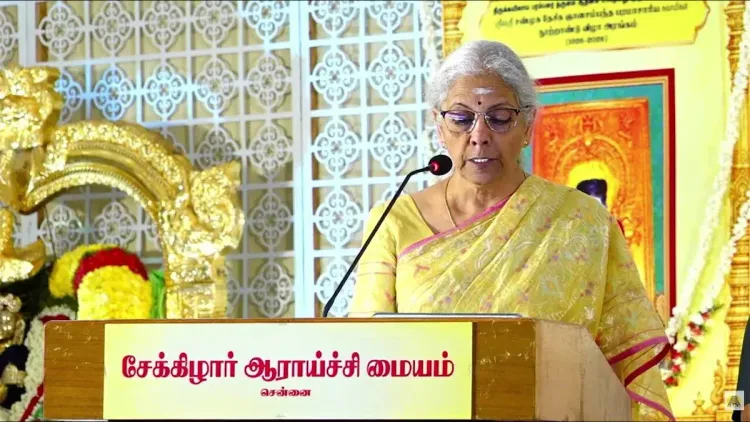
Union Finance Minister Nirmala Sitharaman praised the Saiva Thirumurais in a speech delivered in Chennai .
She described the Thirumurais as enabling ordinary people to understand and sing in Tamil at a time when literary learning was reserved for scholars.
The Saiva Thirumurais are a twelve-volume canon of Tamil Shaiva devotional poetry composed between the 7th and 11th centuries .
Tamil was notified as a classical language by the Government of India in 2004 , the first language to receive that status.
Sitharaman noted the Thirumurais contain several distinct traditions and forms of Tamil literature, underscoring their breadth beyond religious verse.
The remarks are part of a broader pattern of central government cultural engagement with Tamil Nadu's literary and heritage identity.
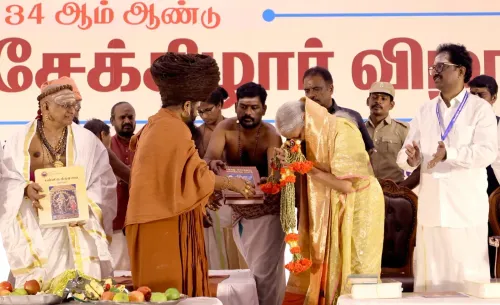
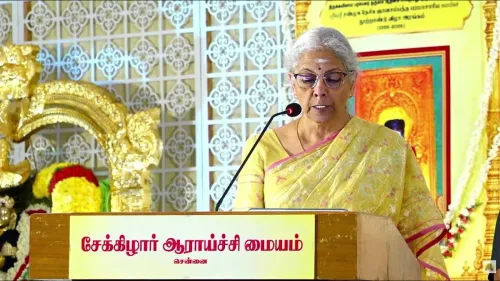
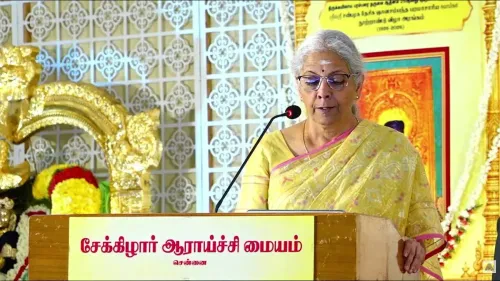
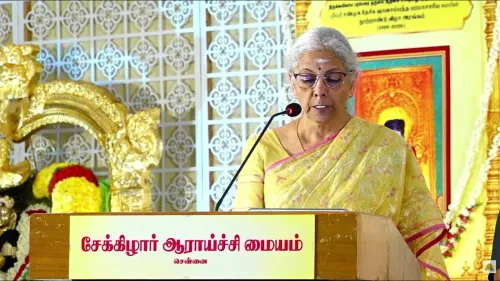
At a time when Tamil literary learning was the preserve of scholars, it was devotional poetry that threw open the doors — and Union Finance Minister Nirmala Sitharaman made exactly that point in Chennai, celebrating the Saiva Thirumurais as one of the most democratising forces in the history of Tamil literature.
What the Thirumurais did that scholarship alone could not
The Saiva Thirumurais are a twelve-volume canon of Tamil Shaiva devotional poetry composed between the 7th and 11th centuries. Sitharaman described their richness as 'truly unparalleled,' arguing that these texts did something formal scholarship never quite managed: they let ordinary people not just understand Tamil but sing in it. That distinction — between passive comprehension and active, joyful participation — is the heart of her observation.
She also noted that the Thirumurais contain within them several distinct traditions and forms of Tamil literature, making them a living anthology of the language's range, not merely a religious artefact.
Tamil as classical language — a status with policy weight
The remarks land on ground already marked by policy. Tamil was notified as a classical language by the Government of India in 2004 — the first language to receive that designation — a recognition of its antiquity, rich literary tradition, and original body of literature distinct from other languages. Successive central governments have supported documentation and study of classical Tamil works as part of intangible heritage preservation. A Union minister speaking at a Tamil literary forum in Chennai fits a pattern of cultural outreach in southern states, where the BJP has been deepening its engagement.
The democratic argument hidden inside a literary tribute
There is a quietly significant argument in Sitharaman's framing. By centering the Thirumurais' role in making Tamil accessible to common people, she is not just praising a canon — she is making a case that great literature derives its power from reach, not exclusivity. In a state where Tamil identity and language pride carry enormous political and cultural weight, that is a message calibrated to resonate well beyond a literary audience.
Whether the speech leads to concrete announcements — grants for classical language development, literary preservation projects in Tamil Nadu — remains the next thing to watch.
Point of View
More inclusive narrative. The speech fits a pattern of senior BJP leaders engaging with southern cultural pride on its own terms rather than in opposition to it. Whether this cultural goodwill translates into fresh policy commitments for Tamil heritage will be the real measure of intent.
NationPress
16 Sept 2026
Frequently Asked Questions
What are the Saiva Thirumurais?
The Saiva Thirumurais are a twelve-volume canon of Tamil Shaiva devotional poetry composed between the 7th and 11th centuries. They are central to the Shaivite religious and literary tradition in Tamil Nadu and are credited with making Tamil literature accessible to ordinary people.
What did Nirmala Sitharaman say about Tamil literature in Chennai?
Sitharaman said the richness of Tamil found in the Saiva Thirumurais is 'truly unparalleled' and that these texts enabled ordinary people to understand Tamil and sing in it at a time when literary learning was considered the exclusive domain of scholars.
When was Tamil recognised as a classical language?
Tamil was notified as a classical language by the Government of India in 2004, making it the first Indian language to receive that designation.
Why is a Union Finance Minister speaking about Tamil literature?
Senior Union ministers engaging with regional literary and cultural forums is part of the central government's broader cultural outreach, particularly in southern states. Such appearances reinforce the government's stated commitment to preserving classical language heritage.
What could follow Sitharaman's remarks on Tamil literary heritage?
Observers will watch for announcements on classical language development grants or literary preservation projects in Tamil Nadu, areas where the central government has historically provided funding support.