Sitharaman Launches Deep-Tech Fund and UPI Book at IIT Madras Event
Synopsis
Union Finance Minister Nirmala Sitharaman launched the IITM Unicorn Frontier Fund-I, a deep-tech AIF by Unicorn India Ventures and IIT Madras, and the book 'Cashless Nation: How UPI Changed Everything' at the IITMAA Sangam 2026 in Bengaluru on 26 September 2026, spotlighting India's lab-to-market and digital payments ambitions.
Key Takeaways
IITM Unicorn Frontier Fund-I launched jointly by Unicorn India Ventures and IIT Madras / IITM Research Park as an Alternative Investment Fund (AIF).
The fund targets deep-tech startups with an IP-centric approach focused on global export potential, import substitution, and sovereign technological advantage.
Its core mandate is to bridge the lab-to-market gap for the next generation of Indian deep-tech innovation.
Finance Minister Nirmala Sitharaman also launched the book 'Cashless Nation: How UPI Changed Everything' by Santanu Paul and B Sambamurthy .
The event was the IITMAA Sangam 2026 held in Bengaluru, Karnataka on 26 September 2026 .
Key attendees included IIT Madras Director Prof V Kamakoti and Unicorn India Ventures founders Anil Joshi and Bhaskar Majumdar .
A fund designed to push Indian laboratory breakthroughs into global markets, and a book chronicling how a homegrown payments system rewired the economy — Union Finance Minister Nirmala Sitharaman launched both on Saturday, 26 September 2026, at the IIT Madras Alumni Association (IITMAA) Sangam 2026 in Bengaluru, Karnataka.
The IITM Unicorn Frontier Fund-I: Lab Research Meets Venture Capital
The headline announcement was the IITM Unicorn Frontier Fund-I, an Alternative Investment Fund (AIF) launched jointly by Unicorn India Ventures (UIV) and IIT Madras / IITM Research Park. The fund is built around an IP-centric investment thesis, targeting deep-tech ventures with global export potential, strategic import substitution credentials, and what the organisers term 'sovereign technological advantage'.
Its stated mission is to close the stubborn lab-to-market gap — the graveyard of countless promising academic discoveries that never reach a production line. Mr Anil Joshi and Mr Bhaskar Majumdar, founders and managing partners of Unicorn India Ventures, were present alongside Prof V Kamakoti, Director of IIT Madras, and Prof Ashwin Mahalingam, signalling the institutional weight behind the initiative. Mr Sridhar Boovaraghavan, President of IITMAA, represented the alumni network that has increasingly become a vehicle for precisely this kind of lab-to-market push.
IIT Madras's Research Park has spent years cultivating an ecosystem where startups in semiconductors, AI, and advanced materials sit steps away from the labs that generated their core intellectual property. The new fund formalises capital flows into that ecosystem, pairing academic rigour with early-stage venture discipline.
Sitharaman in Conversation with Prof Rajeev Srinivasan
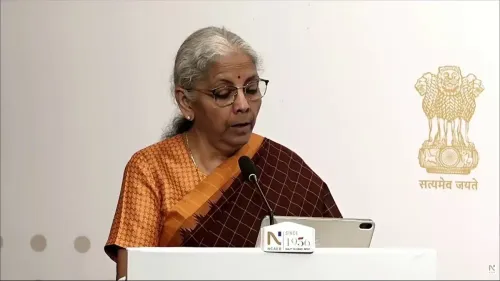
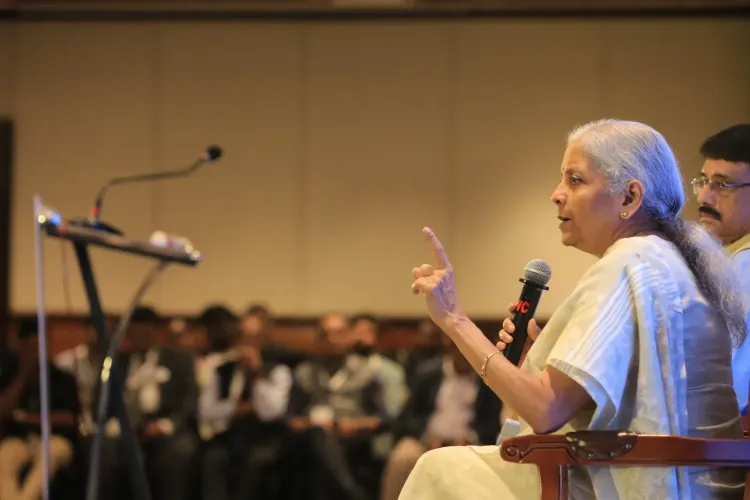
Before the launches, the Finance Minister participated in a fireside chat with Prof Rajeev Srinivasan at the Sangam 2026 gathering. The format — a candid, moderator-led conversation rather than a formal address — has become a preferred setting for senior ministers to speak directly to the innovation community without the constraints of a prepared speech. No specific transcript of remarks has been independently confirmed beyond what the post records.
'Cashless Nation': The UPI Story Gets Its Book
Sitharaman also unveiled 'Cashless Nation: How UPI Changed Everything', authored by Shri Santanu Paul and Shri B Sambamurthy. The title frames UPI not merely as a payments tool but as a civilisational inflection point — a claim the numbers make hard to argue with.
UPI, launched by the National Payments Corporation of India (NPCI) in 2016, has scaled from a pilot instrument to a global reference architecture for real-time retail payments. Several countries have now integrated or are studying its model, making the India-built stack a genuine export of governance innovation. A book examining that decade-long journey — co-authored by two figures from the fintech and financial-literacy space — arrives at a moment when India is actively pitching UPI internationalisation as a strategic priority.
Where This Fits: Atmanirbhar Bharat Meets Deep-Tech Ambition
The twin launches sit squarely inside a policy arc running from the Startup India initiative of 2016 through the Atmanirbhar Bharat programme of 2020. Both were designed to reduce import dependence and build indigenous capacity in critical sectors. What is newer is the instrument: a structured AIF that mobilises alumni networks and private venture capital around publicly funded research, rather than relying on government grants alone.
The proof will be in the first portfolio — which deep-tech bets the IITM Unicorn Frontier Fund-I makes, and how quickly those companies move from prototype to product. IIT alumni networks have capital, connections, and a track record of building; the fund gives them a formal mechanism to deploy all three at once.
India's deep-tech moment is still being written. Today in Bengaluru, it got a new chapter — and a cheque book to go with it.
Point of View
The state is now co-opting private venture capital and alumni networks to commercialise publicly funded research. For Sitharaman, lending ministerial presence to both a deep-tech AIF and a UPI retrospective in a single sitting is a deliberate signal — India's technological self-reliance story runs from foundational payments infrastructure to the next frontier of IP-driven exports. The fund's 'sovereign technological advantage' framing echoes the Atmanirbhar Bharat vocabulary but adds a global-market ambition that earlier import-substitution rhetoric often lacked. Watch whether the first close and portfolio picks live up to that framing — or reveal the usual gap between launch-day vision and deployment reality.
NationPress
26 Sept 2026
Frequently Asked Questions
What is the IITM Unicorn Frontier Fund-I?
The IITM Unicorn Frontier Fund-I is an Alternative Investment Fund (AIF) launched jointly by Unicorn India Ventures (UIV) and IIT Madras / IITM Research Park. It focuses on deep-tech startups with an IP-centric approach targeting global export potential, strategic import substitution, and sovereign technological advantage, and is designed to bridge the lab-to-market gap for Indian innovators.
What is the book 'Cashless Nation: How UPI Changed Everything' about?
'Cashless Nation: How UPI Changed Everything' is authored by Santanu Paul and B Sambamurthy and chronicles the rise of UPI — India's real-time digital payments system launched by NPCI in 2016 — and its transformation of the country's financial landscape. Finance Minister Nirmala Sitharaman launched it at IITMAA Sangam 2026 in Bengaluru.
Where was the IITMAA Sangam 2026 held?
The IITMAA Sangam 2026 was held in Bengaluru, Karnataka, and was organised by the IIT Madras Alumni Association (IITMAA).
Who are the founders of Unicorn India Ventures behind the new deep-tech fund?
Unicorn India Ventures was co-founded by Anil Joshi and Bhaskar Majumdar, who serve as founding managing partners. The firm is an early-stage venture capital outfit specialising in Indian technology startups and co-launched the IITM Unicorn Frontier Fund-I with IIT Madras.
How does the IITM Unicorn Frontier Fund connect to India's Atmanirbhar Bharat policy?
The fund's stated goals of strategic import substitution and sovereign technological advantage align directly with the Atmanirbhar Bharat programme introduced in 2020, which prioritised indigenous development of critical technologies and reducing India's dependence on foreign imports — extended here through private venture capital rather than state grants alone.