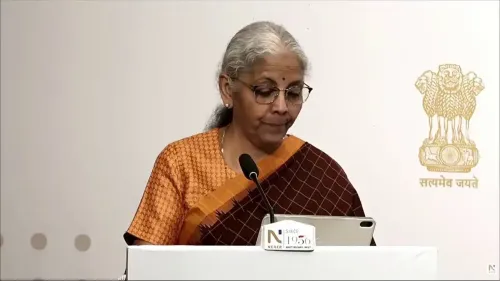
Sitharaman Targets Congress Over Decades of 'Phone Banking'

Synopsis
Finance Minister Nirmala Sitharaman attacked Congress on 30 October 2026 with a chronological list of alleged bank interference from 1957 to the UPA era, arguing the NDA revived IDBI Bank through Rs 25,000 crore recapitalisation and rule-based lending.
Key Takeaways
Nirmala Sitharaman posted a detailed Hindi thread on 30 October 2026 alleging Congress systematically pressured public sector banks to lend to politically connected entities across seven decades.
Cases cited span from the 1957 Haridas Mundhra–LIC scandal to UPA-era minister Pawan Kumar Bansal 's alleged pressure on Canara Bank .
IDBI Bank was described as 'handed over battered,' burdened by forced loans to groups including Videocon, Kingfisher, ABG Shipyard , and Winsome .
The NDA government recapitalised IDBI with over Rs 25,000 crore and says all processes in its ongoing strategic restructuring have been followed.
Sitharaman invoked the February 2024 White Paper on the Indian Economy as an official record of past financial mismanagement.
She warned Congress that its attacks on IDBI's restructuring would be exposed, drawing a direct parallel to the Rafale controversy .
From a 1957 LIC scandal to a battered IDBI Bank handed over laden with bad loans — Union Finance Minister Nirmala Sitharaman on Friday, 30 October 2026, laid out a sweeping indictment of what she called Congress's decades-long practice of treating public sector banks as private lending counters for the politically connected.
In a detailed post on X in Hindi, Sitharaman catalogued case after case stretching across seven decades, charging that @INCIndia 'used banks and financial institutions as their personal entities, pressuring bank employees to disburse loans at will while bypassing prudent lending norms.' The message was pointed and the political intent unmistakable: to frame the NDA government's banking reforms as a clean break from systemic cronyism.
Seven Decades of Alleged Influence, Named and Dated
Sitharaman opened her historical ledger in 1957, citing businessman Haridas Mundhra, who became the face of India's first major public-sector financial scandal when LIC funds were allegedly directed his way under political influence from Congress leaders. The Mundhra affair triggered one of independent India's earliest parliamentary inquiries into government interference in public finance.
She then moved to 1976, alleging that Indira Gandhi's government removed SBI Chairman R.K. Talwar after he refused to bend loan terms for a company close to Sanjay Gandhi. Next came the allegation that Sanjay Gandhi pressured Central Bank of India over loans linked to Maruti. She named B. Janardhan Poojary, Minister of State for Finance under both Indira Gandhi and Rajiv Gandhi, for allegedly pressuring bank employees to disburse loans through the 1980s.
The list extended into the UPA era: Sitharaman alleged that Pawan Kumar Bansal, a minister in the UPA government, pressured Canara Bank to lend to businesses linked to his family.
IDBI Bank: The Centrepiece of the Charge
IDBI Bank emerged as the sharpest exhibit in Sitharaman's argument. She alleged the bank was 'handed over in a battered condition' because it was forced to lend to large corporate groups with close ties to Congress leaders — naming Videocon, Winsome, ABG Shipyard, and Kingfisher as examples. Those loans turned into non-performing assets, inflicting severe losses on the institution.
The NDA government, she said, revived IDBI Bank through professional management, prudent governance, and a recapitalisation of over Rs 25,000 crore. 'IDBI Bank is now ready for the next phase of its growth,' she wrote, adding that all due processes in the bank's ongoing strategic restructuring have been followed — referencing a PIB press release issued the previous day as confirmation.
The White Paper and the Rafale Warning
Sitharaman pointed to the White Paper on the Indian Economy released in February 2024, which she described as an official catalogue of scams and economic mismanagement under previous governments, calling it 'still relevant.' The document was tabled by the NDA government and drew fierce opposition rebuttals at the time — but the Finance Minister invoked it here as settled government record.
She closed with a direct warning to Congress, drawing a parallel to the Rafale fighter jet controversy: 'Your lies on Rafale failed and were exposed. You had to apologise. The same will happen here.' The rhetorical structure was deliberate — remind the audience of a prior opposition offensive that, in the government's telling, collapsed under scrutiny.
The Era of 'Connection Banking' Is Over, Sitharaman Declares
'During the Congress era, banking had a phonebook for the powerful and a rulebook for ordinary citizens,' she wrote. That framing — kनेक्शन और सेटिंग वाली बैंकिंग ('connection-and-setting banking') — captures the government's core counter-narrative to opposition attacks on IDBI's privatisation process. Sitharaman argued that under the NDA, ordinary citizens now have easier access to credit, and bank employees no longer face phone-call pressure to approve loans.
With IDBI Bank's strategic restructuring still in progress and opposition parties yet to formally respond to this specific post, the political battle over India's public sector banking history is far from its final chapter.
Point of View
Deliberately anchoring the IDBI strategic restructuring debate in a decades-long historical narrative rather than defending current process alone. By naming individuals and specific years, she shifts the burden of response onto the opposition — a tactic that mirrors the BJP's approach during the 2024 White Paper rollout. The Rafale reference signals that the government sees this as an all-or-nothing credibility battle, not a technical banking dispute. Whether the opposition can rebut the historical specifics or redirect attention to current IDBI disinvestment terms will shape the next round of this political exchange.
NationPress
30 Oct 2026
Frequently Asked Questions
What is the IDBI Bank controversy Nirmala Sitharaman is talking about?
Sitharaman alleges that IDBI Bank was forced under Congress governments to lend to politically connected corporate groups such as Videocon and Kingfisher, creating massive bad loans. The NDA government later infused over Rs 25,000 crore to recapitalise the bank and is now pursuing a strategic restructuring.
Who was Haridas Mundhra and why is he relevant?
Haridas Mundhra was a businessman at the centre of India's first major public-sector financial scandal in 1957, when LIC funds were allegedly channelled to him under Congress political influence. Sitharaman cited this as the earliest example of Congress interference in financial institutions.
What is the White Paper on the Indian Economy 2024?
The White Paper on the Indian Economy was released by the NDA government in February 2024. It documented alleged instances of economic mismanagement, crony lending, and scams under previous Congress-led UPA governments. Sitharaman cited it as an official reference for her allegations.
What did Sitharaman say about R.K. Talwar and SBI?
Sitharaman alleged that SBI Chairman R.K. Talwar was removed in 1976 by Indira Gandhi's government after he refused to relax loan conditions for a company linked to Sanjay Gandhi, presenting it as evidence of political interference in public sector bank operations.
What is the Rafale comparison Sitharaman made?
Sitharaman warned Congress that its attacks on IDBI Bank's restructuring would fail and be exposed, just as its allegations on the Rafale fighter jet deal were — a controversy the government says the opposition had to back down from. She used it to signal confidence that the current charges will not stick.