Smriti Irani: Congress Blames EC After Blaming EVMs

Synopsis
BJP leader Smriti Irani on 4 November 2026 posted a sharp critique arguing Congress loses elections because of corrupt and weak leadership, and has shifted its blame from EVMs to the Election Commission rather than addressing internal failures.
Key Takeaways
Smriti Irani posted on 4 November 2026 accusing Congress of losing elections due to 'corrupt and weak leadership.' She noted a pattern: Congress first blamed Electronic Voting Machines (EVMs) , and has now shifted to blaming the Election Commission of India .
Congress raised EVM tampering concerns after both the 2014 and 2019 Lok Sabha defeats, with several opposition allies joining in.
The Election Commission of India is a constitutionally mandated body that has consistently rejected allegations of bias or EVM manipulation.
Irani's framing is part of a consistent BJP counter-narrative that attributes opposition losses to organisational weakness rather than institutional interference.
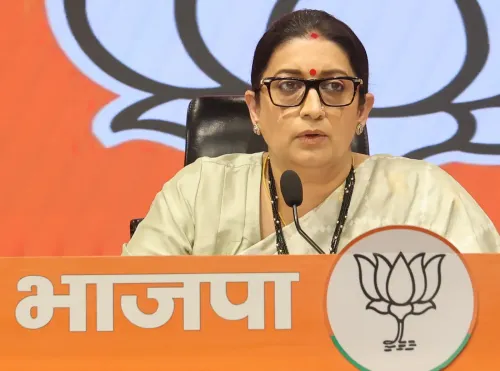
Corrupt and weak leadership — that is BJP leader Smriti Irani's blunt diagnosis for why the Indian National Congress keeps losing elections, and on Wednesday, 4 November 2026, she took that argument straight to social media with a sharp, two-line indictment of the grand old party's post-defeat playbook.
Irani's post, written in Hindi, reads: 'करप्ट और कमजोर नेतृत्व की वजह से कांग्रेस बार-बार चुनाव हारती है। पहले EVM को दोष देती थी, अब इलेक्शन कमीशन को दोष देती है।' — 'Congress loses elections repeatedly because of corrupt and weak leadership. First it used to blame EVMs, now it blames the Election Commission.'
From EVM Doubts to EC Attacks — a Familiar Congress Script
The charge Irani levels is not new, but the sequencing she highlights is pointed. After the 2014 and 2019 Lok Sabha defeats, Congress leaders and several opposition allies publicly questioned whether Electronic Voting Machines had been tampered with, demanding a return to paper ballots. Those calls never produced verifiable evidence of manipulation, but they shaped the party's public posture for years.
The pivot Irani now flags — from blaming the machine to blaming the Election Commission of India, the constitutional body that superintends all national and state polls — follows a pattern political observers have noted across multiple election cycles. When the hardware argument lost traction, attention shifted to the institution. Same outcome, different target.
Why This Attack Line Has Cut-Through for the BJP
For the BJP, framing Congress's election losses as a consequence of internal decay — rather than external interference — is a consistent counter-narrative. It reframes the conversation: instead of defending the EVM or the Election Commission, the ruling party points back at the accuser's own organisational record. Irani, as a senior leader who has sparred with Congress on multiple fronts, is a practised hand at this kind of compact, viral political communication.
The Election Commission of India, a body that derives authority directly from Article 324 of the Constitution, has consistently maintained the integrity of EVMs and rejected allegations of bias. Any formal response from the Commission or a rebuttal from Congress spokespersons would be the next marker in this exchange — particularly with state assembly election calendars still ahead.
The bigger question hanging over Indian electoral politics is not new either: at what point does repeated institutional blame-shifting become a liability for a party seeking to rebuild voter trust? Irani's two-line post is a bet that most voters have already made up their minds.
Point of View
The BJP redirects scrutiny toward Congress's own organisational record, turning a governance-accountability debate into one about the opposition's credibility. The evolution of Congress's critique — from EVM hardware to the Election Commission as institution — does carry a reputational cost for the party, as it risks normalising a posture of institutional distrust without producing actionable reform. At a broader level, the exchange reflects a deepening asymmetry in Indian politics: a ruling party confident enough in electoral institutions to defend them, and an opposition still searching for a compelling post-defeat narrative that resonates beyond its own base.
NationPress
4 Nov 2026
Frequently Asked Questions
What did Smriti Irani say about Congress and the Election Commission?
Smriti Irani posted on 4 November 2026 that Congress repeatedly loses elections due to its own corrupt and weak leadership, and has shifted from blaming EVMs to blaming the Election Commission of India.
Why did Congress blame EVMs after the 2014 and 2019 elections?
After the 2014 and 2019 Lok Sabha defeats, Congress leaders publicly raised concerns about possible EVM malfunction or tampering and, along with other opposition parties, demanded a return to paper ballots — claims the Election Commission has consistently rejected.
Is the Election Commission of India biased toward the BJP?
The Election Commission of India is a constitutional body under Article 324 and has officially and consistently denied all allegations of institutional bias or EVM manipulation; no court has upheld such allegations.
What is Smriti Irani's political role?
Smriti Irani is a senior BJP leader and former Union Minister who held portfolios including Women and Child Development and Minority Affairs; she is known for vocal criticism of the Congress party.
What is the BJP's response to Congress's Election Commission criticism?
The BJP, through leaders like Smriti Irani, argues that Congress's blame of electoral institutions is a deflection from internal organisational failures and weak leadership, and that the real reason for the losses lies within the party itself.