Smriti Irani Inaugurates Model Anganwadi in Pithapuram, AP
Synopsis
BJP leader Smriti Irani inaugurated Apollo Aarambh, a model Anganwadi in Pithapuram, Andhra Pradesh, jointly built by Apollo Foundation and the state government. She highlighted India's 13 crore under-six children, called Anganwadi and ASHA workers 'real heroes,' and urged communities to adopt Tithi Bhojan, linking early childhood investment to the Viksit Bharat 2047 vision.
Key Takeaways
Apollo Aarambh was inaugurated in Pithapuram, Andhra Pradesh on 21 November 2026 by BJP leader Smriti Irani .
The centre is a joint initiative of the Apollo Foundation and Andhra Pradesh's Women Development and Child Welfare Department , designed to serve 20 children .
India has nearly 13 crore children below the age of six , whose health and early learning are framed as central to Viksit Bharat 2047 .
Irani called on communities to adopt Tithi Bhojan — using birthdays, weddings and festivals to provide fruits and nutrition to children and mothers at Anganwadi centres.
Anganwadi and ASHA workers were publicly recognised as 'the real heroes' of India's child nutrition mission.
The centre's 18-month preparation period for 20 beneficiaries was cited as evidence that quality of commitment matters more than volume of reach.
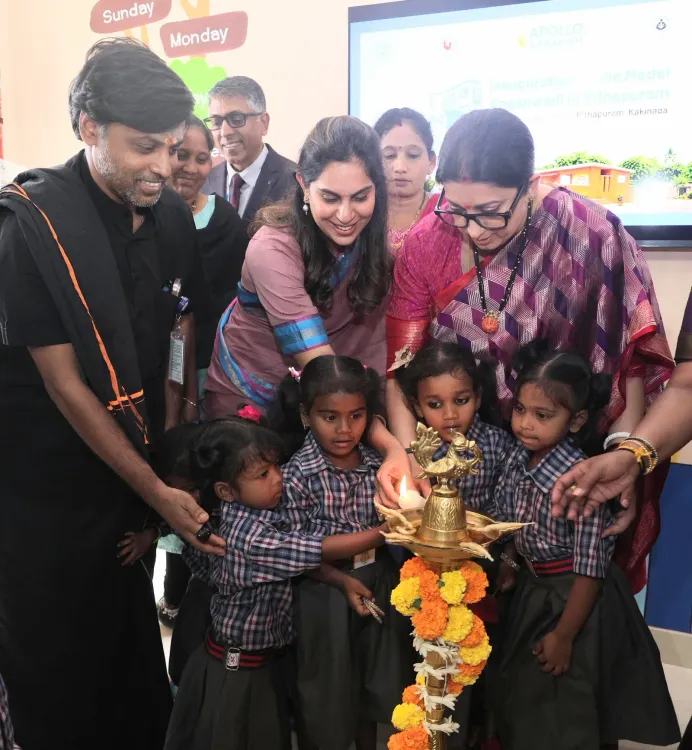
Every great national ambition is ultimately built on the smallest shoulders — and on Saturday, 21 November 2026, BJP leader and former Union Minister Smriti Irani made that case concrete, inaugurating Apollo Aarambh, a model Anganwadi centre in Pithapuram, Andhra Pradesh, built through a partnership between the Apollo Foundation and the state's Women Development and Child Welfare Department.
What Apollo Aarambh Is — and Why It Took 18 Months for 20 Children
The centre is a joint initiative of the philanthropic arm of the Apollo Hospitals Group and the Government of Andhra Pradesh, designed as a replicable model for early childhood care. What Irani highlighted most pointedly was the scale of effort behind it: nearly one and a half years of preparation to create a nurturing environment for just 20 children. Her argument was deliberate — that genuine development is measured not by the volume of beneficiaries, but by the depth of commitment to each one. That is a direct challenge to the headcount logic that has long dominated welfare programme metrics.
India's 13 Crore Under-Six Children and the Anganwadi Backbone
India is home to nearly 13 crore children below the age of six — a demographic whose health, nutrition and early learning outcomes will define the country's human capital for the next generation. The Integrated Child Development Services (ICDS), launched in 1975, remains the principal architecture for reaching them, delivering nutrition, health checks and pre-school education through a national network of Anganwadi centres. The POSHAN Abhiyaan, launched in 2018, layered additional nutritional targets on top of that framework, with a focus on children, adolescent girls and pregnant women.
Irani used the inauguration to spotlight the workers who keep that architecture alive — Anganwadi and ASHA workers, supervisors and grassroots functionaries — calling them 'the real heroes of this mission.' Their work is chronically invisible in policy headlines; naming them from a public platform carries its own signal.
Tithi Bhojan: Turning Celebrations Into Community Nutrition
Pithapuram, a town and assembly constituency in East Godavari district, became the setting for Irani's call to revive a community participation model: Tithi Bhojan. The concept — promoted since the mid-2010s — invites families to mark birthdays, weddings and festivals by donating fruits and nutritional support to children and mothers at Anganwadi centres, converting personal celebrations into collective nourishment. It is a low-cost, high-ownership mechanism designed to supplement government provision without replacing it.
Irani closed with the phrase 'Sabka Saath, Sabka Vikas' (Together with all, development for all), appending a third clause: 'Sabka Prayas' — everyone's effort. The addition is not incidental; it repositions community participation as a constitutional obligation of citizenship, not optional generosity.
Public-Private Models and the Road to Viksit Bharat 2047
The Apollo Aarambh centre fits a broader pattern in which public-private partnerships are used to demonstrate upgraded Anganwadi service standards before potential state-level scale-up. Viksit Bharat 2047 — the Government of India's vision for a fully developed nation by the centenary of independence — increasingly frames early childhood investment as a non-negotiable input to long-term economic resilience. Whether Andhra Pradesh expands the model Anganwadi template, and whether upcoming state or union budgets allocate fresh capital to early childhood infrastructure, will determine how far this inauguration day moment travels beyond Pithapuram.
The children in that room on Saturday are six years old or younger. By 2047, they will be in the workforce. The investment made now is the wager India is placing on its own future.
Point of View
Irani reframes human capital investment as a quality-first, not quantity-first, mandate — a subtle critique of how welfare outcomes have historically been measured. The emphasis on Tithi Bhojan and community co-ownership also signals a continued push to reduce the state's sole accountability for nutrition outcomes, distributing responsibility to civil society. Spotlighting Anganwadi and ASHA workers by name is politically meaningful ahead of any budget cycle, as their wage and recognition demands remain a recurring pressure point. The public-private model demonstrated here will be watched as a potential template for state-level replication across Andhra Pradesh and beyond.
NationPress
21 Nov 2026
Frequently Asked Questions
What is Apollo Aarambh and where is it located?
Apollo Aarambh is a model Anganwadi centre inaugurated in Pithapuram, East Godavari district, Andhra Pradesh. It is a joint initiative of the Apollo Foundation and the Andhra Pradesh Women Development and Child Welfare Department, designed to provide early childhood care, nutrition and learning support.
What is Tithi Bhojan and how does it work?
Tithi Bhojan is a community participation model that encourages families to mark personal celebrations — birthdays, weddings, festivals — by donating fruits and nutritional food to children and mothers at Anganwadi centres. It supplements government nutrition programmes through voluntary community contributions.
How many children below six years old are there in India?
According to figures cited by Smriti Irani at the inauguration, India is home to nearly 13 crore children below the age of six.
What is Viksit Bharat 2047?
Viksit Bharat 2047 is the Government of India's vision to transform India into a fully developed, resilient and prosperous nation by 2047, the centenary of independence. Early childhood development and human capital formation are central pillars of this framework.
What is the role of Anganwadi workers in India's child welfare system?
Anganwadi workers are frontline functionaries under the Integrated Child Development Services, launched in 1975. They deliver nutrition supplements, health check-ups and pre-school education at community-level Anganwadi centres, reaching children under six, pregnant women and lactating mothers across India.