Smriti Irani Champions India's Traders as Manufacturing Backbone
Synopsis
BJP leader Smriti Irani on August 12, 2026, placed the Indian trader at the heart of India's manufacturing ambitions, invoking a 'Chip to Ship' and 'Tubelight to Satellite' vision to argue that retail and trade are the true pivot of the country's industrial rise.
Key Takeaways
BJP leader Smriti Irani posted on X on August 12, 2026 , declaring the Indian trader the 'centre point' of India's manufacturing retail ecosystem.
Her post invoked two paired phrases — 'Chip to Ship' and 'Tubelight to Satellite' — to capture the full range of India's manufacturing ambitions.
The framing aligns with the Make in India initiative launched in September 2014 , which has targeted sectors from electronics to shipbuilding and space.
India's trading and MSME community forms the critical last-mile distribution layer across all manufacturing supply chains.
The statement carries political weight as traders have historically been both key BJP constituents and vocal critics of policy disruptions.
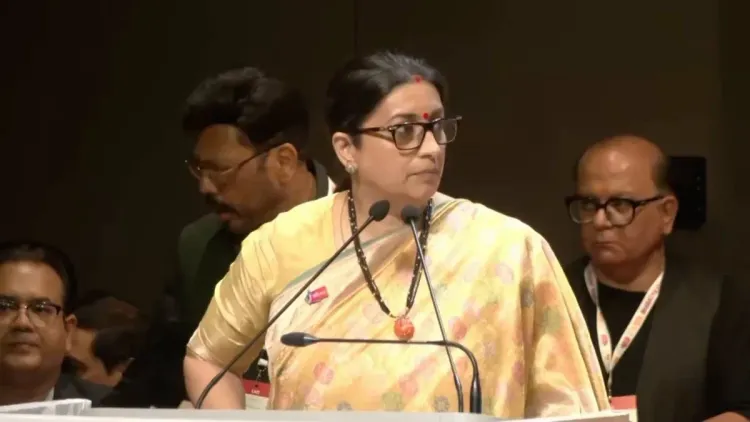
From semiconductors to shipyards, from the humble tubelight to satellites orbiting the earth — BJP leader Smriti Irani has drawn a sweeping arc of India's manufacturing ambition, placing the Indian trader at its very centre. In a post on X on Wednesday, August 12, 2026, the former Union Minister of Women and Child Development invoked the full spectrum of the country's industrial imagination to make one pointed argument: none of it works without the trader.
Irani wrote, 'चाहे Chip से Ship की कल्पना हो या Tubelight से Satellite की कल्पना... भारत के Manufacturing retail का केंद्र बिंदु, भारत का व्यापारी है।' — translated: 'Whether it is the vision from Chip to Ship or from Tubelight to Satellite... the pivot of India's manufacturing retail is the Indian trader.'
Chip to Ship, Tubelight to Satellite — What the Phrase Captures
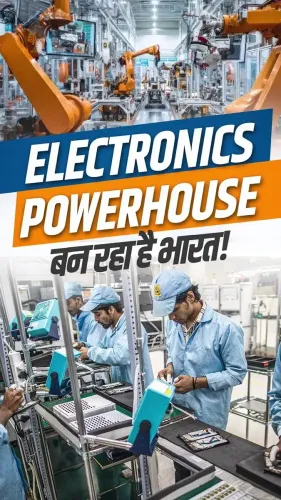
The paired imagery is deliberate and pointed. 'Chip to Ship' spans the two ends of India's most ambitious manufacturing push — semiconductors, which the country is racing to produce domestically, and shipbuilding, a sector the government has flagged as a strategic priority. 'Tubelight to Satellite' covers the everyday consumer goods market at one end and India's fast-expanding space economy at the other. Together, the phrases compress the entire logic of the Make in India initiative — launched in September 2014 — into a single rhetorical breath. The initiative has sought to pull India up the global manufacturing value chain, targeting sectors from electronics and defence to aerospace and green energy. Across all of them, the distribution and retail layer — dominated by small and medium traders — remains the connective tissue between factory floor and end consumer.Why the Trader Sits at the Centre of This Argument
Irani's framing is a pointed political and economic claim: that India's manufacturing story cannot be told through production data alone. The country's trading community — spanning millions of MSMEs, wholesale distributors, and retail entrepreneurs — forms the last mile of every supply chain, from a chip assembled in a fab unit to a satellite component sourced from a domestic vendor. Indian policy has repeatedly acknowledged this link, with schemes targeting MSME credit access, GST simplification, and logistics infrastructure. Yet traders have also been among the most vocal critics of policy disruptions over the past decade, making Irani's explicit elevation of the trader's role a notable gesture of political solidarity as much as an economic observation. If the coming budget cycle or a fresh manufacturing policy statement follows this signal, the trader community will be watching for specifics — on credit, on compliance costs, and on how India's high-technology ambitions translate into real demand for the businesses that move goods from production to people.Point of View
A group that has been both a bedrock of BJP support and a source of friction over GST and demonetisation. By anchoring high-technology ambitions like chip fabrication and satellite manufacturing to the figure of the trader, she is making an inclusive argument: that India's industrial rise must be felt in the retail lane, not just the production hall. This fits a broader BJP pattern of framing macro-economic policy through the lens of small-business identity. The timing, ahead of a potential budget or policy cycle, suggests this rhetoric may be laying the ground for trader-focused announcements.
NationPress
26 Sept 2026
Frequently Asked Questions
What did Smriti Irani say about Indian traders and manufacturing?
Smriti Irani stated on August 12, 2026, that the Indian trader is the central pivot of India's manufacturing retail, whether the vision is 'Chip to Ship' or 'Tubelight to Satellite.'
What does 'Chip to Ship' mean in India's manufacturing context?
'Chip to Ship' refers to India's ambition to manufacture across the full industrial spectrum — from semiconductors (chips) to large vessels (ships) — both of which are priority sectors under Make in India.
What is the Make in India initiative?
Make in India is a government initiative launched in September 2014 to boost domestic manufacturing, attract investment, and integrate India into global supply chains across sectors including electronics, defence, and aerospace.
Why are Indian traders important to the manufacturing sector?
Indian traders and MSMEs form the last-mile distribution network for manufactured goods, connecting factory output to end consumers across the country's vast and fragmented retail market.
Is Smriti Irani currently a Union Minister?
Smriti Irani is a senior BJP leader and former Union Minister who held portfolios including Women and Child Development and Minority Affairs; her current ministerial status as of August 2026 is not confirmed in available data.