CM Uttarakhand: Solar Self-Employment Thrives in Bageshwar
Synopsis
The Chief Minister's Office of Uttarakhand on 23 June 2026 highlighted solar energy-based self-employment flourishing in Bageshwar district, positioning off-grid solar enterprise as a livelihood model for remote Himalayan communities and rural youth facing limited formal employment options.
Key Takeaways
The Chief Minister's Office of Uttarakhand on 23 June 2026 spotlighted solar energy-based self-employment in the state.
Bageshwar district in the Kumaon division has been a focal site for off-grid solar pilots linked to household-level enterprises.
India's Jawaharlal Nehru National Solar Mission , launched in 2010 , underpins the national policy framework enabling such state-level initiatives.
Solar self-employment targets rural youth and hill entrepreneurs , offering income without requiring migration to urban centres.
Uttarakhand's approach mirrors similar solar-livelihood models in Himachal Pradesh and north-eastern states .
District-level employment data and possible replication in other Uttarakhand blocks are expected to emerge in the next state budget cycle.
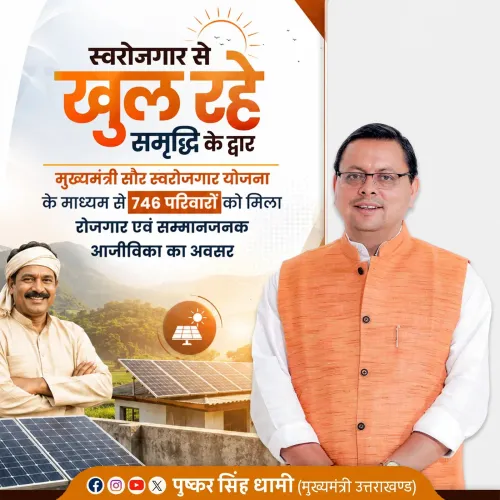
The Chief Minister's Office of Uttarakhand on Tuesday, 23 June 2026 highlighted the growing success of solar energy-based self-employment in the hill state, drawing specific attention to Bageshwar district as a model for renewable-powered micro-enterprise in remote Himalayan communities.
The post, shared in Hindi, reads: 'Uttarakhand mein phal phool raha hai saur urja aadharit swarozgar' — 'Solar energy-based self-employment is flourishing in Uttarakhand' — with Bageshwar and Uttarakhand tagged as focal locations.
Context
Bageshwar, a high-altitude district in the Kumaon division of Uttarakhand, has been among the early sites for off-grid solar pilots aimed at powering household-level enterprises. The district's difficult terrain makes conventional grid extension costly, making decentralised solar solutions especially practical for local livelihoods.
The state government's emphasis on swarozgar (self-employment) through solar energy connects energy access directly to income generation, rather than treating electrification as a standalone infrastructure goal.
Policy Backdrop
India's push for solar-linked employment has roots in the Jawaharlal Nehru National Solar Mission, launched in 2010, which promoted both grid-connected and off-grid solar deployment across the country. The mission created downstream demand for local installation, maintenance, and manufacturing workers, particularly in states with dispersed rural populations.
Uttarakhand, long dependent on hydropower for its energy identity, has increasingly paired central renewable targets with state-level skill and enterprise schemes. This mirrors approaches taken in Himachal Pradesh and several north-eastern states, where solar deployment has been explicitly linked to micro-enterprise creation to reduce dependence on diesel generators and expensive grid extension into remote areas.
Stakeholders and Impact
The primary beneficiaries of solar self-employment programmes in hill districts are rural youth and hill entrepreneurs — groups that have historically faced limited formal employment options and significant out-migration pressures. Solar-linked livelihoods, ranging from panel installation and maintenance to solar-powered agro-processing and cold storage, offer income opportunities without requiring relocation to urban centres.
For Bageshwar specifically, off-grid solar enterprise also addresses energy poverty in habitations where last-mile grid connectivity remains economically unviable, creating a dual benefit of electrification and income generation within the same intervention.
What's Next
Attention will now turn to district-level employment data that could quantify the scale of solar self-employment gains in Bageshwar and similar blocks across Uttarakhand. The state's next budget cycle may see proposals to replicate the Bageshwar model in other high-altitude districts where terrain and solar irradiance conditions are comparable.
If the Uttarakhand government formalises this as a replicable framework, it could inform renewable-linked livelihood policy in other Himalayan states navigating the twin challenges of energy access and rural employment retention.
Point of View
A relatively remote Kumaon district, suggests the government is keen to demonstrate that the gains of the green transition are reaching the state's most difficult terrain, not just urban or peri-urban areas. This fits a broader pattern across BJP-governed hill states of positioning environmental policy as compatible with — and even generative of — rural employment, countering the narrative that climate commitments come at the cost of local livelihoods. The proof of impact will depend on granular employment data that the state has yet to publish publicly.
NationPress
22 Sept 2026
Frequently Asked Questions
What is solar energy-based self-employment in Uttarakhand?
Solar energy-based self-employment in Uttarakhand refers to income-generating activities powered by or linked to solar installations, including panel installation, maintenance, solar-powered agro-processing, and small enterprises in remote hill districts like Bageshwar where grid connectivity is limited.
Why is Bageshwar district highlighted for solar self-employment?
Bageshwar is a high-altitude district in Uttarakhand's Kumaon division where off-grid solar pilots have been implemented. Its difficult terrain makes conventional grid extension expensive, making decentralised solar solutions both practical and economically attractive for local livelihoods.
What is the Jawaharlal Nehru National Solar Mission?
The Jawaharlal Nehru National Solar Mission is a central government programme launched in 2010 to scale solar energy capacity across India, promoting both grid-connected and off-grid solutions and creating employment in installation, maintenance, and manufacturing.
How does solar self-employment help rural youth in Uttarakhand?
Solar self-employment provides income opportunities in remote areas without requiring migration to cities. Young people in hill districts can work in solar installation, maintenance, and solar-powered enterprises, addressing the longstanding problem of out-migration from Uttarakhand's rural communities.
Which other states have similar solar livelihood models?
Himachal Pradesh and several north-eastern states have adopted comparable approaches, pairing solar deployment with micro-enterprise creation to reduce diesel dependence and generate local income in areas where extending the conventional electricity grid is costly.