Sonowal: ₹70,000 Cr Shipbuilding Push to Put India in Top 5
Synopsis
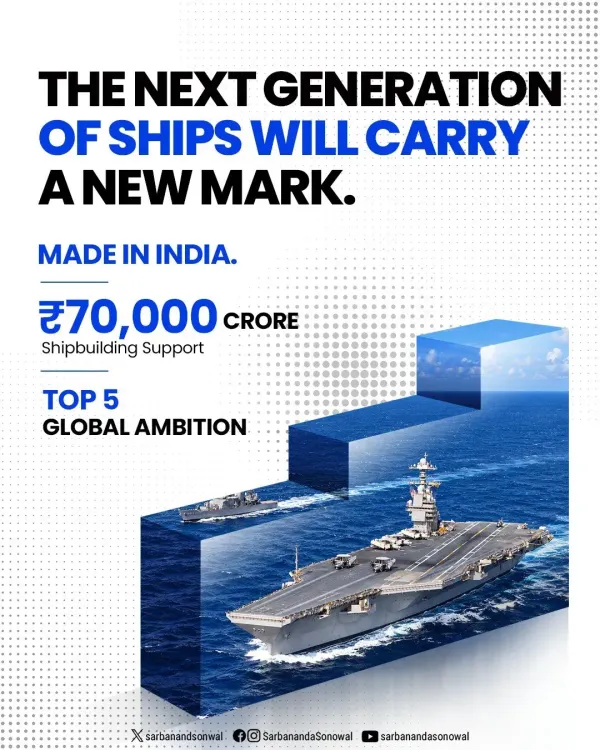
Union Minister Sarbananda Sonowal on 19 October 2026 announced a ₹70,000 crore shipbuilding support package under PM Modi's Atmanirbhar Bharat vision, targeting a top-five global ranking and ensuring new vessels carry the 'Made in India' mark.
Key Takeaways
₹70,000 crore shipbuilding support package announced by Union Minister Sarbananda Sonowal on 19 October 2026 .
India's stated goal is to break into the top five global shipbuilding nations, currently dominated by China, South Korea and Japan.
All vessels built under the scheme are to carry a 'Made in India' mark, aligning with Atmanirbhar Bharat.
The announcement builds on the Sagarmala Project (2015) , Maritime India Vision 2030 (2021) , and the Shipbuilding Financial Assistance Policy (2021) .
Disbursement mechanism and eligibility criteria for the package are yet to be detailed in a formal notification.
A thriving domestic shipbuilding sector also strengthens India's naval defence procurement pipeline.
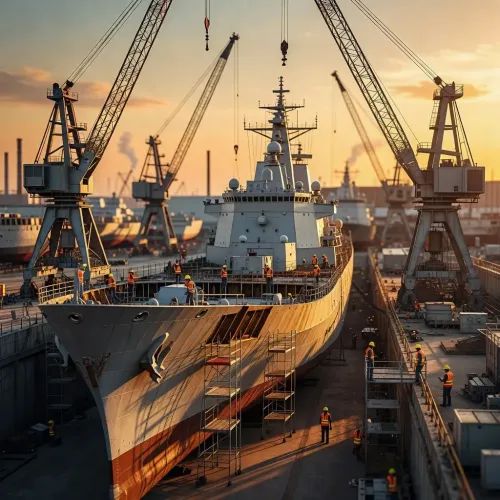
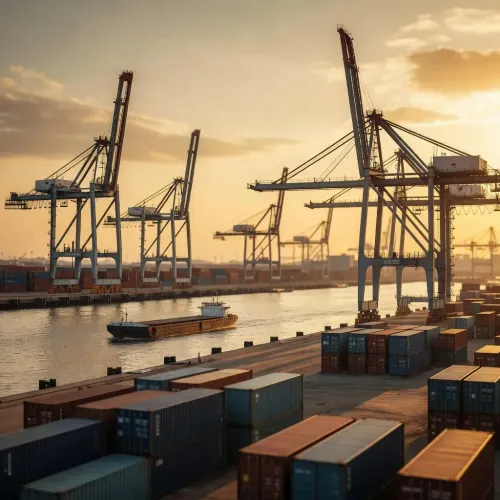
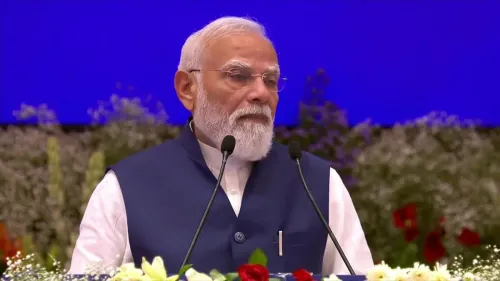
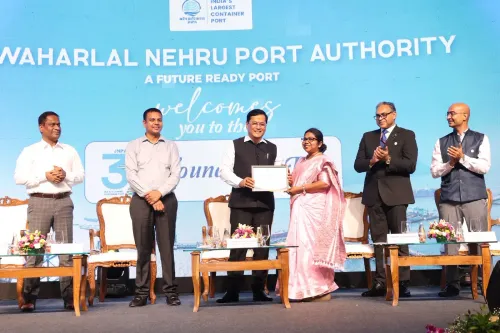
India's shipbuilding sector is getting one of its biggest financial injections yet — and Union Minister of Ports, Shipping and Waterways Sarbananda Sonowal wants the world to take note. On Monday, 19 October 2026, the minister announced a ₹70,000 crore shipbuilding support package aimed squarely at vaulting India into the top five global shipbuilding nations, with every vessel built under the scheme set to carry a 'Made in India' mark.
₹70,000 Crore and a Global League Table to Climb
The scale of the announced support is striking. Sonowal framed it as the financial muscle behind India's 'Top 5 global ambition' — a phrase that signals intent to compete directly with dominant shipbuilding powers such as China, South Korea, and Japan, which together account for the overwhelming majority of the world's commercial tonnage. The emphasis on 'the next generation of ships' suggests the support is designed not merely to prop up existing yards but to catalyse a step-change in domestic capability.
The minister tied the announcement explicitly to Prime Minister Narendra Modi's Atmanirbhar Bharat vision, describing the initiative as India 'charting a bold new course towards self-reliance in the global maritime sector.' The framing is deliberate: shipbuilding sits at the intersection of manufacturing, defence, and trade — making it a strategic prize, not just an industrial policy line item.
Policy Runway: From Sagarmala to Maritime India Vision 2030
Monday's announcement does not arrive in a vacuum. India's push to build ships at home has been gathering policy momentum for over a decade. The Sagarmala Project, launched in 2015, placed domestic shipbuilding at the centre of port-led development, linking coastal infrastructure upgrades with incentives for Indian yards. Six years later, the Maritime India Vision 2030 — unveiled in 2021 — set hard targets for maritime infrastructure capacity and explicitly called for growing India's share of global shipbuilding orders.
A Shipbuilding Financial Assistance Policy, also extended in 2021, provided interest subsidies to domestic yards, acknowledging that Indian builders faced a structural cost disadvantage against heavily subsidised Asian rivals. The ₹70,000 crore package Sonowal announced appears to be the most ambitious escalation of that support architecture to date — though the disbursement mechanism and eligibility criteria are yet to be detailed in a formal policy notification.
Why the 'Made in India' Ship Matters Beyond the Shipyard
Every large vessel India builds domestically displaces a foreign-currency order — typically placed with yards in China, South Korea, or Japan. At current global freight-vessel prices, shifting even a fraction of India's fleet-renewal pipeline to domestic production represents billions of dollars in retained value and tens of thousands of skilled manufacturing jobs. Defence procurement adds another layer: the Indian Navy's surface fleet expansion requires hulls, and a robust commercial yard ecosystem shortens the build-time and cost curve for warships too.
Indian shipbuilders, who currently hold a fraction of a percent of global order books, have long argued that sustained government support — not episodic injections — is what separates ambition from output. Whether the ₹70,000 crore commitment delivers on that consistency will be the real test when the scheme's fine print emerges.
India has the policy pedigree, the coastline, and now — if the numbers hold — the financial firepower. The question is whether this package turns a long-held ambition into a berth on the global order book.
Point of View
000 crore shipbuilding package represents the most financially ambitious escalation in India's decades-old effort to compete in global maritime manufacturing — a sector it has consistently aspired to but never meaningfully penetrated. By anchoring it to the Atmanirbhar Bharat narrative, the Modi government is attempting to convert a strategic vulnerability — near-total dependence on foreign yards — into a flagship industrial policy win ahead of what is likely to be an election-season policy showcase. The announcement also carries a defence-industrial logic that rarely gets articulated openly: commercial shipbuilding capacity is dual-use, and a stronger yard ecosystem reduces the Navy's build-time and cost exposure. Investors and industry will, however, watch closely for the disbursement architecture — past schemes have suffered from slow subsidy release, and the gap between announced quantum and actual utilisation has been India's recurring shipbuilding story.
NationPress
19 Oct 2026
Frequently Asked Questions
What is the ₹70,000 crore shipbuilding support announced by Sonowal?
Union Minister Sarbananda Sonowal announced a ₹70,000 crore financial support package on 19 October 2026 to boost domestic shipbuilding in India, aimed at placing India among the top five shipbuilding nations globally and ensuring new vessels carry a 'Made in India' mark.
What is India's current rank in global shipbuilding?
India currently holds a very small share of global shipbuilding order books, well outside the top five. The dominant players are China, South Korea and Japan, which together account for the vast majority of the world's commercial tonnage.
What is the Sagarmala Project and how does it relate to shipbuilding?
The Sagarmala Project, launched in 2015, is a port-led development initiative that placed domestic shipbuilding at its core, linking coastal infrastructure upgrades with incentives for Indian shipyards to grow their capacity and competitiveness.
What is Maritime India Vision 2030?
Maritime India Vision 2030 is a roadmap unveiled in 2021 that sets targets for India's ports, shipping and shipbuilding sectors, including capacity expansion and capturing a larger share of global shipbuilding orders.
How does India's shipbuilding push connect to Atmanirbhar Bharat?
Shipbuilding is central to Atmanirbhar Bharat because India currently depends heavily on foreign yards — primarily in Asia — for commercial and defence vessels. Building ships domestically retains foreign-currency value, creates skilled jobs and strengthens naval procurement self-sufficiency.