Sonowal: Cabinet clears VISTAR scheme to overhaul India's stats
Synopsis
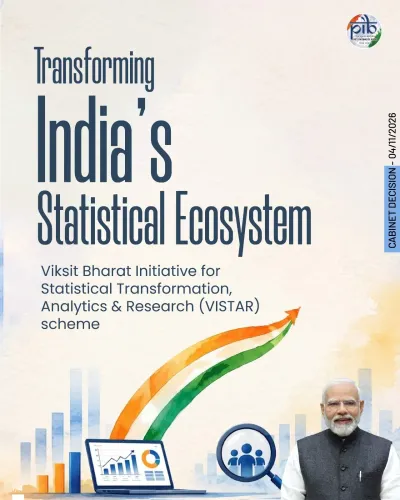
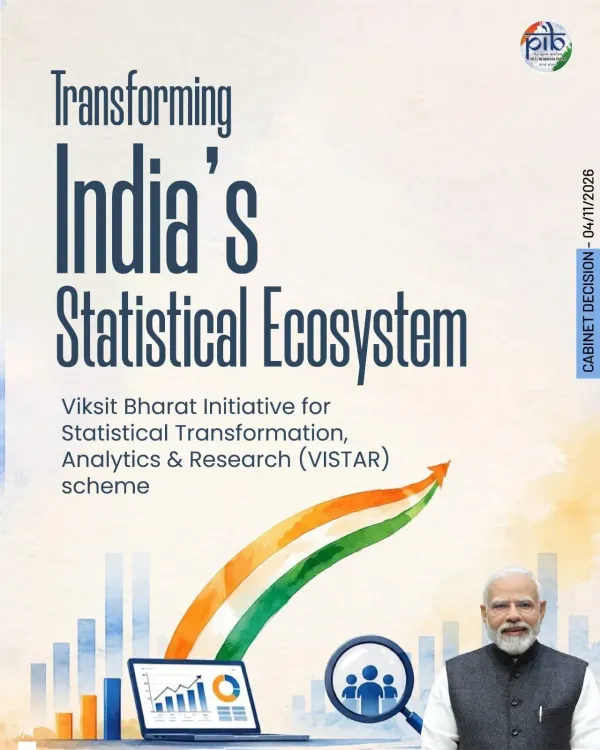
The Union Cabinet approved the VISTAR scheme on 4 November 2026, committing India to a five-year overhaul of its official statistical ecosystem from 2026–27 to 2030–31 under the broader Viksit Bharat framework.
Key Takeaways
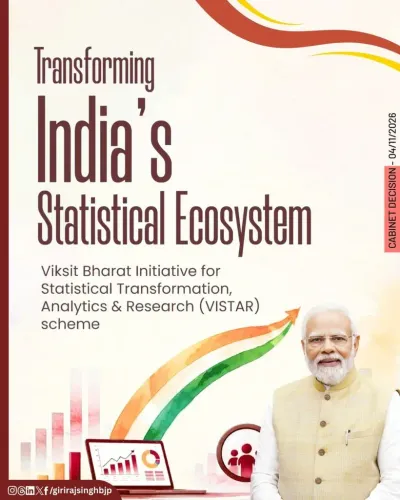
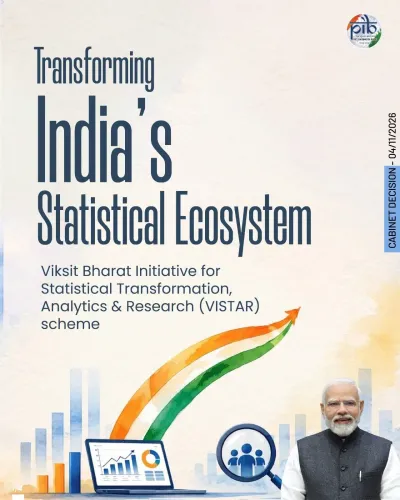
VISTAR stands for Viksit Bharat Initiative for Statistical Transformation, Analytics and Research.
The scheme was approved by the Union Cabinet chaired by PM Narendra Modi on 4 November 2026 .
It covers a five-year period from 2026–27 to 2030–31 .
The goal is to modernise India's official statistical ecosystem — improving timeliness, granularity, and analytical capacity.
The initiative is aligned with the Viksit Bharat vision of a developed India by 2047 .
Detailed budget outlays, agency roles, and implementation guidelines are yet to be formally released.
India's official data machinery is getting a five-year overhaul. The Union Cabinet, chaired by Prime Minister Narendra Modi, on Wednesday, 4 November 2026, approved the Viksit Bharat Initiative for Statistical Transformation, Analytics and Research (VISTAR) scheme, a dedicated programme to modernise the country's official statistical ecosystem running from 2026–27 to 2030–31. Union Minister Sarbananda Sonowal announced the decision on X, flagging it as a Cabinet highlight.
What VISTAR is built to do
The VISTAR scheme is framed squarely within the Viksit Bharat vision — the government's blueprint for a fully developed India by 2047. The logic is straightforward: you cannot govern your way to a developed economy on unreliable data. VISTAR is designed to address exactly that gap — improving the timeliness, granularity, and analytical horsepower of India's official statistics, which span everything from GDP estimates and agricultural surveys to employment tracking and social indicators.
The scheme spans five financial years, giving statistical institutions a stable, medium-term runway to build systems, recruit analysts, and roll out digital infrastructure rather than lurching from annual budget cycle to annual budget cycle. That continuity is itself a signal: the government is treating statistical reform as a structural priority, not a one-off upgrade.
India's long road to credible official data
India's statistical architecture — anchored by the National Statistical Office (NSO) and the Ministry of Statistics and Programme Implementation (MoSPI) — has faced persistent questions over methodology, survey frequency, and lag times in key indicators. Successive administrations have attempted incremental upgrades, but a dedicated, Cabinet-approved scheme with a named five-year horizon marks a sharper institutional commitment. If VISTAR delivers, policymakers, economists, and investors get better numbers to work with. That is a compounding dividend — better data means better policy design, sharper welfare targeting, and more credible growth forecasting.
What to watch as VISTAR takes shape
The Cabinet approval is the starting gun, not the finish line. The critical details — total budget outlay, the specific agencies involved, the institutional framework for implementation, and the measurable targets — are still to emerge once formal guidelines are released ahead of the 2026–27 start. Analysts and data-governance watchers will be scrutinising whether VISTAR addresses the structural bottlenecks in India's survey systems or stays confined to tech-layer upgrades. The scheme's name drops 'analytics and research' alongside transformation — suggesting ambitions beyond mere data collection toward genuine analytical capacity inside the government.
India is trying to build a developed-nation data system before it finishes building the developed nation itself. VISTAR is the bet that getting the numbers right now will make the rest of the journey measurably shorter.
Point of View
Not just a technical housekeeping matter. By packaging the reform as a named, Cabinet-cleared scheme with a five-year horizon, the government is elevating data quality to a Viksit Bharat deliverable — implying it will be tracked and held accountable alongside physical infrastructure targets. The move also signals awareness that as India pushes for higher foreign investment and global economic credibility, the reliability of its macro data is itself a sovereign asset. The real test, however, will be whether VISTAR produces measurable improvements in survey turnaround times and indicator coverage, or remains a rebranding exercise for incremental upgrades.
NationPress
4 Nov 2026
Frequently Asked Questions
What is the VISTAR scheme approved by the Cabinet?
VISTAR — Viksit Bharat Initiative for Statistical Transformation, Analytics and Research — is a government scheme approved on 4 November 2026 to modernise India's official statistical ecosystem. It runs from 2026–27 to 2030–31.
What does VISTAR stand for?
VISTAR stands for Viksit Bharat Initiative for Statistical Transformation, Analytics and Research.
How long will the VISTAR scheme run?
The VISTAR scheme covers five financial years, from 2026–27 to 2030–31.
Why did the government launch the VISTAR scheme?
The scheme aims to improve the timeliness, granularity, and analytical capacity of India's official statistics as part of the broader Viksit Bharat goal of building a developed India by 2047, where reliable data underpins evidence-based policy.
Who approved the VISTAR scheme?
The Union Cabinet, chaired by Prime Minister Narendra Modi, approved the VISTAR scheme on 4 November 2026.