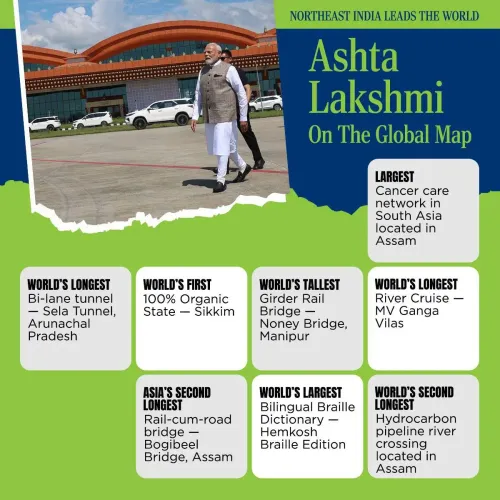
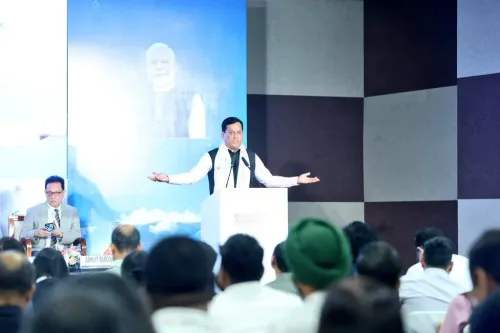
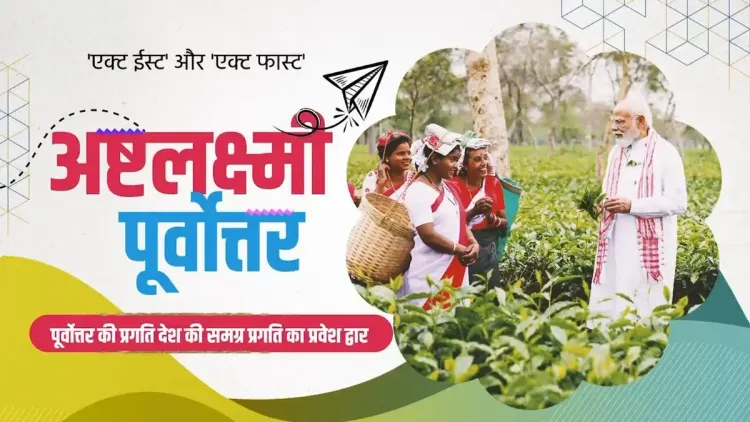
Sonowal hails Northeast as India's Ashtalakshmi after 12 years of Modi rule
Synopsis
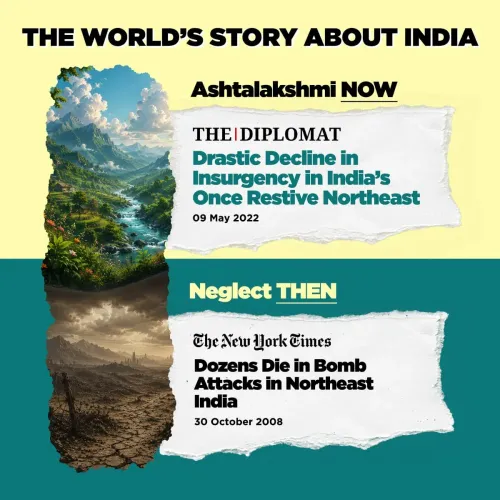
Union Minister Sarbananda Sonowal has hailed Northeast India as the nation's 'Ashtalakshmi' on the 12-year mark of PM Narendra Modi's government, citing the region's shift from neglect to prosperity and its role as a strategic gateway to Southeast Asia.
Key Takeaways
Union Minister Sarbananda Sonowal posted on 20 June 2026 calling Northeast India the 'Ashtalakshmi' of national growth.
The post marks 12 years of the Modi government and its focus on Northeast transformation under the hashtag #12YearsOfRisingNorthEast .
The Act East Policy , launched at the 2014 India-ASEAN Summit , underpins the strategic framing of the Northeast as a gateway to Southeast Asia .
Key connectivity projects include the Kaladan Multimodal Transit Transport Project and the India-Myanmar-Thailand Trilateral Highway .
The Northeast comprises eight states — Arunachal Pradesh, Assam, Manipur, Meghalaya, Mizoram, Nagaland, Sikkim and Tripura — with a combined population of roughly 45 million .
Progress on stalled corridor projects and fresh ASEAN-linked budgetary outlays will be the key metrics to watch going forward.
Union Minister of Ports, Shipping and Waterways Sarbananda Sonowal on Saturday, 20 June 2026 invoked the cultural metaphor of 'Ashtalakshmi' to describe Northeast India's transformation under Prime Minister Narendra Modi, calling the eight-state region the engine of national growth over the past twelve years.
Context
Sonowal's post, shared under the hashtag #12YearsOfRisingNorthEast, frames the region's journey as a passage 'from decades of neglect to the forefront of national prosperity.' The term 'Ashtalakshmi' — a reference to the eight forms of the goddess Lakshmi — has been adopted by the central government as a symbolic name for the eight northeastern states: Arunachal Pradesh, Assam, Manipur, Meghalaya, Mizoram, Nagaland, Sikkim and Tripura. The minister's invocation of this term signals a deliberate effort to anchor Northeast development within a broader civilisational and economic narrative.
Sonowal, himself a former Chief Minister of Assam, carries particular political weight in this messaging. His tenure as a state executive and his current role overseeing ports and waterways place him at the intersection of both regional identity and national connectivity policy.
Policy Backdrop
The rhetorical pivot from neglect to prosperity tracks a policy shift that began in 2014, when the central government upgraded the older 'Look East Policy' to the Act East Policy at the India-ASEAN Summit. The reorientation placed Northeast India at the centre of India's strategic and commercial engagement with Southeast Asia, treating the region as a land bridge rather than a peripheral zone.
Since then, successive budgets have channelled funds into infrastructure corridors, road and rail connectivity projects, and multimodal transport initiatives — including the Kaladan Multimodal Transit Transport Project linking Mizoram to Myanmar's coast, and sections of the India-Myanmar-Thailand Trilateral Highway. The framing of the Northeast as a 'gateway to Southeast Asia' is consistent with these investments and with the broader logic of the Act East Policy.
Peace accords and internal security improvements in states such as Manipur, Nagaland and Tripura have also been cited by the central government as enabling conditions for economic activity, though ground-level assessments of stability vary across the sub-region.
Stakeholders and Impact
The primary beneficiaries of Northeast-focused policy are the region's roughly 45 million residents, long underserved by national infrastructure networks. Improved road, rail and air connectivity has reduced travel times and logistics costs for local businesses, farmers and consumers alike.
At the international level, ASEAN member states — particularly Myanmar, Thailand and Vietnam — stand to gain from a more integrated Northeast corridor that can reduce overland trade costs and create new supply-chain routes. Indian exporters in sectors such as agri-products, textiles and light manufacturing also have a stake in operationalising the gateway vision that Sonowal's post promotes.
What's Next
Attention will now turn to whether the political messaging around the 12-year milestone is accompanied by concrete policy announcements — fresh budgetary outlays, new connectivity agreements with ASEAN partners, or updated timelines for stalled corridor projects. Progress on the Trilateral Highway and the Kaladan project will be the most closely watched indicators of whether the gateway vision is moving from rhetoric to reality.
As India deepens its engagement with the Indo-Pacific, the Northeast's strategic role is likely to feature prominently in upcoming diplomatic and trade forums, making Sonowal's framing not merely celebratory but a signal of continued policy priority for the region.
Point of View
Timed to the 12-year mark of the Modi government and designed to consolidate the BJP's political equity in a region where it has made significant electoral inroads since 2014. By invoking 'Ashtalakshmi' — a term with both religious resonance and policy currency — he bridges cultural identity with economic aspiration, a combination that has proven effective in Northeast electoral politics. The Act East framing also serves a dual purpose: it positions the region's development as a matter of national strategic interest, making it harder for critics to dismiss it as peripheral. The real test, however, lies in the pace of implementation of flagship connectivity projects, where timelines have historically slipped.
NationPress
20 Jun 2026
Frequently Asked Questions
What does 'Ashtalakshmi' mean in the context of Northeast India?
'Ashtalakshmi' refers to the eight forms of the goddess Lakshmi and has been adopted as a symbolic name for the eight northeastern states — Arunachal Pradesh, Assam, Manipur, Meghalaya, Mizoram, Nagaland, Sikkim and Tripura — to signify their collective potential as engines of national prosperity.
What is the Act East Policy and how does it relate to Northeast India?
The Act East Policy was launched at the 2014 India-ASEAN Summit as an upgrade to the earlier Look East Policy. It places Northeast India at the centre of India's connectivity and trade strategy with Southeast Asia, treating the region as a strategic land bridge to ASEAN markets.
What has Sarbananda Sonowal said about Northeast India's development?
On 20 June 2026, Sonowal posted on X calling Northeast India the nation's 'Ashtalakshmi', crediting 12 years of Prime Minister Narendra Modi's leadership for transforming the region from one of neglect to one of peace, progress and national prosperity.
What are the key infrastructure projects linking Northeast India to Southeast Asia?
The two most significant projects are the Kaladan Multimodal Transit Transport Project, which links Mizoram to Myanmar's coastline, and the India-Myanmar-Thailand Trilateral Highway, both of which aim to create overland trade corridors between Northeast India and Southeast Asian markets.
Why is Northeast India considered a gateway to Southeast Asia?
Northeast India shares borders with Myanmar, Bangladesh, Bhutan and China, making it the only part of India with a land connection to Southeast Asia. Developing road, rail and waterway infrastructure in the region can significantly reduce trade and logistics costs for Indian exporters accessing ASEAN markets.