Sonowal: India's port capacity up 81% since 2014, 3 ports in global top 30
Synopsis
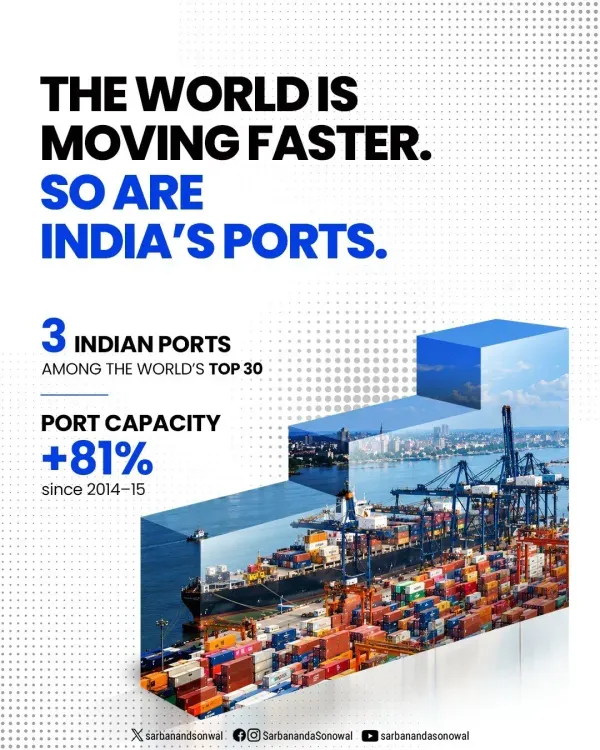
Union Minister Sarbananda Sonowal highlights that India's port capacity has surged 81% since 2014-15 under PM Modi's vision, with three Indian ports now ranking among the world's top 30 — marking a major milestone in the country's maritime ambitions.
Key Takeaways
81% surge in India's port capacity since 2014-15 , as cited by Union Minister Sarbananda Sonowal .
Three Indian ports now rank among the world's top 30 , a global credibility marker for trade and shipping.
The Sagarmala Project , launched in 2015 , has been the central policy engine driving port-led development and logistics reform.
Public-private partnerships and new terminal projects at major ports have been key drivers of capacity addition.
Higher port rankings attract larger vessels and direct shipping routes, reducing freight costs for Indian exporters.
The government's target of making India a top-tier maritime nation by 2030 now has a measurable data trail supporting it.
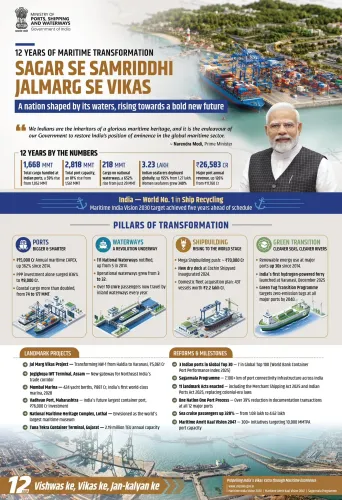
India's ports are no longer just gateways — they are becoming statements of economic ambition. On Saturday, October 17, 2026, Union Minister of Ports, Shipping and Waterways Sarbananda Sonowal took to X to spotlight a striking milestone: port capacity has surged by 81% since 2014-15, with three Indian ports now ranking among the world's top 30.
From margin to mainstream: the scale of India's port leap
The numbers Sonowal cited are not incremental — they describe a structural transformation. An 81% jump in port capacity over roughly a decade means India's maritime infrastructure has, in measurable terms, nearly doubled its throughput potential. Port capacity is the backbone of trade competitiveness: it determines how quickly cargo moves, how much it costs to move, and whether global shipping lines bother to call at your shores. Three Indian ports breaking into the global top 30 signals that international benchmarks are beginning to confirm what domestic policy had been promising.
The minister framed the achievement squarely within Prime Minister Narendra Modi's economic vision, crediting directional leadership from the top as the organising force behind the sector's rise.
Sagarmala and the decade-long push behind the numbers
The policy engine driving this expansion has a name: the Sagarmala Project, launched in 2015 to promote port-led development and coastal shipping. The scheme brought public-private partnerships, new terminal projects at major ports, and a deliberate effort to cut logistics costs — costs that had long made Indian exports less competitive on global markets. Port modernisation, inland waterways linkage, and coastal economic zones were all part of the same design: make the sea work harder for the economy.
Sonowal has helmed the Ministry of Ports, Shipping and Waterways since 2021, presiding over the phase where these long-gestation infrastructure projects began delivering visible results. The ministry has overseen capacity addition at both major and non-major ports, with PPP-driven terminal expansions contributing significantly to the headline growth figure.
Why the global ranking matters as much as the raw capacity
Capacity numbers are internal. Rankings are how the world sees you. Having three Indian ports in the global top 30 matters for a specific commercial reason: global shipping lines and logistics companies use port rankings to decide route calls, vessel deployments, and long-term contracts. A higher-ranked port attracts larger vessels, lower per-unit freight costs, and more direct connectivity — which translates directly into cheaper exports and a leaner supply chain for domestic manufacturers.
The government's broader ambition — positioning India as a top-tier maritime nation by 2030 — now has a credible data trail behind it. The next markers to watch are further ranking improvements, progress on ongoing greenfield port projects, and how India's share in global container throughput evolves in the years ahead.
India's maritime story is no longer a future tense. The infrastructure is here. The rankings are moving. The question now is how fast the trade volumes follow.
Point of View
If it holds up to independent verification, would represent a genuine structural shift, not just a budgetary one. What the post does not address is the demand side: whether cargo volumes, connectivity indices, and turnaround times have kept pace with capacity — the full picture of competitiveness that rankings alone do not capture.
NationPress
17 Oct 2026
Frequently Asked Questions
By how much has India's port capacity increased since 2014?
According to Union Minister Sarbananda Sonowal, India's port capacity has increased by 81% since 2014-15 , nearly doubling the country's maritime throughput potential over roughly a decade.
Which Indian ports are in the world's top 30?
Minister Sonowal's post states that three Indian ports now rank among the world's top 30, though the specific names of those ports were not mentioned in the post.
What is the Sagarmala Project and how does it relate to port growth?
The Sagarmala Project is a central government scheme launched in 2015 to promote port-led development, coastal shipping, and logistics efficiency. It has been the primary policy framework driving India's port capacity expansion through public-private partnerships and new terminal projects.
Who is Sarbananda Sonowal and what ministry does he head?
Sarbananda Sonowal is India's Union Minister of Ports, Shipping and Waterways, a senior BJP leader and former Chief Minister of Assam. He has helmed the shipping ministry since 2021 .
Why does a port's global ranking matter for India's trade?
Global port rankings influence decisions by international shipping lines on route calls, vessel deployments, and long-term contracts. Higher-ranked ports attract larger vessels and more direct connectivity, which lowers per-unit freight costs and makes Indian exports more competitive on world markets.