Sonowal Hails 12 Years of Defence Self-Reliance Under Modi

Synopsis
Union Minister Sarbananda Sonowal marked 12 years of the Modi government's security record on June 17, 2026, highlighting INS Vikrant, rising defence exports, and border infrastructure as proof of India's shift to defence self-reliance under the Atmanirbhar Bharat framework.
Key Takeaways
Union Minister Sarbananda Sonowal posted on June 17, 2026 , under the #12YearsOfSurakshitBharat hashtag, marking 12 years of the Modi government's security record.
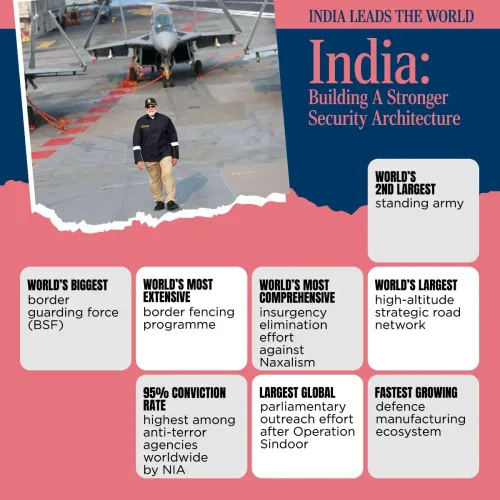
INS Vikrant , commissioned in September 2022 at Cochin Shipyard , is cited as the flagship symbol of India's indigenous defence manufacturing capability.
The Atmanirbhar Bharat defence initiative, launched in May 2020 , introduced negative import lists and raised FDI caps to reduce reliance on foreign arms suppliers.
The government claims 'unprecedented border infrastructure' along India's northern and western frontiers, built primarily through the Border Roads Organisation .
The 'Surakshit Bharat' narrative is being explicitly linked to the Viksit Bharat 2047 development goal, framing national security as a foundation for economic progress.
Upcoming Defence Ministry acquisition plans and exhibitions like Aero India and DefExpo are the next milestones to watch for indigenisation targets and export data.
Union Ports and Shipping Minister Sarbananda Sonowal on Wednesday, June 17, 2026, invoked the #12YearsOfSurakshitBharat campaign to assert that India's security architecture has undergone a fundamental transformation under Prime Minister Narendra Modi, pointing to indigenous defence production, record exports, and upgraded border infrastructure as evidence of a self-reliant 'New India'.
Context
Sonowal's post, framed around the slogan 'A Surakshit Bharat is the foundation of a Viksit Bharat,' aligns with a broader BJP-led communication drive marking 12 years of the Modi government's tenure. The minister cited the indigenously built aircraft carrier INS Vikrant as a symbol of the country's shift away from defence import dependence, alongside what he described as 'record defence exports' and 'unprecedented border infrastructure.'
The post is part of a coordinated hashtag campaign across BJP leaders, anchoring national security achievements to the government's development narrative ahead of the party's political messaging cycle.
Policy Backdrop
INS Vikrant, India's first domestically built aircraft carrier, was commissioned in September 2022 at Cochin Shipyard Limited, placing India among a small group of nations capable of constructing aircraft carriers indigenously. The vessel has since become the flagship symbol of the Atmanirbhar Bharat defence initiative launched by PM Modi in May 2020.
The Atmanirbhar Bharat push in defence included the introduction of negative import lists — categories of equipment that must be sourced domestically — and raised foreign direct investment caps in the defence manufacturing sector. The policy reorientation was aimed at reducing India's historically high dependence on foreign arms suppliers while simultaneously building an export-capable domestic industry.
Since 2014, the government has also accelerated construction of border roads, bridges, and tunnels along the northern and western frontiers, projects overseen primarily by the Border Roads Organisation. A stated 'zero-tolerance policy on terror' has been a consistent plank of the administration's national security posture.
Stakeholders and Impact
The indigenisation drive has direct implications for Indian defence manufacturers, including public-sector undertakings and a growing private-sector ecosystem, which have benefited from guaranteed domestic procurement pipelines and government support for export promotion. Armed forces personnel are the end-users of platforms developed under these programmes, with indigenisation aimed at reducing supply-chain vulnerabilities during conflict.
Border communities and strategic analysts have also noted the visible expansion of connectivity infrastructure in frontier regions, which carries both civilian and military-logistics significance. The broader narrative of a 'Surakshit Bharat' — a secure India — is being presented by the ruling party as a prerequisite for achieving the 'Viksit Bharat' (Developed India) goal set for 2047.
What's Next
The #12YearsOfSurakshitBharat messaging is expected to intensify across the BJP's ministerial ranks in the coming days, with defence indigenisation, border infrastructure, and counter-terror posture as the three central pillars. Industry observers will watch the Defence Ministry's upcoming acquisition announcements and major defence exhibitions such as Aero India and DefExpo for concrete indigenisation targets and new export order disclosures that would substantiate the claims being made in the campaign.
As India's strategic ambitions grow, the convergence of the 'Surakshit Bharat' and 'Viksit Bharat' frameworks signals that national security will remain a central electoral and governance theme for the administration through the decade.
Point of View
Broadening the campaign's reach beyond the usual defence establishment voices. The invocation of INS Vikrant and Atmanirbhar Bharat ties a tangible, visible achievement to an abstract policy goal, giving the #12YearsOfSurakshitBharat drive a concrete anchor. Framing security as the 'foundation' of development is a deliberate rhetorical move that positions any challenge to the government's security record as an attack on India's development aspirations. The campaign also signals that the BJP intends to contest the 2047 Viksit Bharat narrative on the security terrain, not just the economic one.
NationPress
16 Sept 2026
Frequently Asked Questions
What is the #12YearsOfSurakshitBharat campaign about?
The #12YearsOfSurakshitBharat campaign is a BJP-led communication drive marking 12 years of the Modi government, highlighting achievements in defence indigenisation, border infrastructure, and counter-terror policy as evidence of a transformed national security landscape.
What is INS Vikrant and why is it significant?
INS Vikrant is India's first indigenously built aircraft carrier, commissioned in September 2022 at Cochin Shipyard Limited in Kerala. It is significant because it places India among a select group of nations capable of constructing aircraft carriers domestically, symbolising progress under the Make in India and Atmanirbhar Bharat initiatives.
What is Atmanirbhar Bharat in defence?
Atmanirbhar Bharat in defence refers to a policy framework announced by PM Modi in May 2020 aimed at reducing India's dependence on foreign arms imports. It includes negative import lists mandating domestic procurement for certain equipment categories and increased foreign direct investment caps in the defence manufacturing sector.
What has India achieved in defence exports under Modi?
The government has cited record defence exports as a marker of success under the Atmanirbhar Bharat framework, with domestic defence production and exports rising significantly since 2014. Precise figures for 2026 are subject to official Defence Ministry disclosures.
What is Viksit Bharat and how does it connect to national security?
Viksit Bharat, or 'Developed India,' is the Modi government's vision for India to become a fully developed nation by 2047. The ruling party frames national security — a 'Surakshit Bharat' — as a prerequisite and foundation for achieving this development goal.