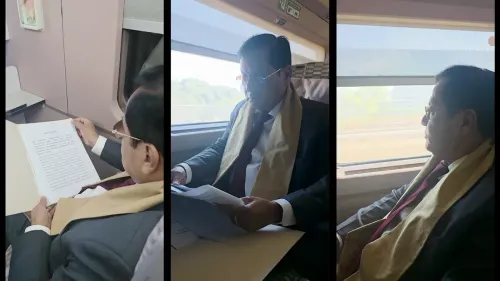
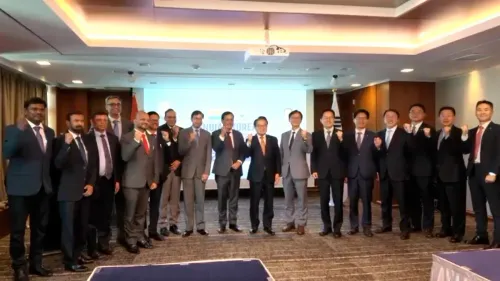
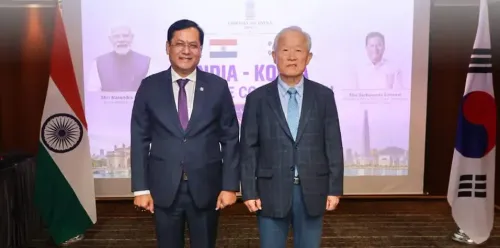
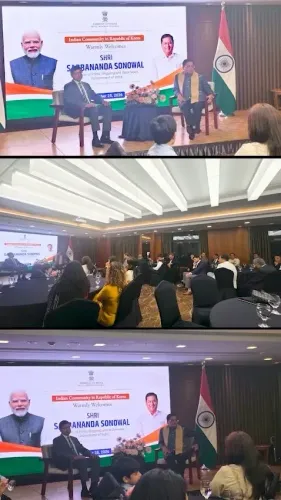
Sonowal visits HD Hyundai shipyard, pitches India-Korea maritime tie-up
Synopsis
Union Minister Sarbananda Sonowal visited HD Hyundai's HD-KSOE shipyard in Ulsan on October 28, 2026, pitching India-Korea collaboration on maritime manufacturing, port equipment, and advanced green vessel technologies under the Aatmanirbhar maritime vision.
Key Takeaways
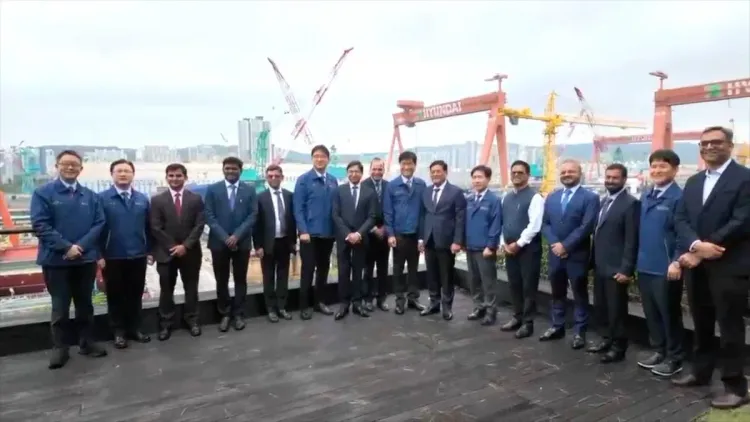
Sarbananda Sonowal visited the HD-KSOE shipyard in Ulsan, South Korea on October 28, 2026 and met HD Hyundai leadership.
Discussions covered maritime manufacturing, port equipment, and advanced green vessel technologies .
Sonowal highlighted India's surging cargo demand and business-friendly ecosystem as key assets in the partnership pitch.
The visit aligns with Maritime India Vision 2030 and the Sagarmala Project , which set domestic shipbuilding capacity targets.
The minister framed the partnership under Aatmanirbhar Bharat , positioning Korea's technology as a bridge to Indian self-reliance in maritime manufacturing.
The India-South Korea CEPA (2009) provides the existing trade and investment framework underpinning deeper maritime ties.
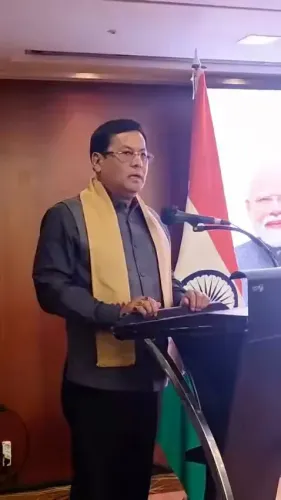
In the industrial heart of South Korea's shipbuilding capital, Union Minister of Ports, Shipping and Waterways Sarbananda Sonowal walked the floors of the HD-KSOE shipyard in Ulsan on Wednesday, October 28, 2026 — and left with a blueprint for what India wants next: Korea's green-vessel technology married to India's surging cargo economy.
What Sonowal pitched inside the Ulsan shipyard
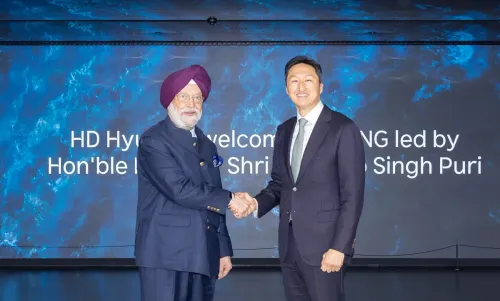
Sonowal met the leadership of HD Hyundai, one of the world's largest commercial shipbuilders, at its flagship HD-KSOE facility — a yard synonymous with ultra-large container ships and next-generation LNG carriers. The minister placed three items squarely on the table: deeper cooperation in maritime manufacturing, port equipment, and advanced green vessel technologies.
His central argument was India's own momentum. 'I highlighted India's surging cargo demand and business-friendly ecosystem as we build a globally competitive shipbuilding hub,' Sonowal wrote, framing India not as a supplicant seeking technology but as a rising market offering scale in return. That framing matters: it positions the partnership as mutual rather than one-directional technology transfer.
The policy architecture behind the visit
This engagement does not arrive in a vacuum. India's Maritime India Vision 2030, released in 2021, set explicit targets for domestic shipbuilding capacity and green vessels. The Sagarmala Project, launched in 2015, has been modernising port infrastructure and promoting coastal shipping. Together, they create the scaffolding that makes a Korea tie-up logical rather than incidental.
The India-South Korea Comprehensive Economic Partnership Agreement (CEPA), signed in 2009, provides the legal foundation for the kind of manufacturing and technology investment the minister is now actively soliciting. Decades of trade architecture, now being loaded with maritime ambition.
Sonowal invoked Aatmanirbhar Bharat — the government's self-reliance initiative launched in 2020 — to describe the end-goal: 'an Aatmanirbhar maritime ecosystem.' The phrase does real work here. It signals to domestic industry that foreign technology partnerships are a bridge to self-sufficiency, not a bypass around it.
Korea's tech, India's scale — and the supply-chain bet
South Korea commands roughly a third of global shipbuilding order books, with its yards consistently leading on fuel-efficient and dual-fuel vessel designs. HD Hyundai in particular has pushed hard into ammonia and hydrogen-ready ship concepts — precisely the green-vessel segment India needs as international shipping emissions rules tighten.
India's counter-offer is volume and geography. Cargo throughput at Indian ports has climbed steadily, and the country's coastline — over 7,500 kilometres — is chronically under-served by domestically built vessels. For Korean shipbuilders eyeing new production partnerships as global supply chains diversify, Indian yards represent an attractive satellite manufacturing option.
'Building on deep India-Korea ties, we are uniting Korea's technological prowess with India's economic scale to forge resilient global supply chains,' Sonowal said. The language of 'resilient supply chains' is deliberate — it speaks directly to a post-pandemic world recalibrating dependencies.
Whether the Ulsan meeting translates into signed MoUs, joint-venture announcements, or technology-transfer agreements remains to be confirmed. But the minister's visit to one of the world's premier shipyards sends an unambiguous signal: India is no longer simply a buyer in the global maritime market — it is negotiating to become a builder.
Point of View
Yard-level engagements with leading shipbuilding nations — signalling that the government's maritime ambitions are moving from policy documents to procurement diplomacy. By framing India as a market offering 'economic scale' rather than merely seeking technology, the ministry is attempting to shift the negotiating posture from buyer to partner. The invocation of Aatmanirbhar Bharat alongside a foreign technology giant is a careful political balancing act — reassuring domestic industry while signalling openness to strategic foreign capital. The real test will be whether follow-on agreements materialise before the next maritime summit or budget cycle, where shipbuilding incentives are widely expected to feature.
NationPress
28 Oct 2026
Frequently Asked Questions
Why did Sarbananda Sonowal visit South Korea in October 2026?
Sonowal visited the HD-KSOE shipyard in Ulsan on October 28, 2026, to meet HD Hyundai leadership and discuss cooperation in maritime manufacturing, port equipment, and green vessel technologies as part of India's effort to build a globally competitive shipbuilding hub.
What is HD Hyundai and why does it matter for India?
HD Hyundai is one of the world's largest commercial shipbuilders, headquartered in Ulsan, South Korea, and is a leader in green and dual-fuel vessel technology — exactly the capability India needs to meet international shipping emissions standards and scale domestic production.
What is the Aatmanirbhar maritime ecosystem Sonowal mentioned?
It refers to the application of the government's Aatmanirbhar Bharat self-reliance initiative to the maritime sector, aiming to reduce India's dependence on foreign-built vessels by developing domestic shipbuilding capacity, potentially through technology partnerships like the one discussed with HD Hyundai.
What is Maritime India Vision 2030?
Maritime India Vision 2030, released in 2021, is a government roadmap outlining targets for modernising ports, scaling domestic shipbuilding capacity, promoting coastal shipping, and advancing green vessel technology across Indian maritime infrastructure.
Will India and South Korea sign a shipbuilding MoU after Sonowal's visit?
No formal MoU or joint-venture agreement has been confirmed from the October 2026 Ulsan meeting. Analysts are watching for possible follow-up announcements at upcoming maritime summits or in the next Union Budget, where shipbuilding incentives are widely anticipated.