CM Hemant Soren Calls for Jharkhand to Move Beyond Mines
Synopsis
Chief Minister Hemant Soren has called for Jharkhand to redefine itself through minds, research, and innovation rather than mineral extraction alone. The statement signals a push toward inclusive, knowledge-driven growth in one of India's most resource-rich but economically unequal states.
Key Takeaways
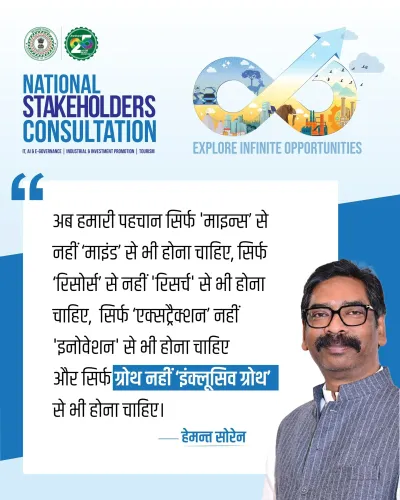
CM Hemant Soren called for Jharkhand to build its identity around minds, research, and innovation — not just mines and mineral extraction.
The statement was shared by the Chief Minister's Office of Jharkhand on 8 July 2026 .
Jharkhand holds major reserves of coal, iron ore, copper, and mica, making it historically dependent on raw resource extraction.
State industrial policies since 2015-16 have attempted to promote downstream processing, but structural dependence on extraction has persisted.
Key stakeholders include tribal communities, mining workers, and youth — all of whom stand to be affected by any shift in the state's economic model.
Concrete follow-through will be tracked through budget allocations for higher education, research parks, incubation centres, and any mining-policy amendments.
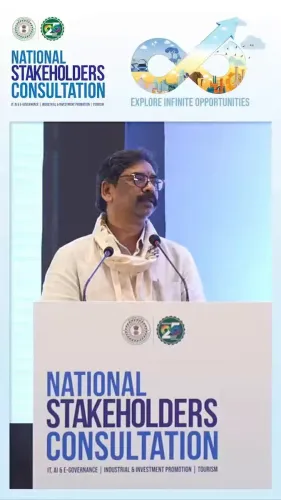
The Chief Minister's Office of Jharkhand on Wednesday, 8 July 2026, shared a pointed statement by Chief Minister Hemant Soren calling on the state to redefine its identity — moving beyond mineral extraction toward knowledge, research, and inclusive economic growth.
Context
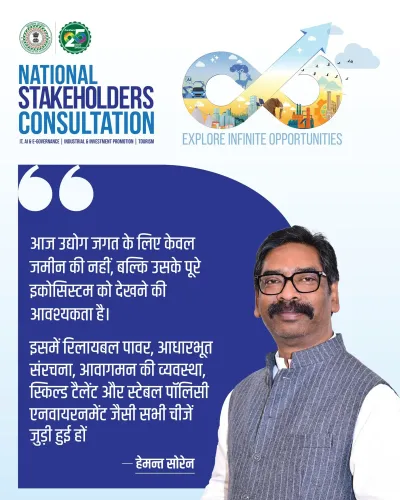
Hemant Soren, speaking in Hindi, laid out a four-part vision for Jharkhand's economic future. Translated, his words read: 'Ab hamari pehchaan sirf mines se nahin, mind se bhi honi chahiye' — 'Our identity must now come not just from mines, but also from minds; not just from resources, but also from research; not just from extraction, but also from innovation; and not just from growth, but from inclusive growth.' The statement frames a deliberate pivot in how the state's leadership wants Jharkhand to be perceived nationally and internationally.
Policy Backdrop
Jharkhand is one of India's most mineral-rich states, holding significant reserves of coal, iron ore, copper, and mica. For decades, its economy has been anchored in raw resource extraction, with limited downstream processing or value addition happening within state borders. The state's industrial policies since 2015-16 have sought to encourage manufacturing and processing alongside mineral exports, though the structural dependence on extraction has remained deep.
National frameworks such as Startup India and Atmanirbhar Bharat have provided both rhetorical and fiscal scaffolding for state-level knowledge-economy initiatives. Soren's statement aligns with a broader eastern-India trend of resource-dependent states seeking to climb the value chain — from raw commodity exporters to hubs of manufacturing, skilling, and innovation.
Stakeholders and Impact
The communities most directly affected by this rhetorical shift are Jharkhand's tribal populations, mining workers, and youth. Tribal communities have long borne the environmental and displacement costs of large-scale extraction; a pivot toward research and inclusive growth, if backed by concrete policy, could alter land-use and livelihood dynamics significantly. For the state's youth, the emphasis on 'minds' over 'mines' signals a potential expansion of higher education, skilling infrastructure, and start-up ecosystems.
Mining workers, however, represent a constituency that any transition must handle carefully. A shift away from extraction-led growth without parallel job-creation in new sectors could deepen economic insecurity in districts where collieries and quarries are the primary employers.
What's Next
Observers will watch Jharkhand's upcoming state budget allocations for higher education and research infrastructure, any new announcements around research parks or incubation centres, and potential amendments to mining lease or land-acquisition rules that could signal the pace of this transition. CM Soren's statement sets a directional tone; the credibility of the vision will ultimately rest on whether policy and fiscal commitments follow. A state that has long exported raw wealth now faces the harder task of retaining and multiplying value within its own borders.
Point of View
Resource/research, extraction/innovation, growth/inclusive growth — mirrors language used by development economists and think-tanks pushing eastern Indian states up the value chain. Whether this marks a genuine policy inflection or remains aspirational oratory will depend on budget allocations and institutional investments that follow. For a state where mineral royalties still underwrite a large share of public spending, the transition is as much a fiscal challenge as an ideological one.
NationPress
7 Oct 2026
Frequently Asked Questions
What did Hemant Soren say about Jharkhand's economy?
CM Hemant Soren said Jharkhand's identity must come not just from mines but also from minds — calling for a shift from resource extraction to research, innovation, and inclusive growth.
Why is Jharkhand so dependent on mining?
Jharkhand holds some of India's largest reserves of coal, iron ore, copper, and mica. Since the state's formation in 2000 , mineral extraction has been the primary driver of revenue and employment, limiting economic diversification.
What is inclusive growth in the context of Jharkhand?
In Jharkhand's context, inclusive growth refers to ensuring that economic gains reach tribal communities, mining workers, and marginalised populations who have historically borne the costs of large-scale extraction without proportionate benefits.
What policies is Jharkhand pursuing for economic diversification?
Jharkhand's industrial policies since 2015-16 have aimed to promote downstream manufacturing alongside raw mineral exports. National schemes like Startup India and Atmanirbhar Bharat provide additional frameworks for knowledge-economy initiatives at the state level.
What should we watch for after Soren's mines-to-minds statement?
Key indicators include Jharkhand's budget allocations for higher education and research infrastructure, announcements on research parks or incubation centres, and any changes to mining lease or land-acquisition rules that could signal the pace of economic transition.