CM Hemant Soren Demands Rs 1.36 Lakh Crore Coal Dues
Synopsis
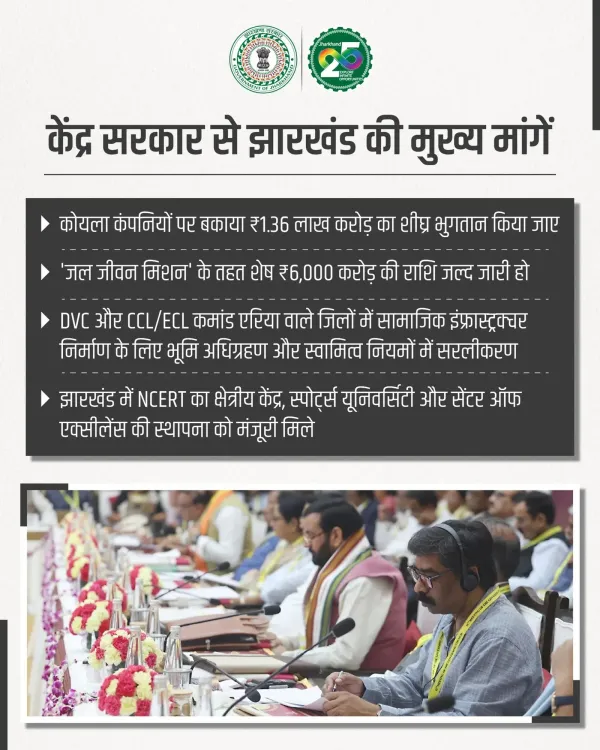
Chief Minister Hemant Soren has demanded urgent release of Rs 1 lakh 36 thousand crore in legitimate dues owed by coal companies and central PSUs to Jharkhand, stating the funds must be used for the state's human resource development.
Key Takeaways
CM Hemant Soren has formally demanded payment of Rs 1 lakh 36 thousand crore in dues owed to Jharkhand by coal companies and central PSUs.
The demand was announced by the Chief Minister's Office of Jharkhand on 11 June 2026 .
The funds are intended for human resource development in Jharkhand, covering education, skills, and welfare in coal-affected districts.
Jharkhand is India's largest coal-producing state; central coal subsidiaries CCL and BCCL operate extensively on its territory.
Similar demands for royalty arrears and rate revision have been made by Jharkhand governments since at least 2020 , reflecting long-standing centre-state friction over resource revenues.
A formal representation to the Ministry of Coal or engagement via the Inter-State Council is expected as a follow-up step.
The Chief Minister's Office of Jharkhand announced on Thursday, 11 June 2026 that Chief Minister Hemant Soren has formally demanded the release of Rs 1 lakh 36 thousand crore in legitimate dues owed to the state by coal companies and central public sector undertakings, urging that the funds be disbursed urgently for the state's human resource development.
Context
The Chief Minister's Office posted in Hindi: 'मुख्यमंत्री @HemantSorenJMM ने कोयला कंपनियों और केंद्रीय उपक्रमों के पास लंबित झारखण्ड की ₹1 लाख 36 हजार करोड़ की वैध बकाया राशि का शीघ्र भुगतान करने की मांग की' — translated: 'Chief Minister Hemant Soren demanded early payment of the legitimate pending dues of Rs 1 lakh 36 thousand crore owed by coal companies and central undertakings to Jharkhand, so that this amount can be used for the human resource development of Jharkhand.' Jharkhand is India's largest coal-producing state, and central public sector coal companies — including subsidiaries of Coal India Limited such as Central Coalfields Limited (CCL) and Bharat Coking Coal Limited (BCCL) — operate extensively on its territory. Royalties, cess payments, and other statutory dues from these entities form a critical share of the state exchequer's non-tax revenue.Policy Backdrop
The demand is not new in spirit. Jharkhand governments have periodically pressed the Union government and central coal PSUs for clearance of royalty arrears and revision of royalty rates, with similar representations made during 2020–22. The royalty rates applicable to coal were last revised in 2012, and mineral-rich eastern states have long argued that the current structure undervalues their resource endowments. This friction sits within a wider pattern of centre-state disputes over resource federalism. States like Jharkhand, Odisha, and Chhattisgarh have consistently raised concerns about royalty payments, District Mineral Foundation funds, and compensation for land used by central PSUs — issues that have been taken up through formal ministerial letters, NITI Aayog meetings, and public statements.Stakeholders and Impact
The primary beneficiary of any release would be the Jharkhand state exchequer, which the Chief Minister has explicitly linked to human resource development — covering education, skill-building, and welfare programmes in coal-affected districts. Mining districts such as Dhanbad, Ramgarh, and Bokaro, which host the heaviest concentration of central PSU operations and also carry significant tribal populations, stand to gain most directly if funds are released and channelled into development spending. For coal companies and central undertakings, clearing a liability of this scale would require either budgetary provisioning by the Union government or direct settlement from PSU balance sheets — neither of which is routine without political will at the Centre.What's Next
The formal demand is likely to be followed by a written representation to the Ministry of Coal or a structured engagement through the Inter-State Council. Analysts tracking resource federalism will watch whether any provision for settlement appears in forthcoming Union budget supplementary grants or in bilateral discussions between Chief Minister Soren and the Union Cabinet. The Chief Minister's framing of the dues as fuel for human resource development signals that the issue will be pressed as a welfare argument, not merely a fiscal one — a framing designed to build broader public support for the demand.Point of View
Soren is making it politically costly for the Union government to remain passive. The move fits a broader pattern among mineral-rich eastern states — Jharkhand, Odisha, Chhattisgarh — that have grown more assertive in demanding that extraction-linked revenues stay closer to source communities. Whether this translates into actual disbursement will depend on the political calculus in New Delhi, but the public pressure campaign has now been formally opened.
NationPress
26 Oct 2026
Frequently Asked Questions
How much money does Jharkhand claim coal companies owe it?
Chief Minister Hemant Soren has demanded Rs 1 lakh 36 thousand crore (approximately Rs 1.36 lakh crore) as legitimate pending dues from coal companies and central public sector undertakings operating in Jharkhand.
Why is Jharkhand demanding dues from coal companies?
Jharkhand argues that coal companies and central PSUs such as CCL and BCCL have accumulated large unpaid royalties and statutory dues. CM Soren has said the recovered funds should be used for human resource development in the state.
Which coal companies owe money to Jharkhand?
The demand is directed at coal companies and central undertakings broadly, including subsidiaries of Coal India Limited such as Central Coalfields Limited (CCL) and Bharat Coking Coal Limited (BCCL), which have major operations in Jharkhand.
Is this the first time Jharkhand has raised this demand?
No. Jharkhand governments have periodically pressed the Union government and central coal PSUs for clearance of royalty arrears since at least 2020-22, and have also sought revision of royalty rates last fixed in 2012.
What will Jharkhand use the coal dues money for?
CM Hemant Soren has specifically stated the funds would be used for human resource development in Jharkhand, which includes education, skill development, and welfare programmes, particularly in coal-affected districts.