CM Hemant Soren Vows to Bridge Jharkhand Investor Outreach Gap
Synopsis
CM Hemant Soren has declared that past communication failures kept Jharkhand's vast mineral and industrial potential hidden from global investors. The state government now commits to sustained, proactive dialogue with domestic and foreign investors to bridge that gap and accelerate economic growth.
Key Takeaways
CM Hemant Soren acknowledged that poor communication in the past prevented Jharkhand's capabilities from reaching global investors.
The Jharkhand government has pledged continuous dialogue with both domestic and foreign investors going forward.
Jharkhand holds major reserves of coal, iron ore, and bauxite but has historically underperformed economically relative to this resource base.
The Jharkhand Industrial Policy 2021 had already laid incentive groundwork; the new push focuses on closing the investor-communication deficit.
Concrete follow-through is expected in the form of investor summits, single-window clearance upgrades, or new MoUs .
The move aligns with a broader national pattern of states using proactive outreach to compete for FDI under frameworks like Make in India .
The Chief Minister's Office of Jharkhand announced on 9 July 2026 that the state government, under Chief Minister Hemant Soren, will actively close a long-standing communication deficit that has prevented Jharkhand's economic potential from reaching domestic and international investors.
Context
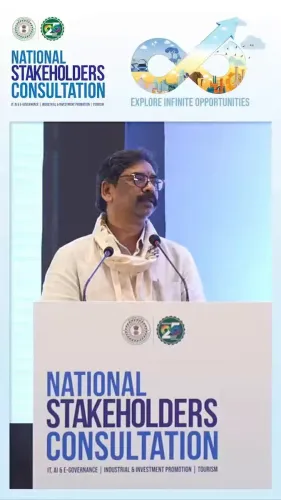
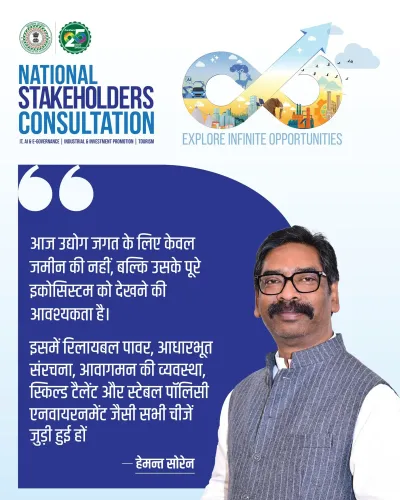
The post, shared under the hashtag #JharkhandSeJohar, quoted CM Soren directly: 'Ateet mein behtar communication ki kami ke kaaran Jharkhand ki kshamataen duniya ke saamne poori tarah nahin aa paayin' — 'In the past, due to a lack of better communication, Jharkhand's capabilities could not be fully presented to the world.' The government stated it will now maintain 'continuous dialogue' with investors from both within India and abroad to eliminate this gap.
The statement signals a deliberate pivot from reactive to proactive investor engagement, positioning communication itself as a policy instrument rather than a secondary concern.
Policy Backdrop
Jharkhand holds some of India's most significant mineral reserves, including coal, iron ore, and bauxite, yet the state has historically underperformed relative to its resource base. The Jharkhand Industrial Policy 2021 had already outlined incentives for manufacturing and mining sectors to improve ease of doing business, but investor perception remained a persistent challenge.
Across India, states compete aggressively for foreign direct investment through outreach programmes, investor summits, and digital engagement — a trend mirrored by national frameworks such as Make in India and Production-Linked Incentive (PLI) schemes that reward improved investor engagement and domestic manufacturing capacity.
Stakeholders and Impact
The primary beneficiaries of improved outreach would be domestic and foreign investors seeking clarity on Jharkhand's regulatory environment, land availability, and mineral access. For the state, closing the communication gap could translate into higher foreign direct investment inflows, more industrial units, and job creation in a state where economic diversification beyond mining remains a work in progress.
Local communities dependent on industrial employment and state revenue from mineral royalties also stand to gain if sustained investor dialogue converts into on-ground projects. The emphasis on 'continuous dialogue' suggests the government intends institutional, not one-off, engagement mechanisms.
What's Next
Observers will watch for concrete follow-through in the form of investor summits, revised single-window clearance mechanisms, or new memoranda of understanding (MoUs) announced by the Jharkhand government. The framing of communication as a gap to be 'eliminated' sets a measurable expectation that the administration will need to back with institutional infrastructure.
If the government sustains this outreach posture, Jharkhand could meaningfully reposition itself within India's competitive investment landscape — converting mineral wealth into industrial momentum that has so far remained unrealised.
Point of View
The administration raises the bar for its own accountability; investor summits and MoUs will now be scrutinised against this promise. The statement also fits a broader arc in which Indian state governments increasingly treat digital and diplomatic outreach as a core economic function, not a PR afterthought. Whether Jharkhand can convert this rhetorical shift into institutional investor-engagement machinery will determine if the pledge has lasting impact.
NationPress
8 Oct 2026
Frequently Asked Questions
What did CM Hemant Soren say about Jharkhand's investor communication?
CM Hemant Soren stated that in the past, a lack of better communication meant Jharkhand's capabilities were not fully presented to the world, and the government will now maintain continuous dialogue with domestic and foreign investors to fix this.
Why has Jharkhand struggled to attract investment despite its mineral wealth?
Jharkhand holds major reserves of coal, iron ore, and bauxite but has historically faced perception and connectivity challenges that kept investor interest below its potential, a gap the state government now aims to close through proactive outreach.
What is the Jharkhand Industrial Policy 2021?
The Jharkhand Industrial Policy 2021 outlined incentives for manufacturing and mining sectors to improve ease of doing business in the state, forming the policy foundation on which the current investor-outreach push builds.
What is #JharkhandSeJohar?
'JharkhandSeJohar' is a hashtag used by the Jharkhand government and CM Soren's office to promote the state's identity and development narrative, with 'Johar' being a traditional Jharkhand greeting symbolising respect and pride.
What should investors watch for from the Jharkhand government next?
Investors and analysts should watch for upcoming investor summits, revised single-window clearance mechanisms, or new MoUs announced by the Jharkhand government as concrete evidence of the promised continuous dialogue.