Stalin calls NEET 'fundamentally unfair', announces op-ed
Synopsis
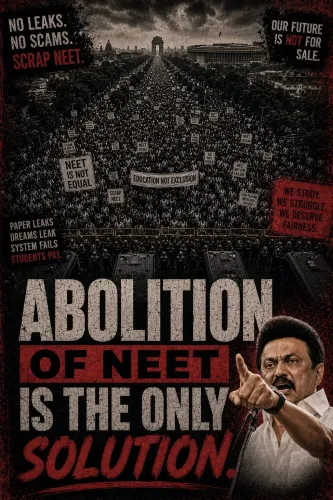
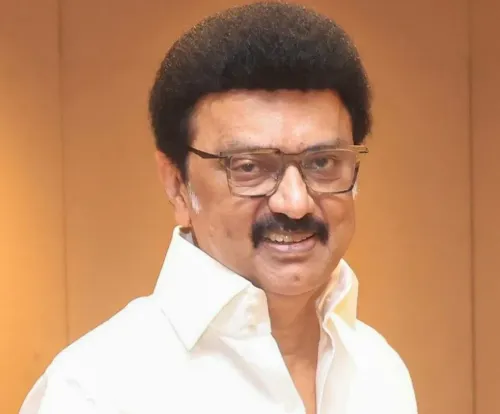
DMK president M. K. Stalin on 22 July 2026 declared NEET 'fundamentally unfair' and called for its abolition, citing unanimous cross-party opposition in Tamil Nadu and the Assembly's repeated exemption bills. He announced a forthcoming op-ed laying out detailed arguments against the national medical entrance test.
Key Takeaways
Stalin declared on 22 July 2026 that NEET is 'fundamentally unfair' and must be abolished.
Every major political party in Tamil Nadu except the BJP opposes NEET, according to Stalin.
The Tamil Nadu Legislative Assembly passed NEET exemption bills in 2017 and 2021 ; the 2021 bill awaits presidential assent.
Stalin announced a detailed op-ed to be published the following day laying out his case against NEET.
The dispute reflects a long-running centre-state conflict over education policy on India's concurrent list.
The BJP remains the sole major Tamil Nadu party supporting NEET's retention as a national standard.
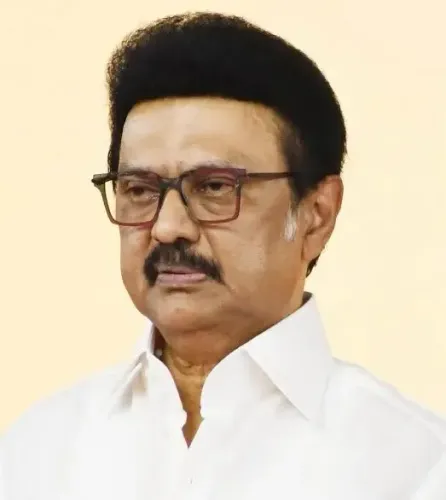
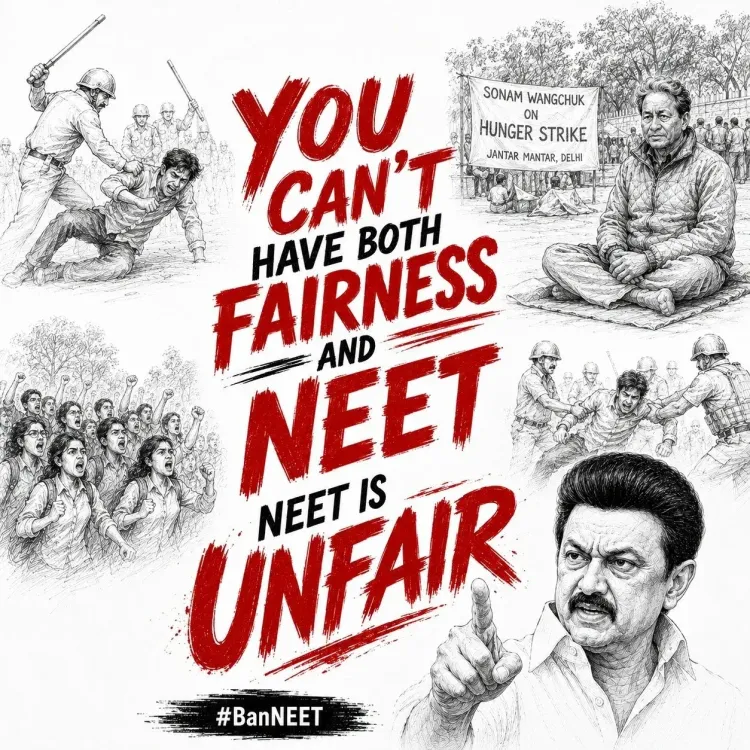
DMK president M. K. Stalin on Wednesday, 22 July 2026, issued a pointed public statement declaring that fairness and NEET cannot coexist, calling the national medical entrance examination 'fundamentally unfair' and renewing his demand for its abolition. Stalin announced that he would elaborate his arguments in a forthcoming opinion piece to be published in a national daily the following day.
Context
In the post, Stalin wrote: 'You cannot have both fairness and NEET. NEET is fundamentally unfair.' He was unambiguous about the political consensus in his state, noting that 'every political party in Tamil Nadu except the BJP opposes NEET.' The statement positions the issue not merely as a policy disagreement but as a matter of basic equity in access to medical education.
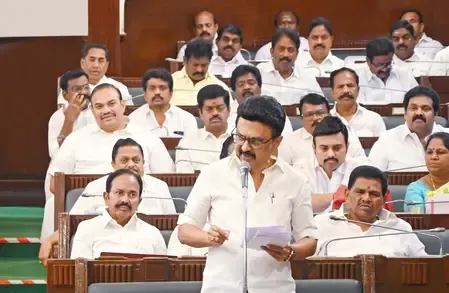
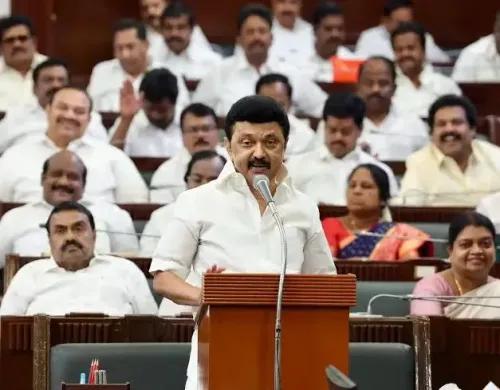
Stalin added that the Tamil Nadu Legislative Assembly has 'repeatedly passed resolutions and Bills seeking exemption from NEET,' framing the state's demand as a settled, cross-party legislative position rather than a partisan stance. His closing line — 'Stop defending the indefensible' — was directed at those who continue to support the examination's mandatory status.
Policy Backdrop
NEET was introduced as the single national entrance test for undergraduate medical admissions and was made mandatory following Supreme Court orders from 2016. Tamil Nadu has been among the most consistent and vocal opponents of the examination since its rollout.
In 2017, the Tamil Nadu Assembly passed a bill seeking permanent exemption from NEET; the bill was returned by the Governor and subsequently lapsed. In 2021, the Assembly unanimously passed a fresh NEET exemption bill, which was forwarded for presidential assent but remains pending without a decision. These legislative efforts underpin Stalin's assertion that the state has exhausted conventional channels without result.
The broader debate reflects a structural tension over education, which sits on India's concurrent list — meaning both the Centre and states have legislative competence — but where the Centre's writ has expanded through national testing agencies. DMK and successive Tamil Nadu governments, including those led by the AIADMK, have consistently argued that NEET disadvantages students from state-board schools and rural, lower-income families who lack access to expensive coaching.
Stakeholders and Impact
The primary stakeholders are Tamil Nadu's medical aspirants, particularly students from state-board backgrounds and rural districts who compete against peers trained in CBSE curricula and private coaching. Critics of NEET argue the examination structurally favours urban, English-medium, and economically privileged students, skewing medical college admissions away from the communities state-run schools serve.
The BJP remains the sole major party in Tamil Nadu backing NEET's retention, arguing that a uniform national standard ensures quality and reduces corruption in admissions. The Centre has upheld NEET on these grounds despite repeated state-level objections, making any legislative or executive exemption contingent on either a constitutional amendment or a fresh Supreme Court ruling.
What's Next
Stalin's announcement of a detailed op-ed signals an intent to shift the debate from political sloganeering to a structured legal and empirical argument. Observers will watch whether the piece introduces new data on student outcomes, fresh constitutional arguments, or a roadmap for renewed legislative action — including a possible third assembly resolution or a petition before the Supreme Court.
With Tamil Nadu's political establishment largely unified on the issue, the pressure will mount on the Centre to respond substantively to what is now a decade-long demand. The episode also reinforces a wider pattern of centre-state friction over concurrent-list subjects, with Tamil Nadu positioning itself as the lead voice for state autonomy in education policy.
Point of View
He is signalling a shift toward a legal and empirical offensive that could reframe the debate ahead of any fresh Supreme Court proceedings. The framing of NEET as an equity issue rather than merely a federalism dispute widens his potential coalition beyond Tamil Nadu to other states with strong state-board traditions. The BJP's isolation on this issue within Tamil Nadu's political landscape gives Stalin a rare opportunity to project state-level consensus as a democratic mandate the Centre cannot indefinitely ignore. Whether the op-ed delivers genuinely new arguments will determine whether this moment translates into legislative or judicial momentum.
NationPress
22 Jul 2026
Frequently Asked Questions
Why does M. K. Stalin oppose NEET?
Stalin argues that NEET is 'fundamentally unfair' because it disadvantages students from Tamil Nadu's state-board schools and rural backgrounds who lack access to the coaching infrastructure that CBSE-stream and urban students enjoy.
Has Tamil Nadu passed any law against NEET?
Yes. The Tamil Nadu Legislative Assembly passed NEET exemption bills in 2017 and 2021 . The 2017 bill lapsed after being returned by the Governor; the 2021 bill was forwarded for presidential assent but remains pending.
Which parties in Tamil Nadu support scrapping NEET?
According to Stalin, every major political party in Tamil Nadu except the BJP opposes NEET. Both the ruling DMK and the principal opposition AIADMK have historically backed exemption from the examination.
What is the Centre's position on NEET exemptions?
The central government has upheld NEET as a uniform national standard that ensures quality and reduces corruption in medical admissions, and has not granted any state a formal exemption.
What did Stalin announce regarding an op-ed on NEET?
Stalin announced on 22 July 2026 that he would publish a detailed opinion piece the following day setting out why NEET is fundamentally unfair and why it must be abolished.