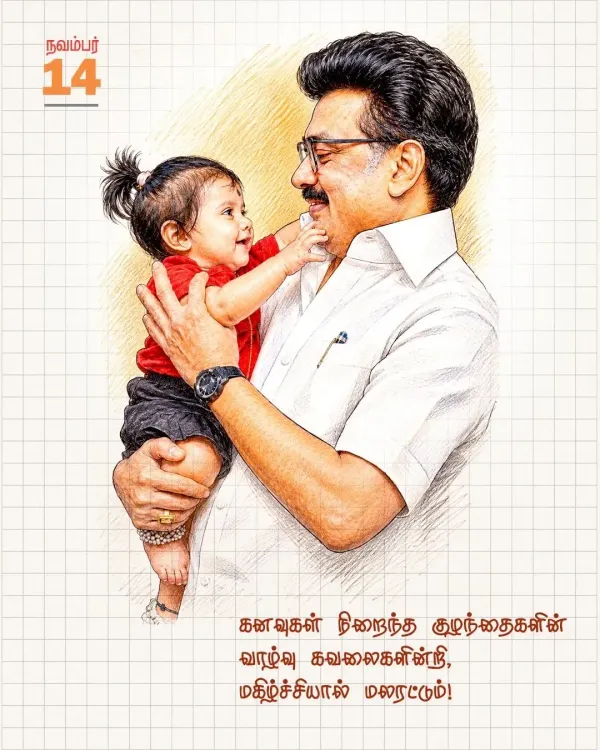
Stalin marks Children's Day citing DMK's child welfare schemes
Synopsis
On Children's Day 2026, DMK president M. K. Stalin highlighted seven child welfare schemes under the Dravidian Model — spanning nutrition, doorstep education, foundational literacy, science clubs, and cervical cancer vaccination — framing them as a continuum of DMK's decades-long social justice agenda in Tamil Nadu.
Key Takeaways
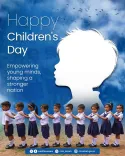
Stalin posted a Children's Day message on 14 November 2026 in Tamil, citing seven active government schemes for children.
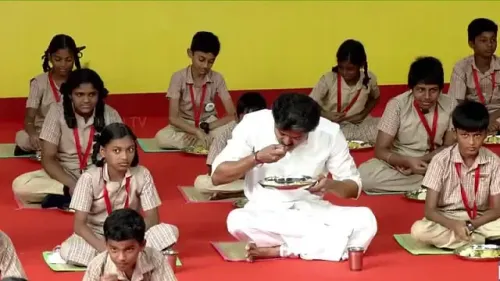
Schemes listed include the Chief Minister's Morning Breakfast Scheme , Illam Thedi Kalvi (doorstep education), and Ennum Ezhuthum (foundational numeracy and literacy).
The post also highlights a cervical cancer vaccination programme for adolescent girls and Vaanavil Manram science interest clubs.
Stalin frames current schemes as continuations of historical DMK welfare milestones: the noon meal scheme with eggs (1980s) and free student bus travel .
The closing line contrasts 'the light of screens' with 'the light of knowledge,' signalling a policy stance on children's digital habits.
All seven programmes fall under the #DravidianModel governance brand being actively promoted by the ruling DMK.
On Children's Day, 14 November 2026, DMK president M. K. Stalin invoked Tamil Nadu's expanding child welfare stack — from free breakfast in classrooms to cervical cancer vaccines for adolescent girls — framing each scheme as proof that a happy present is the surest foundation for a better future.
From noon meals to morning breakfasts: a welfare arc decades in the making
Stalin's post, written in Tamil, opens with a governing philosophy: 'குழந்தைகளுக்குச் சிறந்த எதிர்காலத்தை உருவாக்குவதன் முதல் படி, அவர்களுக்கு மகிழ்ச்சியான நிகழ்காலத்தை உறுதிசெய்வதுதான்!' ('The first step in building a great future for children is ensuring they have a joyful present!'). That is not merely sentiment — it is a lineage claim. DMK administrations have anchored their social-justice identity in child welfare since the 1960s, and Saturday's post names the specific programmes that connect that history to the present.
The arc runs from the expansion of the noon meal scheme with eggs in the 1980s and the introduction of free bus travel for students in earlier DMK tenures, all the way to the current cluster of #DravidianModel initiatives. The continuity argument is deliberate: each new scheme is presented as a direct extension of the same logic, not a fresh departure.
Seven active schemes Stalin listed on Children's Day
The post catalogues the current DMK government's child-focused programmes in a single sweep: Utrach Saththa Urudi (nutrition assurance), the Anbukkarangal (compassionate hands) outreach, the Chief Minister's Morning Breakfast Scheme for government school students, Illam Thedi Kalvi (doorstep education), Ennum Ezhuthum (foundational numeracy and literacy), Vaanavil Manram (science interest clubs), and the cervical cancer vaccination programme for adolescent girls.
The breadth is notable. Health, foundational learning, curiosity-led science exposure, and preventive oncology for young women are rarely bundled in a single political communication — signalling that the Dravidian Model tag is being applied as an integrated brand, not a programme-by-programme pitch.
Screens versus learning: the closing line's quiet ambition
Stalin closed with a pointed couplet: 'திரைகளின் வெளிச்சத்தைத் தாண்டி, அறிவின் வெளிச்சத்தில் அவர்களின் உலகம் விரியட்டும்!' — 'Beyond the light of screens, let their world expand in the light of knowledge!' In an era of near-universal smartphone access and rising concerns about children's screen time, the metaphor is deliberate. It signals that Tamil Nadu's education policy frame is now explicitly weighing curiosity and cognitive development against digital distraction — an argument that will almost certainly surface in the next state budget cycle.
Stakeholders watching Tamil Nadu's education and health departments will note that Children's Day is traditionally when scheme reviews and expansion announcements are previewed. Whether any of Saturday's listed programmes see fresh funding or coverage targets in the coming budget will be the real test of the welfare rhetoric.
Point of View
Nutrition, education, and preventive oncology under a single '#DravidianModel' label, the party is building a coherent governance brand ahead of what could be a consequential budget cycle. The 'screens versus knowledge' metaphor is particularly telling: it positions Tamil Nadu as a state with a considered, not reactive, approach to the digital-age childhood debate. Analysts will watch whether these listed schemes see measurable expansion in coverage or funding in the months ahead, which will determine whether the rhetoric converts into verifiable policy momentum.
NationPress
14 Nov 2026
Frequently Asked Questions
What is the Chief Minister's Morning Breakfast Scheme in Tamil Nadu?
The Chief Minister's Morning Breakfast Scheme is a Tamil Nadu government programme that provides free nutritious breakfasts to students in government schools, aimed at reducing hunger and improving attendance and concentration.
What is Illam Thedi Kalvi?
Illam Thedi Kalvi, meaning 'education at the doorstep,' is a Tamil Nadu initiative that brings foundational learning support to schoolchildren at the community level, particularly targeting students who need help with basic skills outside the classroom.
What is the Ennum Ezhuthum programme?
Ennum Ezhuthum ('numbers and letters') is a Tamil Nadu state programme designed to improve foundational numeracy and literacy skills among children in the early grades of primary school.
Why is Tamil Nadu offering a cervical cancer vaccine to adolescent girls?
Tamil Nadu's cervical cancer vaccination programme for adolescent girls is a preventive public health initiative under the DMK government, intended to reduce the future incidence of cervical cancer by immunising girls before potential exposure.
What is the Dravidian Model of governance?
The Dravidian Model is the DMK's governance framework that emphasises social equity through universal public services — covering nutrition, education access, and health — rooted in the party's historical commitment to reducing caste and gender disparities in Tamil Nadu.