Stalin: Scrap SIR, sack CEC, restore paper ballots
Synopsis
DMK president M. K. Stalin announced four resolutions from a party MPs' meeting: scrap the SIR voter-roll revision, remove and probe Chief Election Commissioner Gyanesh Kumar, support student movements, and replace EVMs with paper ballots. DMK MPs will petition the President.
Key Takeaways
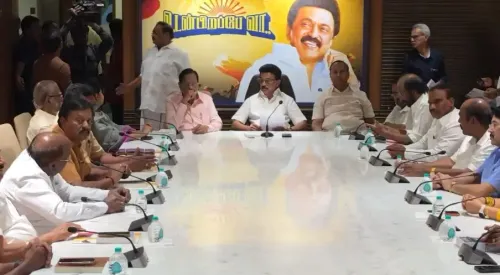
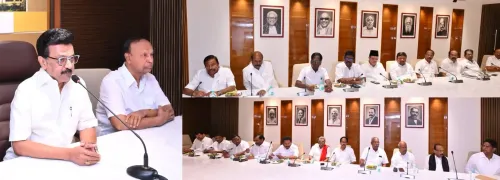
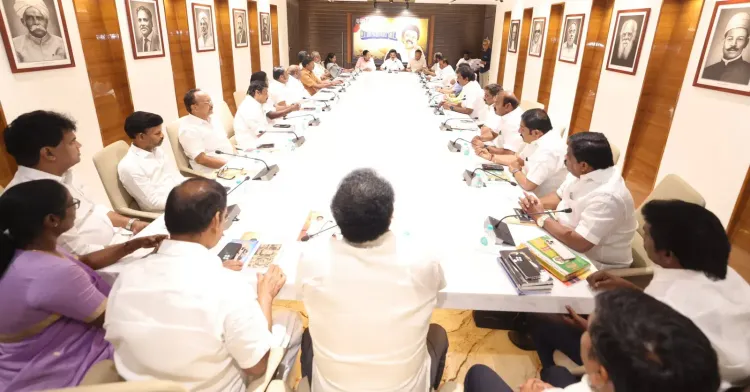
DMK MPs' meeting on 17 October 2026 passed four resolutions targeting the Special Intensive Revision (SIR) of voter rolls and the Election Commission.
The party demands the SIR process be fully cancelled , calling it an attack on citizens' right to vote.
Chief Election Commissioner Gyanesh Kumar must be removed from office and investigated, per the DMK resolution.
DMK has called for a nationwide return to paper ballots instead of EVMs — a demand it has raised since at least 2019.
DMK Parliament members will submit a formal petition to the President of India on the twin demands of SIR cancellation and paper ballot restoration.
Stalin explicitly condemned Congress's varying state-level positions on SIR and TVK's silence on the issue.
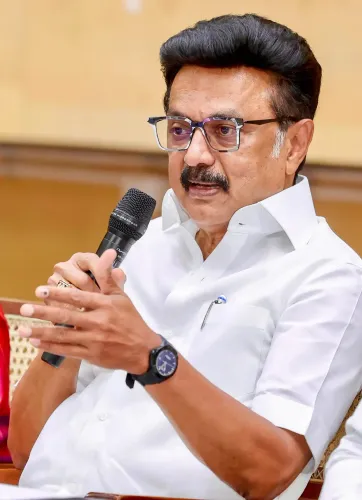
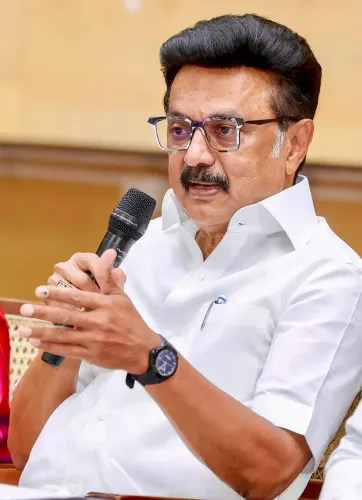
A war cry for the ballot box — and a direct challenge to the Election Commission of India. DMK president M. K. Stalin on Saturday, 17 October 2026, announced a set of sharply worded resolutions passed at a meeting of DMK's Parliament members, demanding the scrapping of the Special Intensive Revision (SIR) of voter rolls, the removal and investigation of Chief Election Commissioner Gyanesh Kumar, and a nationwide return to paper ballots in place of Electronic Voting Machines (EVMs).
Four resolutions, one message: the ballot is under threat
The DMK MPs' meeting produced four pointed demands. First: the SIR process must be cancelled entirely, with the party arguing it strips citizens of their right to vote. Second: Chief Election Commissioner Gyanesh Kumar must be removed from office and subjected to a formal inquiry. Third: student movements fighting for democracy must receive full political support. Fourth: India must abandon EVMs and revert to paper ballot voting — a demand the party has raised consistently since at least 2019.
Stalin framed the twin demands — SIR cancellation and paper ballots — as the twin pillars of protecting Indian democracy. In the Tamil original, he wrote: 'மக்களின் வாக்குரிமையையும் இந்திய ஜனநாயகத்தையும் பாதுகாக்க' (to protect the voting rights of the people and Indian democracy). The DMK's Parliament members will now carry a formal petition on both demands directly to the President of India.
Stalin fires at Congress's 'state-by-state' position and TVK's silence
The announcement came loaded with intra-opposition friction. Stalin aimed direct criticism at the Indian National Congress, calling out what he described as a shifting, state-by-state stance on the SIR issue — and reserved separate condemnation for the silence of TVK (Tamilaga Vettri Kazhagam), the party's rival in Tamil Nadu's political space.
The criticism of Congress is significant. While both parties are partners in the INDIA bloc at the national level, regional fault lines on electoral integrity questions have created visible tension. For DMK, whose electoral base depends heavily on granular voter-mobilisation in Tamil Nadu, any ambiguity in an ally's stand on voter-roll revisions reads as a political liability — and Stalin chose to say so plainly.
EVM battles and the long shadow of 2019
The EVM debate is not new. Indian opposition parties, including DMK, raised questions about EVM security during the 2019 Lok Sabha elections, pushing for a larger role for Voter Verifiable Paper Audit Trails (VVPATs), which the Supreme Court had directed be deployed nationwide between 2013 and 2019. But the demand for a complete return to paper ballots — not just paper trails — is a sharper escalation of that argument, and its appearance alongside a call to sack the sitting Chief Election Commissioner signals that the party sees the current moment as a constitutional-level emergency, not a technical quibble.
Student movements have added a street-level dimension to this fight, and Stalin's explicit backing for them in the resolutions is a deliberate signal that DMK intends to take this campaign beyond Parliament.
Watch for the formal petition's delivery date and any response from the Election Commission — two moments that will tell us whether this is the beginning of a sustained constitutional confrontation or a high-decibel warning shot before negotiations begin.
Point of View
EVMs, and the Election Commission's leadership into a single narrative of institutional capture. By naming Congress's inconsistency and TVK's silence in the same breath, he is simultaneously applying pressure on a national ally and drawing a sharp contrast with a regional rival, a dual manoeuvre that consolidates DMK's position as the principal custodian of Tamil Nadu's electoral interests. The petition-to-the-President mechanism is a constitutionally visible but practically limited tool — its real value lies in optics and escalation, signalling that DMK is prepared to take this dispute to every available forum. If the Election Commission responds, or if Congress is forced to clarify its stand nationally, Stalin will have succeeded in forcing the agenda.
NationPress
17 Oct 2026
Frequently Asked Questions
What is SIR and why is DMK opposing it?
SIR stands for Special Intensive Revision, a process to update and revise electoral rolls. DMK opposes it, arguing the process results in eligible voters being removed from rolls, effectively stripping citizens of their right to vote.
Why is DMK demanding the removal of Chief Election Commissioner Gyanesh Kumar?
DMK's resolution calls for CEC Gyanesh Kumar to be removed from office and subjected to a formal investigation, holding him accountable for the conduct of the SIR exercise. The specifics of the allegations were not detailed beyond this demand.
What is DMK's stand on EVMs?
DMK has demanded a return to paper ballot voting, arguing EVMs pose a risk to the integrity of elections. The party has raised EVM concerns since at least the 2019 Lok Sabha elections , but is now calling for a complete replacement rather than just paper audit trails.
What will DMK MPs do next on the SIR and EVM issue?
DMK's Parliament members will submit a formal petition to the President of India , pressing both the cancellation of SIR and the restoration of paper ballots.
Why did Stalin criticise Congress on the SIR issue?
Stalin accused the Indian National Congress of taking different positions on SIR depending on the state, calling this inconsistency unacceptable. He also condemned TVK's silence on the matter, using both critiques to position DMK as the most unambiguous defender of voter rights.