CM Sukhu Demands BBMB Clear Himachal's Water Arrears
Synopsis
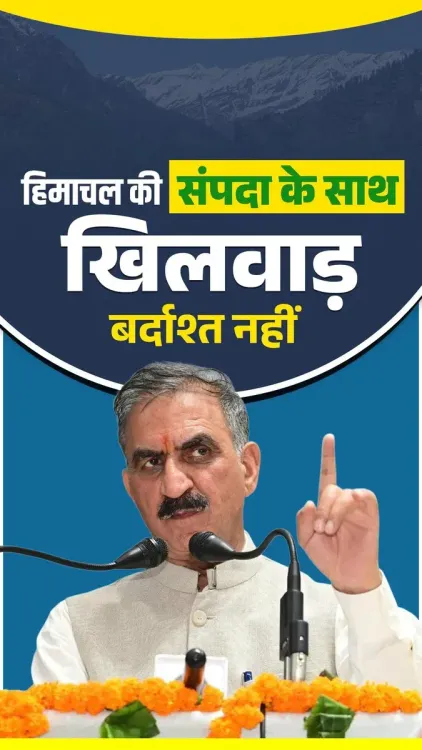
Himachal Pradesh CM Sukhvinder Singh Sukhu on 16 July 2026 warned BBMB that the state will not permit water access until Supreme Court-directed royalty arrears, pending for approximately 15 years, are fully released. He called it a matter of Himachal's rights and self-respect.
Key Takeaways
CM Sukhvinder Singh Sukhu issued a public ultimatum to BBMB on 16 July 2026 , linking water access to payment of long-pending arrears.
He cited Supreme Court of India directions that have not been complied with, framing BBMB's inaction as defiance of the apex court.
Himachal Pradesh is the upstream source of the Sutlej and Beas rivers managed under the Punjab Reorganisation Act, 1966 .
The dispute affects downstream irrigation in Punjab and Haryana , where farming communities depend on Bhakra-Nangal project water.
CM Sukhu framed the issue as one of rights and dignity: 'The public elected us to protect this wealth, not to sell or distribute it.' Possible next steps include fresh Supreme Court proceedings, a new water tribunal referral, or central government mediation.
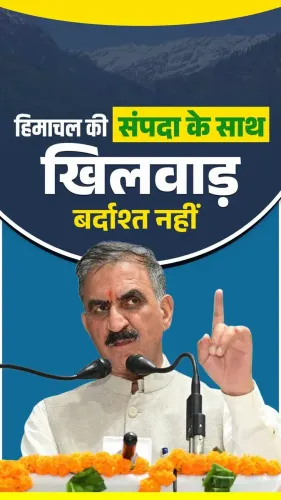
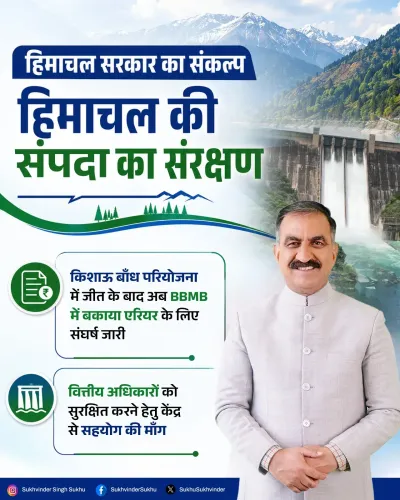
Himachal Pradesh Chief Minister Sukhvinder Singh Sukhu on Thursday, 16 July 2026, issued a sharp public warning to the Bhakra Beas Management Board (BBMB), demanding immediate release of long-pending water royalty arrears owed to the state and asserting that access to Himachal Pradesh's water resources will not be granted until the state's dues are cleared.
Posting on X in Hindi, Chief Minister Sukhu said: 'BBMB pichle lagbhag 15 varshon se hamare bahumulya paani ka upyog kar rahi hai' ('BBMB has been using our precious water for approximately the last 15 years'). He added that despite directions from the Supreme Court of India, the outstanding arrears have not been released to the state to date. His government's position, he stated, is unambiguous: 'If you want the water, you must first give Himachal its rightful dues. No evasion by BBMB will be tolerated.'
Context
The BBMB was constituted under the Punjab Reorganisation Act, 1966 to operate and maintain joint irrigation and power infrastructure on the Sutlej and Beas rivers, which originate in Himachal Pradesh. The board's member states include Punjab, Haryana, Rajasthan, and Himachal Pradesh. As the upstream riparian state and the geographic source of both rivers, Himachal Pradesh has consistently argued that it is entitled to a greater revenue and royalty share from the hydro projects managed under this framework.
CM Sukhu took office in December 2022, heading a Congress government that has made assertion of the state's natural-resource rights a defining political position. His statement on 16 July 2026 represents the sharpest public articulation yet of the state's stance on the BBMB arrears dispute.
Policy Backdrop
The legal and administrative framework governing water sharing among the basin states has been shaped by the Punjab Reorganisation Act, 1966, the Ravi-Beas Waters Tribunal constituted in 1986, and a series of Supreme Court proceedings addressing inter-state allocations, royalties, and compensation claims. Himachal Pradesh's claim for arrears rests on the argument that the state has been the source of the water resource while downstream beneficiaries — primarily Punjab and Haryana — have reaped the agricultural and economic benefits.
The Supreme Court of India has issued directions on inter-state water disputes in this basin on multiple occasions. CM Sukhu's post specifically invokes those court directions as the legal basis for the state's demand, framing BBMB's non-compliance as a defiance not just of Himachal Pradesh but of the apex court itself.
Stakeholders and Impact
The primary stakeholders in this dispute are the residents of Himachal Pradesh, who the Chief Minister says elected his government to protect the state's natural wealth, and the downstream farming communities of Punjab and Haryana, whose irrigation and drinking water supply depends substantially on the Bhakra-Nangal and Beas projects managed by BBMB. Any disruption or renegotiation of water access could have significant agricultural consequences in those states.
CM Sukhu framed the issue in terms of dignity and rights, stating: 'This is a question of the rights and self-respect of the people of Himachal. We will not back down.' The political messaging is directed simultaneously at BBMB, the central government — which holds administrative oversight of the board — and Himachal Pradesh's own electorate.
What's Next
The immediate trigger for escalation could be any upcoming BBMB board meeting at which water allocation or project management decisions are tabled. Himachal Pradesh could press for a formal referral to a new inter-state water disputes tribunal or seek a fresh listing before the Supreme Court to enforce existing directions on royalty arrears.
If the standoff hardens, the central government may be drawn in as a mediator given its supervisory role over BBMB. The dispute also has the potential to become a flashpoint in relations between the Congress-governed Himachal Pradesh and the BJP-led governments in Punjab, Haryana, and at the centre — adding a federal political dimension to what is already a complex inter-state resource dispute.
Point of View
Timed to signal to his home constituency that the Congress government is willing to use leverage over water access as a bargaining chip. By invoking Supreme Court directions, he places BBMB in an uncomfortable legal and political position, shifting the burden of non-compliance onto the board rather than the state. The statement fits a broader pattern across India's federal system where upstream states increasingly challenge post-reorganisation water-sharing arrangements negotiated in a very different political economy. Whether this translates into concrete legal action or remains political signalling will determine its real impact.
NationPress
15 Oct 2026
Frequently Asked Questions
What is BBMB and why is Himachal Pradesh in dispute with it?
BBMB, the Bhakra Beas Management Board, was set up under the Punjab Reorganisation Act 1966 to manage joint irrigation and power projects on the Sutlej and Beas rivers. Himachal Pradesh, as the upstream source state of both rivers, has long demanded royalty and revenue arrears from BBMB for the use of its water, a claim it says is backed by Supreme Court directions that remain unimplemented.
What did CM Sukhu say about BBMB on 16 July 2026?
CM Sukhvinder Singh Sukhu posted on X on 16 July 2026 warning that Himachal Pradesh will not allow BBMB to access its water until the state's long-pending arrears — owed for approximately 15 years — are cleared, calling it a matter of the rights and self-respect of the people of Himachal Pradesh.
Has the Supreme Court ruled on Himachal Pradesh's water dues from BBMB?
The Supreme Court of India has issued directions related to inter-state water sharing and royalty claims in the Sutlej-Beas basin. CM Sukhu's statement specifically cites those court directions as the basis for Himachal Pradesh's demand, asserting that BBMB has not complied with them despite the apex court's orders.
Which states depend on BBMB water and could be affected?
Punjab, Haryana, and Rajasthan are the primary downstream beneficiaries of the Bhakra-Nangal and Beas projects managed by BBMB. Farming communities in Punjab and Haryana in particular depend heavily on this water for irrigation, making any disruption to access a matter of significant agricultural concern.
What could happen next in the Himachal Pradesh-BBMB water dispute?
Possible next steps include Himachal Pradesh seeking a fresh Supreme Court listing to enforce existing directions on arrears, a referral to an inter-state water disputes tribunal, or central government intervention as the supervisory authority over BBMB. The dispute may also acquire a sharper political dimension given the different party governments in the states involved.