Swamy Backs Book Calling for Constitution Rewrite
Synopsis
Former Union Minister Dr. Subramanian Swamy has publicly backed economist Dr. M. R. Venkatesh's new book, which contends India's Constitution embodies Christian philosophical roots alien to the country's Hindu civilisational identity, and called for the document to be revisited and rewritten.
Key Takeaways
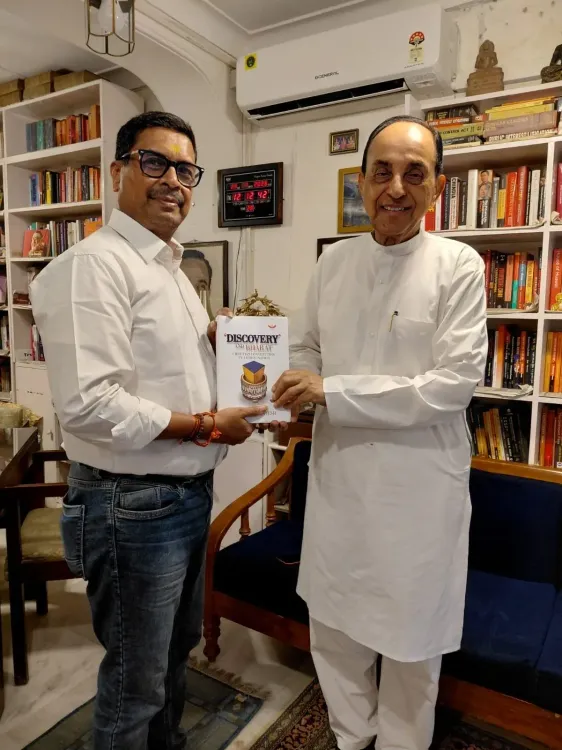
Subramanian Swamy met Dr.
Venkatesh on 23 July 2026 and received a copy of his new book.
The book is titled 'Discovery' And Bharat: Christian Constitution in a Hindu Nation and argues the Constitution carries Christian philosophical underpinnings.
Swamy publicly called the work an 'excellent case for revisiting and re-writing our constitution.' The Constitution of India has been in force since 26 January 1950 and its basic structure has been held unamendable by the Supreme Court.
A previous government commission — the National Commission to Review the Working of the Constitution — was set up in 2000 but its 2002 report was never enacted.
Any rewrite would require a two-thirds parliamentary majority and ratification by at least half of state legislatures.
Veteran politician Dr. Subramanian Swamy, former Union Minister and Rajya Sabha MP, on Thursday, 23 July 2026, met economist and commentator Dr. M. R. Venkatesh and publicly endorsed his newly released book, which argues that India's Constitution carries Christian philosophical underpinnings incompatible with the nation's Hindu civilisational identity. Swamy called the work an 'excellent case for revisiting and re-writing our constitution.'
Context
In his post, Swamy stated that Dr. Venkatesh presented him with a copy of the book titled 'Discovery' And Bharat: Christian Constitution in a Hindu Nation. Swamy described the work as making an 'excellent case for revisiting and re-writing our constitution' — a pointed formulation that goes beyond routine criticism and calls for structural replacement of the founding document. The endorsement from a figure of Swamy's standing amplifies the book's reach into mainstream political discourse.
Dr. M. R. Venkatesh is an economist and commentator with a record of writing on Indian economic policy and cultural-nationalist themes. His latest work, as characterised by Swamy's post, frames the Constitution of India as shaped by Christian Western legal philosophy rather than indigenous traditions — a thesis that sits within a broader intellectual current questioning the civilisational authenticity of India's post-independence institutional architecture.
Policy Backdrop
The Constitution of India was adopted by the Constituent Assembly on 26 November 1949 and came into force on 26 January 1950. It has since been amended over a hundred times, but its basic structure — including provisions on secularism and fundamental rights — has been upheld by the Supreme Court as unamendable through ordinary parliamentary procedure.
Calls to revisit or rewrite the Constitution are not new. As far back as 2000, the government established the National Commission to Review the Working of the Constitution to examine possible changes to the constitutional framework. That commission submitted its report in 2002 but its recommendations were never legislated upon. The debate has periodically resurfaced, often tied to questions about the balance between secularism and cultural majoritarianism.
Stakeholders and Impact
Constitutional scholars and legal bodies such as the Law Commission of India have historically resisted wholesale rewriting of the Constitution, arguing that amendment through established parliamentary procedure is the appropriate route for reform. Any serious legislative push toward rewriting the document would require a two-thirds majority in both Houses of Parliament and ratification by at least half of state legislatures.
Hindu nationalist groups are likely to find resonance in Swamy's endorsement, given his credibility as a former Cabinet minister and Harvard-trained economist. Minority communities and civil society organisations, however, have consistently viewed proposals to rewrite the Constitution with alarm, seeing the document's secular and rights-based provisions as essential protections. The debate touches directly on questions of national identity, religious pluralism, and the limits of majoritarian reform.
What's Next
Swamy's endorsement is likely to draw responses from constitutional lawyers, opposition politicians, and minority-rights advocates in the coming days. The book itself may now attract wider readership and academic scrutiny given the public backing of a prominent political figure. Parliamentary debates on constitutional amendments — already a live topic — could see this argument enter the formal legislative conversation.
Whether Swamy translates his endorsement into a concrete legislative proposal or a formal party position will determine how far this episode moves from social-media commentary to actionable political pressure. Watchers of constitutional reform will monitor whether the Law Commission or any parliamentary committee takes cognisance of the arguments advanced in the book.
Point of View
Swamy raises the political cost for parties that wish to defend the constitutional status quo without engaging its cultural arguments on their own terms. The episode illustrates how book launches and social-media posts have become effective vehicles for injecting radical constitutional ideas into the policy conversation ahead of potential legislative battles.
NationPress
21 Oct 2026
Frequently Asked Questions
What did Subramanian Swamy say about the Indian Constitution?
Swamy said that Dr. M. R. Venkatesh's new book makes an 'excellent case for revisiting and re-writing our constitution,' publicly endorsing the argument that the Constitution has Christian philosophical roots incompatible with India's Hindu identity.
What is the book 'Discovery' And Bharat: Christian Constitution in a Hindu Nation about?
The book, authored by economist Dr. M. R. Venkatesh, argues that the Indian Constitution is philosophically rooted in Christian Western legal traditions rather than indigenous Hindu civilisational values, and makes a case for rewriting it.
Can India's Constitution be rewritten?
Rewriting the Constitution would require a two-thirds majority in both Houses of Parliament and ratification by at least half of the state legislatures. The Supreme Court has also held that the Constitution's 'basic structure' cannot be altered even by amendment.
Has India ever reviewed its Constitution before?
Yes. The government established the National Commission to Review the Working of the Constitution in 2000, which submitted its report in 2002, but none of its major recommendations were enacted into law.
Who is Dr. M. R. Venkatesh?
Dr. M. R. Venkatesh is an Indian economist and commentator known for writings on economic policy and cultural-nationalist themes. His latest book on the Constitution has drawn public endorsement from Dr. Subramanian Swamy.