Swamy Launches Fresh Critique of Modi's 12-Year Rule

Synopsis
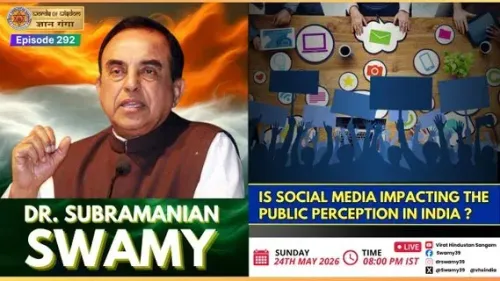
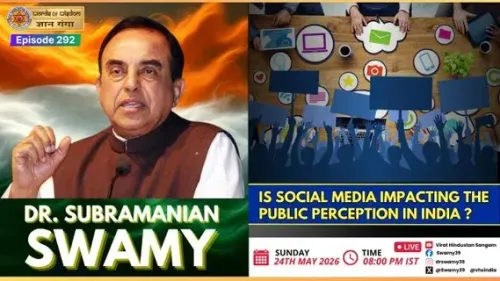
Veteran BJP politician Dr. Subramanian Swamy, former Union Minister and Rajya Sabha MP, on 28 May 2026 promoted a live interview on Public India describing it as a fresh exposé on Prime Minister Narendra Modi's 12 years in office, extending his long-established pattern of intra-party public dissent.
Key Takeaways
Subramanian Swamy , former Union Minister and Rajya Sabha MP, shared a live interview on 28 May 2026 calling it a 'new exposé' on Modi 's rule.
The interview was broadcast on the YouTube channel Public India , bypassing conventional media intermediaries.
Modi has been Prime Minister since May 2014 , making the reference to '12 years' a full-tenure assessment.
Swamy has a documented history of publicly questioning Modi government decisions — including demonetisation and China policy — while remaining a BJP member.
The specific claims made in the interview have not been independently verified.
Reactions from senior BJP spokespersons and any follow-up parliamentary statements by Dr.
Swamy are being closely watched.
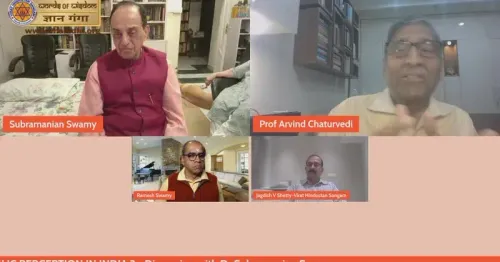
Veteran politician Dr. Subramanian Swamy, former Union Minister and Rajya Sabha MP, on Thursday, 28 May 2026, shared what he described as an 'explosive interview' offering a new exposé on Prime Minister Narendra Modi's 12 years in power, directing followers to a live-streamed conversation on the YouTube channel Public India.
Context
In the post, Dr. Swamy characterised the interview as a fresh exposé on Modi's rule since May 2014, when the Bharatiya Janata Party swept to power in a landmark general-election victory. The interview was broadcast live on Public India's YouTube channel, signalling a deliberate choice of a direct-to-audience platform over conventional media appearances.
The framing — 'new exposé' and '12-year rule' — positions the commentary as a comprehensive accounting of the full arc of Modi-era governance rather than a critique of any single policy. The specific claims made in the interview cannot be independently verified from records available at the time of publication.
Policy Backdrop
Dr. Swamy has periodically and publicly questioned specific decisions of successive Modi governments while remaining a member of the BJP. His critiques have spanned a wide range of domains: the demonetisation exercise of November 2016, aspects of India-China foreign policy, and questions around institutional autonomy within the judiciary and economic policymaking bodies.
This pattern of intra-party dissent aired through media platforms has made Dr. Swamy an unusual figure in Indian politics — a ruling-party member whose commentary is frequently at odds with the official party line. The May 2026 interview continues that established pattern, now extended to a retrospective assessment of the full 12-year period of BJP-led government.
Stakeholders and Impact
The primary stakeholders in any fallout from the interview are BJP leadership and its communication apparatus, which will face questions about whether and how to respond to a critique originating from within the party. Senior BJP spokespersons have in the past either dismissed Dr. Swamy's statements as personal opinion or declined to engage publicly.
For the broader Indian electorate, commentary from a figure with Dr. Swamy's institutional experience — he has held cabinet rank and served in the upper house — carries a different weight than opposition-party attacks. His willingness to use the language of 'exposé' sharpens the political salience of the interview ahead of any potential electoral or parliamentary proceedings.
What's Next
Attention will now turn to whether senior BJP leaders issue a formal or informal response to the interview, and whether Dr. Swamy follows up with parliamentary statements or further media appearances elaborating on the specific charges. Opposition parties may seek to amplify the interview's reach, given the credibility that an intra-party critic can lend to governance arguments.
The episode underlines a recurring tension within the BJP: how to manage a veteran member whose public profile and institutional standing make him difficult to ignore, even when his commentary diverges sharply from the party's preferred narrative on Modi-era governance.
Point of View
Suggesting he intends to move beyond specific policy disagreements toward a broader indictment of Modi-era governance. This fits a well-worn pattern of intra-party dissent that the BJP has historically managed by neither expelling nor formally engaging its most prominent internal critic. The use of a direct YouTube platform rather than a studio interview reflects a wider shift in Indian political communication, where social media reach can amplify a message beyond what gatekeepers might otherwise allow. Whether this episode triggers a formal party response or is absorbed as routine Swamy commentary will be a telling indicator of the BJP's political confidence heading into the next cycle.
NationPress
11 Oct 2026
Frequently Asked Questions
What did Subramanian Swamy say about Modi's 12-year rule?
On 28 May 2026 , Dr. Subramanian Swamy promoted a live interview on Public India 's YouTube channel, describing it as a 'new exposé' on Prime Minister Modi 's 12 years in office. The specific claims made in the interview have not been independently verified.
Is Subramanian Swamy still in the BJP?
Dr. Subramanian Swamy remains a member of the Bharatiya Janata Party . He has periodically issued public critiques of Modi government decisions while maintaining his party membership.
What has Swamy criticised the Modi government for in the past?
Dr. Swamy has publicly questioned several Modi government decisions over the years, including the demonetisation of November 2016 , aspects of India-China foreign policy, and issues relating to institutional autonomy.
What is Public India on YouTube?
Public India is a YouTube channel on which Dr. Swamy chose to broadcast his May 2026 interview live, using the direct-to-audience platform to share his critique of Modi 's governance record.
How long has Narendra Modi been Prime Minister?
Narendra Modi has served as Prime Minister of India since May 2014 , when the BJP won a decisive general-election majority. By May 2026 , that constitutes 12 years in office across successive terms.