Tamil Nadu launches ₹100 Diwali vegetable kits at 218 cooperative outlets

Synopsis
Tamil Nadu has put a full Diwali vegetable basket — 10 items, roughly 2.6 kg — on sale for just ₹100 through 218 cooperative outlets for three days. With vegetable prices running hot this festive season, the state is deploying both fixed stores and mobile vending vehicles, capping purchases at one kit per person to prevent bulk buying.
Key Takeaways
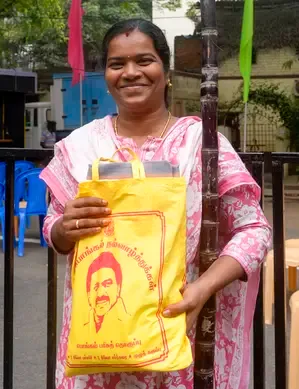
Tamil Nadu's 'Vetri Special Vegetable Package' offers 10 essential items for ₹100 at 218 cooperative outlets from 5 to 7 November 2026 .
Each kit weighs approximately 2.55–2.60 kg and includes onions, tomatoes, brinjal, potatoes, carrots, beans, green chillies, lemons, ginger, and a coconut.
Four mobile vegetable vending vehicles have been deployed in Chennai to extend reach beyond fixed outlets.
Purchases are capped at one package per person to ensure equitable distribution.
The scheme was formally launched at the Poonga Nagar Cooperative Wholesale Store on 15th Main Road, Chennai .
District and regional cooperative officials have been instructed to supervise supply and prevent shortages during the festive period.
The Tamil Nadu government, led by Chief Minister C. Joseph Vijay, has rolled out a subsidised 'Vetri Special Vegetable Package' — a ₹100 kit containing 10 essential items — to ease the burden of rising food costs on households ahead of Deepavali. The scheme, implemented through the State Cooperation Department, is available at 218 selected cooperative outlets across the state from 5 to 7 November 2026.
What the Package Contains
Each kit weighs approximately 2.55 to 2.60 kilograms and is designed to cover the daily cooking requirements of an average household. The package includes 500 grams each of onions and tomatoes, 250 grams each of brinjal and potatoes, 200 grams each of carrots and beans, 100 grams each of green chillies and lemons, 50 grams of ginger, and one coconut weighing between 400 and 450 grams.
Officials stated that all vegetables are procured, graded, weighed, and packed under hygienic conditions to guarantee freshness and quality — a safeguard against the adulteration concerns that have dogged festive-season retail markets in past years.
How the Scheme Is Being Rolled Out
The initiative was formally launched at the 15th Main Road outlet of the Poonga Nagar Cooperative Wholesale Store in Chennai. In addition to the fixed outlets, four mobile vegetable vending vehicles have been deployed across the city to extend the scheme's reach to consumers who may be distant from cooperative stores.
To prevent bulk buying and ensure equitable access, the government has capped purchases at one package per person. Kits will be available during regular working hours throughout the three-day window.
Distribution and Supply Chain Oversight
District-level cooperative coordinators and regional officials have been directed to supervise distribution at all participating outlets and maintain uninterrupted supply chains. The department has also instructed officials to coordinate closely between procurement centres and retail points to pre-empt shortages during the peak festive shopping period.
Adequate stocks have reportedly been arranged in advance, with the Cooperation Department appealing to residents statewide to avail themselves of the subsidised packages before the sale concludes on 7 November 2026.
Context and Significance
The launch comes as vegetable prices in Tamil Nadu — and across India — have remained elevated through the festive quarter, driven by erratic monsoon patterns and supply-chain disruptions. Diwali typically amplifies demand for cooking ingredients, pushing open-market prices higher. This is not the first time Tamil Nadu has deployed cooperative infrastructure to cushion consumers during festive peaks; similar subsidy drives have been run in preceding years under both the current and previous administrations.
The scheme underscores the Vijay government's focus on direct welfare delivery through the cooperative network — a model that bypasses private intermediaries and, critics note, also carries visible political signalling ahead of local governance cycles.
Point of View
Low-cost welfare gesture rather than a structural fix for food inflation — and that distinction matters. Tamil Nadu's cooperative network is one of the country's more functional distribution machines, which gives this scheme genuine last-mile credibility, but the benefit window of 72 hours reaching 218 outlets is narrow relative to the state's population. The one-pack-per-person cap is sensible, yet enforcement at busy festive-season counters has historically been patchy. More broadly, repeated short-window subsidies at festive peaks treat the symptom — price spikes — without addressing supply-side volatility in vegetables, which remains a structural challenge for every state government.
NationPress
5 Nov 2026
Frequently Asked Questions
What is Tamil Nadu's Vetri Special Vegetable Package?
It is a subsidised festive kit launched by the Tamil Nadu government offering 10 essential vegetables and cooking ingredients for ₹100. Each package weighs approximately 2.55 to 2.60 kg and is sold through 218 cooperative outlets across the state from 5 to 7 November 2026.
What items are included in the ₹100 Diwali vegetable kit?
The kit contains 500 grams each of onions and tomatoes, 250 grams each of brinjal and potatoes, 200 grams each of carrots and beans, 100 grams each of green chillies and lemons, 50 grams of ginger, and one coconut weighing 400–450 grams.
Where can residents buy the ₹100 vegetable package in Tamil Nadu?
The kits are available at 218 selected cooperative outlets across Tamil Nadu during regular working hours from 5 to 7 November 2026. In Chennai, four mobile vegetable vending vehicles have also been deployed to widen access.
Is there a limit on how many kits one person can buy?
Yes. The government has restricted purchases to one package per person to ensure equitable distribution and prevent bulk buying during the three-day festive sale.
Why has Tamil Nadu launched this scheme ahead of Deepavali?
Vegetable prices typically rise during the Diwali season due to increased demand. The state government launched the scheme to reduce household expenditure on essential cooking ingredients and provide relief to consumers facing elevated food costs during the festive period.