Tejashwi Yadav pays tribute to V.P. Singh on birth anniversary
Synopsis
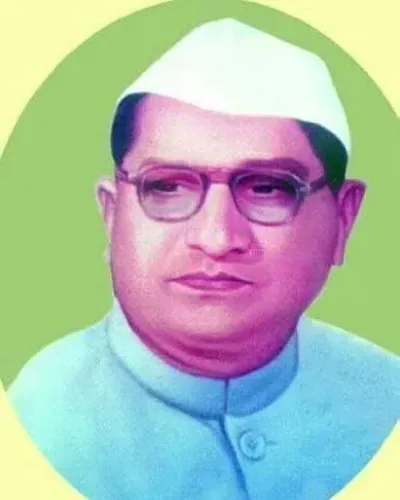
RJD leader Tejashwi Yadav paid tribute to former Prime Minister V.P. Singh on his birth anniversary on 25 June 2026, honouring him as the architect of the 1990 Mandal Commission implementation that secured 27% OBC reservation and reshaped India's social justice politics.
Key Takeaways
Tejashwi Yadav posted a Hindi tribute to former PM V.P.
Singh on his birth anniversary on 25 June 2026 .
Singh announced implementation of the Mandal Commission recommendations on 7 August 1990 , granting 27% reservation to OBCs in central government jobs and educational institutions.
Tejashwi described V.P.
Singh as an advocate of OBCs and a hero of marginalised groups, noting that he brought the struggle of historically excluded classes 'to a conclusion'.
He added a personal dimension, stating he 'played in the lap' of V.P.
Singh and holds a personal attachment to the late leader.
The post carried an ideological message: working for a class's upliftment does not require belonging to that class, but requires rising above the 'illusion of superiority'.
The tribute reinforces the RJD's positioning as the primary custodian of Mandal-era social justice politics in Bihar .
RJD leader Tejashwi Yadav on Thursday, 25 June 2026, paid tribute to former Prime Minister V.P. Singh on his birth anniversary, hailing him as a champion of Other Backward Classes and the architect of the landmark Mandal Commission implementation that transformed India's social justice landscape.
Context
Posting on X, Tejashwi wrote in Hindi that V.P. Singh brought 'yugon-yugon se bahishkrit, uphasit, vanchit, upekshit aur utpidit vargon' (classes excluded, ridiculed, deprived, neglected and oppressed for ages) to a point of resolution by approving the Mandal Commission report. He described the former Prime Minister as a 'pairokar' (advocate) of OBCs and a 'naayak' (hero) of marginalised groups.
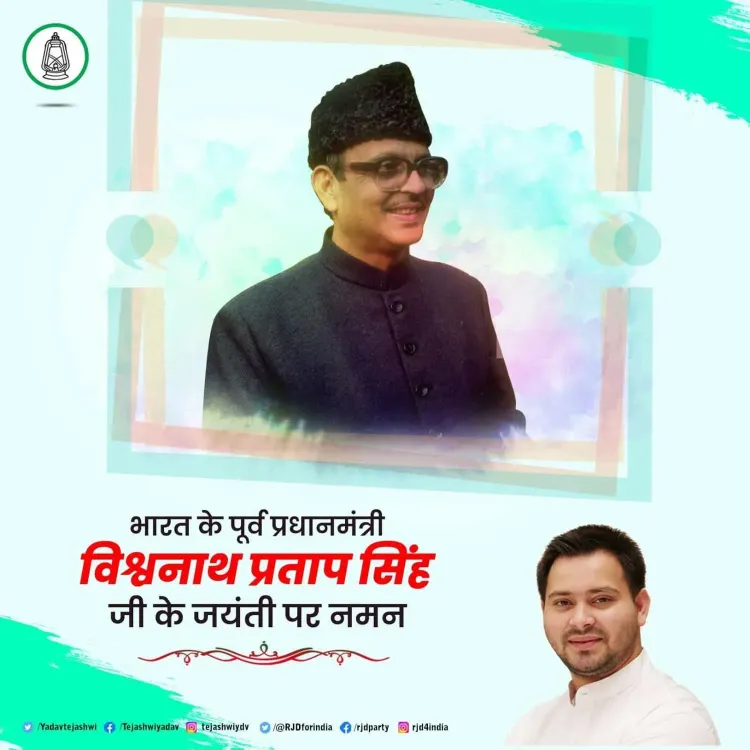
Tejashwi also added a personal note, writing: 'I have played in the lap of former Prime Minister V.P. Singh. I have had a personal attachment to him. We are grateful to him. His short tenure changed the condition and direction of the country.' The post was accompanied by an image and carried hashtags #VPSingh, #TejashwiYadav, #Bihar, and #RJD.
Policy Backdrop
The Mandal Commission, formally the Second Backward Classes Commission, was constituted in 1979 and submitted its report in December 1980, recommending 27% reservation for Other Backward Classes in central government jobs and educational institutions. For nearly a decade the report lay unimplemented.
It was V.P. Singh who, as Prime Minister, announced the implementation of these recommendations on 7 August 1990, extending reservations beyond Scheduled Castes and Scheduled Tribes for the first time at the central level. The decision set off a political earthquake, accelerating the consolidation of OBC communities across northern India and reshaping party formations in states such as Bihar and Uttar Pradesh.
Tejashwi's tribute also carried an implicit ideological message: 'It is not necessary to belong to a class to work for its upliftment — what is needed is to rise above the illusion of superiority and understand the importance of the upliftment of all in the national interest and public interest.'
Stakeholders and Impact
Bihar has long been the crucible of Mandal-era politics. The Rashtriya Janata Dal, founded by Tejashwi's father Lalu Prasad Yadav, drew its original energy from the OBC mobilisation that V.P. Singh's decision unleashed. OBC communities — estimated at roughly 60 per cent of the population by the post's own framing — remain the central electoral constituency for the RJD.
The tribute resonates with backward-class youth and social justice constituencies in Bihar, where debates over caste survey data utilisation and reservation percentages continue to animate political discourse. For the opposition RJD, invoking V.P. Singh keeps the Mandal legacy central to its identity ahead of future electoral contests.
What's Next
Bihar's political conversation around caste survey data and any proposed revision to reservation structures is expected to intensify in the months ahead. Tejashwi Yadav's positioning of the RJD as the inheritor of V.P. Singh's social justice legacy signals that OBC reservation politics will remain a defining fault line in state politics. How the ruling NDA alliance in Bihar responds to this framing — and whether it seeks to claim a share of the Mandal legacy — will shape the next phase of the state's caste arithmetic.
Point of View
Tejashwi seeks to personalise an ideological inheritance, lending authenticity to the RJD's social justice claims beyond pure electoral arithmetic. The post's assertion that one need not belong to a class to champion its cause is a nuanced argument that could cut both ways — defending upper-caste allies of the OBC movement while also pre-empting criticism of dynastic politics. As Bihar's caste survey data enters the policy arena, such symbolic positioning will be integral to how opposition parties frame the reservation debate against the ruling coalition.
NationPress
23 Sept 2026
Frequently Asked Questions
Who was V.P. Singh and why is he remembered for OBC reservation?
V.P. Singh served as Prime Minister of India from 1989 to 1990 . He is remembered for announcing the implementation of the Mandal Commission recommendations on 7 August 1990 , which granted 27% reservation in central government jobs and educational institutions to Other Backward Classes — a decision that fundamentally altered India's social and political landscape.
What is the Mandal Commission and what did it recommend?
The Mandal Commission , formally the Second Backward Classes Commission, was set up in 1979 and submitted its report in December 1980 . It identified Other Backward Classes and recommended 27% reservation for them in public employment and education to address centuries of social exclusion. The recommendations remained unimplemented until V.P. Singh acted on them in 1990.
Why did Tejashwi Yadav post a tribute to V.P. Singh?
Tejashwi Yadav posted the tribute on 25 June 2026 to mark V.P. Singh's birth anniversary . He credited V.P. Singh with implementing the Mandal Commission report and securing social equality for OBC communities. Tejashwi also mentioned a personal bond, saying he had played in V.P. Singh's lap as a child.
What is the significance of Mandal Commission politics in Bihar?
Bihar is one of the states most deeply shaped by Mandal-era politics. The implementation of OBC reservation in 1990 accelerated the political consolidation of backward classes, giving rise to regional parties including the RJD . OBC communities form a large share of Bihar's electorate, making reservation and social justice central issues in every state election.
What did Tejashwi Yadav say about V.P. Singh in his post?
Tejashwi wrote in Hindi that V.P. Singh brought the struggle of historically excluded and oppressed classes 'to a conclusion' by implementing the Mandal Commission report. He called V.P. Singh an 'advocate of OBCs' and a 'hero of marginalised groups', and stated that V.P. Singh's short tenure 'changed the condition and direction of the country'. He also noted a personal attachment, saying he had 'played in the lap' of the former Prime Minister.