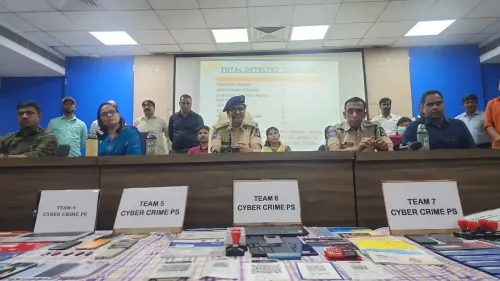
Telangana Cyber Police Launch Operation Crackdown 2.0, Track 335 Offenders

Synopsis
Telangana's TGCSB deployed 300 teams in 'Operation Crackdown 2.0', tracking 335 cybercrime accused linked to over 1,200 cases nationwide. One accused was found in Nepal. With 115 still untraced, this first-ever post-arrest cybercrime surveillance drive could become a national policing model.
Key Takeaways
The Telangana Cyber Security Bureau (TGCSB) launched Operation Crackdown 2.0 on April 25, 2025 , deploying 300 teams statewide to monitor previously arrested cybercrime offenders.
Between 2024–2025 , 3,567 cybercrime accused were arrested in Telangana; 335 persons from this pool were selected for intensive post-arrest verification.
The verified accused are linked to 480 cases in Telangana and 1,233 cybercrime cases across India , revealing a vast criminal network.
218 accused have been traced , while 115 remain untraced ; Prasad Kumar, 30 , a CSEAM case accused, was found residing in Nepal .
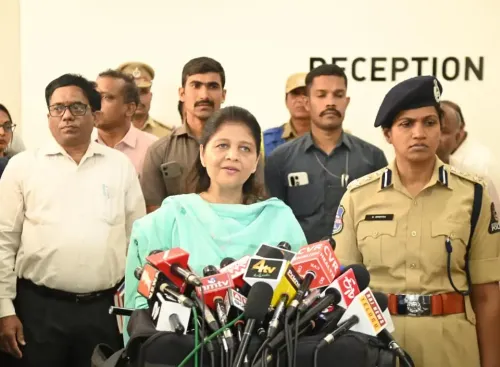
TGCSB Director Shikha Goel confirmed this is India's first coordinated post-arrest cybercrime monitoring drive , structured around five strategic pillars.
Suspect sheets have been opened for accused showing signs of repeat involvement, with strict surveillance measures now in place at jurisdictional police stations.
Hyderabad, April 26 — The Telangana Cyber Security Bureau (TGCSB) launched a sweeping statewide surveillance initiative called 'Operation Crackdown 2.0' on Saturday, April 25, targeting previously arrested cybercrime offenders to prevent repeat offences and disrupt ongoing illegal networks. The operation, announced publicly on Sunday, marks the first large-scale post-arrest monitoring drive in cybercrime history by Telangana Police. Over 300 field teams were deployed simultaneously across multiple districts in a coordinated crackdown.
Scale of the Operation and Key Numbers
Between 2024 and 2025, a total of 3,567 cybercrime accused were arrested across Telangana. From this pool, 614 accused who are residents of Telangana were identified, and a subset of those linked to major financial cyber frauds and multiple crime records were shortlisted for intensive verification.
Of the targeted individuals, 335 persons were subjected to rigorous verification. These accused are collectively linked to 480 cybercrime cases in Telangana and a staggering 1,233 cases across India, highlighting the national scale of the threat posed by these offenders.
Among those verified, 218 accused have been successfully traced. Some continue to reside at their original addresses, while others have relocated — often under the guise of employment — making tracking more complex. 115 persons remain untraced, and active efforts are underway to locate them. Additionally, three persons were reported deceased during the verification process.
One Accused Found in Nepal, CSEAM Case Flagged
A significant find during the operation was the discovery that Prasad Kumar, 30, an accused in a Child Sexual Exploitation and Abuse Material (CSEAM) case, is currently residing in Nepal. This cross-border dimension adds a layer of complexity to the investigation and raises serious concerns about the ability of offenders to evade Indian jurisdiction by moving abroad.
This development underscores the urgent need for stronger international cybercrime cooperation mechanisms, particularly with neighbouring countries that share open borders with India.
Five Strategic Pillars Behind the Drive
According to TGCSB Director Shikha Goel, the operation was structured around five strategic pillars: physical verification, intelligence gathering, network mapping, legal compliance, and deterrence. These pillars ensured that the drive was not merely a headcount exercise but a comprehensive surveillance and intelligence-building mission.
In cases where repeat involvement or suspicious behaviour was detected, strict surveillance measures have been initiated — including the formal opening of suspect sheets as per police standing orders. Detailed data compiled during the drive will be used for further analysis and strategic follow-up actions.
Director Goel emphasised that this is the first coordinated effort to verify such individuals and share their criminal history with respective jurisdictional police stations, strengthening inter-station coordination and enabling more effective long-term monitoring.
Why This Operation Matters: Broader Implications
India has witnessed an explosive rise in cybercrime in recent years. According to the National Crime Records Bureau (NCRB), cybercrime cases in India have grown by over 300% in the last five years, with financial fraud emerging as the dominant category. Telangana, home to Hyderabad's thriving IT ecosystem, has been a particularly high-value target for cybercriminals — both as victims and, alarmingly, as perpetrators.
The fact that accused persons linked to 1,233 national cases were found residing in a single state points to a systemic problem: cybercrime networks are not isolated incidents but organised operations with deep local roots. Operation Crackdown 2.0 is a direct acknowledgment of this reality and represents a shift from reactive policing to proactive, intelligence-led surveillance.
Notably, this operation also signals a growing recognition within Indian law enforcement that arrest alone is insufficient — post-conviction and post-bail monitoring is equally critical to dismantling cybercrime ecosystems. Critics have long argued that India's cybercrime recidivism rates remain high due to the absence of structured post-arrest oversight mechanisms.
What Comes Next
The TGCSB has indicated that the compiled data will feed into a broader strategic framework for cybercrime prevention across Telangana. Authorities are expected to intensify efforts to trace the remaining 115 untraced accused, while the cross-border case involving the accused in Nepal may prompt diplomatic and legal coordination through Interpol or bilateral channels.
Director Shikha Goel stated that this operation sends a clear message of zero tolerance towards repeat offenders, and future editions of the crackdown are likely to expand in scope — potentially covering accused persons who have migrated to other Indian states or abroad. With cybercrime evolving rapidly, Operation Crackdown 2.0 could serve as a national model for other state police forces to replicate.
Point of View
And one has fled to Nepal, reveals how easily cybercriminals exploit the gap between arrest and conviction to rebuild their networks. Telangana's initiative is commendable, but it also raises uncomfortable questions: why did it take until 2025 for any Indian state to attempt structured post-arrest surveillance of cybercrime offenders? As digital fraud becomes India's fastest-growing crime category, this operation should be the baseline — not the exception.
NationPress
19 Sept 2026
Frequently Asked Questions
What is Operation Crackdown 2.0 by Telangana Police?
Operation Crackdown 2.0 is a statewide post-arrest surveillance drive conducted by the Telangana Cyber Security Bureau (TGCSB) to monitor previously arrested cybercrime offenders and prevent repeat offences. Launched on April 25, 2025, the operation deployed 300 teams across Telangana to physically verify and track 335 accused persons linked to major financial cyber frauds.
How many cybercrime accused were tracked in Operation Crackdown 2.0?
A total of 335 accused persons were verified during Operation Crackdown 2.0. Of these, 218 have been successfully traced, 115 remain untraced, and 3 were reported deceased.
Who is leading Operation Crackdown 2.0 in Telangana?
The operation is being led by TGCSB Director Shikha Goel, in coordination with Law & Order Police across Telangana. Director Goel stated the initiative sends a strong message of zero tolerance towards repeat cybercrime offenders.
Why is one cybercrime accused from Telangana found in Nepal?
During Operation Crackdown 2.0, it was discovered that Prasad Kumar, 30, an accused in a CSEAM (Child Sexual Exploitation and Abuse Material) case, is currently residing in Nepal. Authorities are expected to pursue cross-border legal channels to bring him back to India.
Is this the first cybercrime post-arrest monitoring operation in India?
Yes, according to TGCSB Director Shikha Goel, Operation Crackdown 2.0 is the first extensive post-arrest monitoring initiative undertaken for cybercrime cases by any state police force in India. It is structured around five pillars: physical verification, intelligence gathering, network mapping, legal compliance, and deterrence.