Anurag Thakur: PSUs now engine of Indian economy after 12 years
Synopsis
BJP MP Anurag Thakur has credited the Modi government and PSU employees for transforming India's public sector undertakings into the engine of the national economy over 12 years, pointing to a decade-plus of board reforms, strategic disinvestment policy, and capital expenditure expansion.
Key Takeaways
BJP MP Anurag Thakur stated on 29 May 2026 that the Modi government , backed by PSU workers, made public sector undertakings 'the engine of Indian economy' over 12 years .
The government's PSU reform journey began with the 2014-15 Budget , which set a disinvestment target of Rs 58,425 crore and introduced strategic sales.
The Insolvency and Bankruptcy Code (2016) enabled faster resolution of stressed assets, including those of public sector firms.
A Public Sector Enterprise Policy (February 2021) classified 18 strategic sectors for continued state presence and outlined exits from non-strategic ones.
Defence and petroleum PSUs received fresh capital under production-linked incentive schemes , expanding domestic capacity.
The next Economic Survey and Union Budget will be key markers for updated PSU performance data and fresh disinvestment plans.
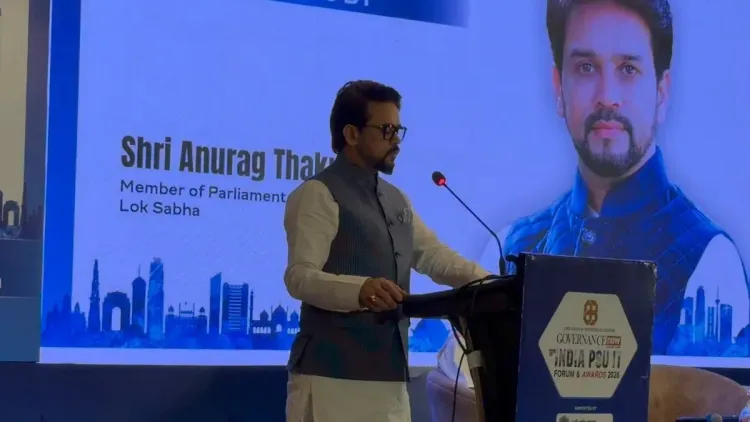
BJP MP Anurag Thakur, former Union Minister and Lok Sabha member from Hamirpur, Himachal Pradesh, on Friday, 29 May 2026, credited the Modi government and the workforce of India's public sector undertakings for transforming PSUs into what he called 'the engine of the Indian economy' over the past 12 years.
Context
Posting from New Delhi, Thakur wrote that 'it took almost 12 years for the Modi government supported by the dedicated workforce of the PSUs to make PSUs as the engine of Indian economy.' The statement marks a political stocktaking of the Narendra Modi government's record on public sector reform since it first assumed office in May 2014.
The claim comes as the government approaches the completion of a full decade-plus in office, a period during which central public sector enterprises have been repositioned from perceived liabilities to contributors to national capital expenditure and fiscal consolidation.
Policy Backdrop
The Modi government began restructuring the PSU landscape from its first budget in 2014-15, raising the disinvestment target to Rs 58,425 crore and introducing the concept of strategic sales in select undertakings. The Insolvency and Bankruptcy Code, enacted in 2016, enabled faster resolution of stressed assets, including those held by several public sector companies.
A landmark Public Sector Enterprise Policy was notified in February 2021, classifying 18 strategic sectors where state presence would be retained and outlining minority stake sales or privatisation in non-strategic ones. Defence and petroleum PSUs simultaneously received fresh capital expenditure under production-linked incentive schemes, expanding domestic manufacturing capacity.
Board professionalisation, performance-linked pay structures, and the use of listed PSUs for minority stake sales to meet fiscal targets have been the operational levers of this approach — balancing privatisation rhetoric with continued strategic state ownership.
Stakeholders and Impact
PSU employees — numbering in the lakhs across sectors including energy, steel, defence, and banking — are central to Thakur's framing, which explicitly credits the 'dedicated workforce' alongside government policy. Their productivity and morale have been cited by the government in successive economic documents as a driver of the turnaround narrative.
Retail and institutional investors in listed PSUs have also been direct beneficiaries, with several central public sector enterprise stocks delivering significant returns over the past several years as profitability improved and capital allocation became more disciplined. The broader economy has felt the impact through increased PSU-led infrastructure spending, which has underpinned headline GDP growth figures.
What's Next
The next Economic Survey and Union Budget will be closely watched for updated PSU profit aggregates and any fresh disinvestment or strategic sale announcements. If a Public Sector Enterprises (Regulation) Bill is introduced in Parliament, it could institutionalise the reforms Thakur is pointing to, giving them a statutory foundation beyond executive policy.
For the BJP, the PSU turnaround story is likely to remain a key plank in its economic governance narrative heading into future electoral cycles, with leaders like Thakur amplifying it on public platforms to shape voter perception of the government's decade-long record.
Point of View
Timed to consolidate the BJP's economic governance narrative as the Modi government crosses the 12-year mark. By centring both policy and workforce — rather than privatisation alone — the framing is calibrated to appeal to PSU employees as a constituency while also satisfying market-oriented audiences. The emphasis on 'engine of the economy' signals a broader shift in how the government wants PSUs perceived: not as fiscal drags requiring divestment, but as active growth drivers. This sets the rhetorical stage for defending continued strategic state ownership even as disinvestment targets remain on the books.
NationPress
12 Oct 2026
Frequently Asked Questions
What did Anurag Thakur say about PSUs in May 2026?
Anurag Thakur stated that it took almost 12 years for the Modi government, supported by the dedicated PSU workforce, to make public sector undertakings the engine of the Indian economy.
How has the Modi government reformed PSUs since 2014?
The government introduced strategic disinvestment, enacted the Insolvency and Bankruptcy Code in 2016, notified a Public Sector Enterprise Policy in February 2021 covering 18 strategic sectors, and channelled fresh capital expenditure into defence and petroleum PSUs under production-linked incentive schemes.
What is the Public Sector Enterprise Policy of 2021?
Notified in February 2021, the policy classifies 18 strategic sectors where the government will retain a public sector presence and outlines minority stake sales or privatisation in non-strategic sectors to improve efficiency and reduce fiscal burden.
Who is Anurag Thakur and why is his statement significant?
Anurag Thakur is a BJP Lok Sabha MP from Hamirpur, Himachal Pradesh, and a former Union Minister of Information and Broadcasting and Youth Affairs and Sports. His statement carries weight as a senior party voice articulating the government's decade-long economic record on public sector reform.
What should investors and PSU employees watch for next?
The upcoming Economic Survey and Union Budget will provide updated PSU profit figures and signal any new disinvestment or strategic sale plans; a potential Public Sector Enterprises (Regulation) Bill in Parliament could further institutionalise recent reforms.