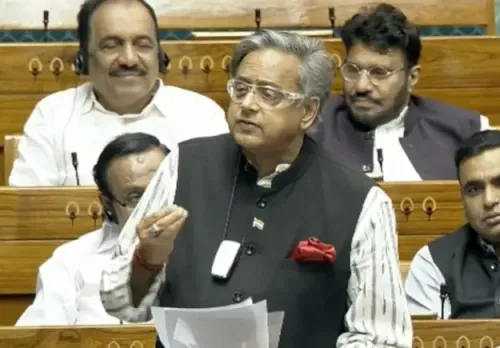
Tharoor Backs Careful Choice of Law Enforcement Tools
Synopsis
Congress MP Dr. Shashi Tharoor backed calls on July 30, 2026 for far greater care in selecting law enforcement instruments, saying the question 'should be past debating' and aligning himself with advocates of proportionality in state force deployment.
Key Takeaways
On July 30, 2026 , Congress MP Dr.
Shashi Tharoor publicly agreed that law enforcement instruments must be chosen with 'far greater care than hitherto.' Tharoor stated the matter 'should be past debating,' signalling his view that this is a settled democratic principle awaiting implementation.
The post was a reply in a conversation involving @yashoazad , @jomalhotra , and @tribunnews .
The intervention aligns with a broader Congress position favouring restraint and proportionality in state force deployment.
Tharoor's background as a former UN Under-Secretary-General and former Union Minister lends institutional weight to the position.
Any follow-up parliamentary intervention on law enforcement practices will be significant to watch.
The debate over which instruments of law enforcement the state should deploy — and when — rarely surfaces with such directness in Indian political discourse. On Thursday, July 30, 2026, Congress MP Dr. Shashi Tharoor weighed in firmly, stating the question of choosing law enforcement mechanisms with greater care 'should be past debating.'
Replying to @yashoazad, @jomalhotra, and @tribunnews, Tharoor wrote: 'Agree entirely. This should be past debating, but if a debate is called for, I agree with you that the instruments of law enforcement ought to be chosen with far greater care than hitherto.'
A Long-Running Fault Line in Indian Governance
The question of proportionality in deploying state force — whether police, paramilitary, or other mechanisms — has been a recurring flashpoint in Indian political life. Congress leaders, and Tharoor in particular, have consistently advocated for restraint and calibrated responses in public-order situations. His intervention here is brief but pointed: the selection of law enforcement tools is not a matter still open to casual debate. It is, in his view, a settled question of democratic governance that has simply not been acted upon. Tharoor's credentials on the subject carry weight. As a former UN Under-Secretary-General and former Union Minister, he has engaged with questions of institutional accountability at both the national and international level. His use of the word 'hitherto' — meaning up to this point — signals that past practice has fallen short, and that a course correction is overdue.What 'Greater Care' Actually Means
The phrase 'instruments of law enforcement' is deliberately broad. It encompasses everything from the choice between civil police and paramilitary deployment, to the use of riot-control measures, to the legal provisions invoked during public order situations. The argument for 'greater care' is, at its core, an argument for proportionality — matching the tool to the situation, not reaching for the heaviest instrument available. This is not a fringe position. It sits at the heart of constitutional jurisprudence on the use of state force, and has been affirmed repeatedly by courts examining the legality of specific deployments. Tharoor's post aligns him with that legal and democratic mainstream — and signals he may carry the argument further in parliamentary forums. Whether this exchange translates into a formal legislative intervention or a broader campaign on law enforcement reform will be worth watching. When a parliamentarian of Tharoor's standing says a debate 'should be past' the arguing stage, the next logical move is the floor of the House.Point of View
He is staking out a position that proportionality in law enforcement is no longer a debatable premise but an implementation problem. For the Congress party, this fits a long pattern of using governance and civil-liberties framing to challenge the ruling establishment on public-order questions. The phrase 'far greater care than hitherto' is a quiet indictment of past practice — including, implicitly, decisions made under multiple governments. If Tharoor converts this into a parliamentary question or a private member motion, it could sharpen the legislative debate around police reform, an agenda that has stalled for decades despite successive committee recommendations.
NationPress
30 Jul 2026
Frequently Asked Questions
What did Shashi Tharoor say about law enforcement on July 30 2026?
Tharoor said the choice of law enforcement instruments 'should be past debating' and that they 'ought to be chosen with far greater care than hitherto,' backing calls for proportionality in state force deployment.
Who was Shashi Tharoor replying to in this post?
Tharoor was replying to @yashoazad , @jomalhotra , and @tribunnews in a conversation on the platform X.
What does 'instruments of law enforcement' mean in this context?
The phrase refers broadly to the mechanisms the state can deploy in public-order situations — including police, paramilitary forces, riot-control measures, and specific legal provisions — and the need to match the tool proportionately to the situation.
What is Shashi Tharoor's background on governance issues?
Tharoor is a Congress MP from Thiruvananthapuram , a former Union Minister , and a former UN Under-Secretary-General , giving him significant experience with questions of institutional accountability at both national and international levels.
Could this lead to a parliamentary debate on law enforcement reform in India?
It is possible. When a parliamentarian of Tharoor's standing describes the issue as settled in principle, the next step is typically a formal legislative intervention such as a parliamentary question or a private member motion.