Tharoor backs 'grand strategy' call, cites his 2012 Pax Indica

Synopsis
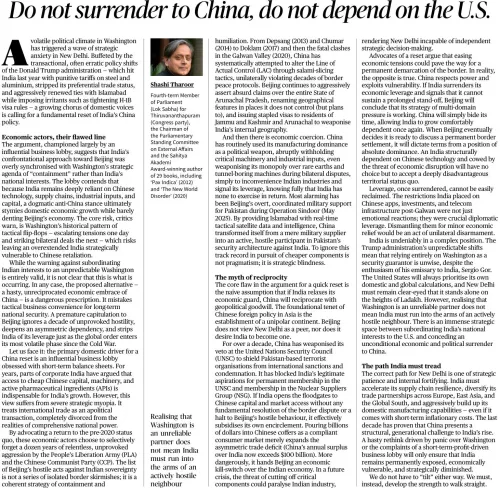
Congress MP Dr. Shashi Tharoor endorsed a new analysis calling for India to adopt a formal grand strategy, linking it to nearly two decades of his own advocacy — including a dedicated chapter in his 2012 book Pax Indica — reigniting a long-running debate in India's foreign-policy community.
Key Takeaways
Shashi Tharoor publicly backed a new analysis arguing India needs a formal 'grand strategy.' Tharoor has advocated for an Indian grand strategy for nearly two decades , a position anchored in his 2012 book Pax Indica .
Pax Indica included an entire chapter devoted to the case for an articulated Indian grand strategy.
India's foreign-policy community has debated the merits of an explicit grand strategy without producing a formal, binding public doctrine to date.
As a former UN Under-Secretary-General and former Union Minister of State for External Affairs , Tharoor brings operational credibility to the debate.
The specific analysis Tharoor endorsed in the post has not been publicly identified.
Nearly two decades of advocacy distilled into a single post — Congress MP Dr. Shashi Tharoor on Friday, September 25, 2026, publicly endorsed what he called a 'deeply-researched, carefully thought out and far-reaching analysis' arguing that India urgently needs a formal grand strategy to shape its future.
A two-decade argument finds fresh voice
Tharoor has been making this case since the early 2000s. The clearest marker is his 2012 book Pax Indica, which included an entire chapter devoted to the necessity of an articulated Indian grand strategy — one that would align the country's diplomatic, economic, and security objectives into a coherent, long-horizon framework. That book placed him among the few sitting politicians who had put the argument in print rather than confining it to closed-door seminars.
The post does not name the specific analysis he is endorsing — the research behind it remains unidentified — but the endorsement carries weight precisely because it arrives from someone whose own published record on the subject stretches back fourteen years before this moment.
What 'grand strategy' actually means for India
The phrase sounds abstract. It is not. A grand strategy — in the classical sense used by strategic thinkers from Kautilya to Kissinger — is a state's master plan for translating national power into national security and prosperity across generations. For India, the debate centres on whether New Delhi can continue to operate through ad-hoc, reactive foreign policy or whether it needs an explicit, publicly articulated doctrine the way the United States publishes a National Security Strategy.
Critics of the status quo argue that India's foreign-policy instincts — non-alignment, strategic autonomy, multi-alignment — are dispositions rather than strategies. Advocates of a formal grand strategy want those dispositions translated into binding priorities: which partnerships matter most, which threats are existential, which economic corridors anchor India's future, and how military, diplomatic and soft-power tools reinforce each other.
Tharoor's place in this debate
As a former UN Under-Secretary-General and former Union Minister of State for External Affairs, Tharoor brings rare operational credibility to a conversation that often stays inside think-tanks. His congressional perch in Thiruvananthapuram does not diminish that — it adds a democratic accountability dimension that pure strategists lack. When he flags a piece of analysis as 'far-reaching,' the foreign-policy community takes notice.
The broader pattern here is significant. India's strategic community has periodically convened around this question — at institutes, in parliamentary committees, and through occasional government white-paper-adjacent documents — without ever producing the kind of formal, public grand-strategy document that comparable powers maintain. Every few years, a scholar or practitioner restates the case. Tharoor's post signals that the argument has fresh analytical ammunition behind it.
Whether this round of advocacy prompts a parliamentary debate, a think-tank rejoinder, or an official government response will be the measure of its traction. The case has been made before. The question India's policymakers keep deferring is when they will finally answer it.
Point of View
It tests whether the ruling establishment will engage or deflect. With India navigating an increasingly multi-polar order — balancing relations with Washington, Moscow, and Beijing simultaneously — the absence of a publicly articulated doctrine is becoming a harder position to defend. Tharoor's endorsement keeps the pressure on, even if the immediate political impact is limited.
NationPress
25 Sept 2026
Frequently Asked Questions
What is Shashi Tharoor's book Pax Indica about?
'Pax Indica,' published in 2012 , is Tharoor's examination of India's foreign policy and its place in the world, including a full chapter arguing that India needs a coherent grand strategy to guide its diplomacy, security, and economic engagement.
What does 'grand strategy' mean in the context of India's foreign policy?
A grand strategy is a long-horizon master plan that aligns a state's diplomatic, military, and economic tools toward defined national objectives. For India, advocates argue it would replace reactive, ad-hoc foreign policy with a clear public doctrine — similar to documents other major powers publish regularly.
Has India ever officially adopted a grand strategy?
India has not produced a formal, publicly articulated grand-strategy document equivalent to a national security strategy. The country's approach — often described as strategic autonomy or multi-alignment — reflects a disposition rather than a codified doctrine.
Why is Shashi Tharoor considered credible on foreign policy?
Tharoor served as UN Under-Secretary-General for Communications and Public Information and as Union Minister of State for External Affairs in the UPA government , giving him direct experience in multilateral diplomacy and India's foreign-policy machinery.
What triggered Tharoor's post on India's grand strategy in September 2026?
Tharoor referenced a 'deeply-researched' and 'far-reaching' analysis he had read, though the specific paper or publication was not named in the post. He used it as an occasion to highlight his nearly two-decade advocacy on the subject.