Tharoor Backs Ex-Foreign Secy on India's Strategic Presence
Synopsis
Congress MP Dr. Shashi Tharoor backed former Foreign Secretary Nirupama Menon Rao's call for India to remain present wherever it is a direct stakeholder, reinforcing New Delhi's long-standing doctrine of strategic autonomy and multi-alignment across global forums.
Key Takeaways
Shashi Tharoor publicly endorsed a remark by former Foreign Secretary Nirupama Menon Rao on June 5, 2026 .
Tharoor stressed India 'cannot afford to be absent from situations where we are direct stakeholders.' Nirupama Menon Rao served as Foreign Secretary from 2009 to 2011 and as ambassador to the US and China .
India's doctrine of strategic autonomy has guided its multi-alignment approach across the Quad , BRICS , and G20 .
Tharoor's former role as UN Under-Secretary-General lends particular weight to his views on multilateral engagement.
Focus now shifts to India's posture at the next UN General Assembly and the forthcoming monsoon session of Parliament.
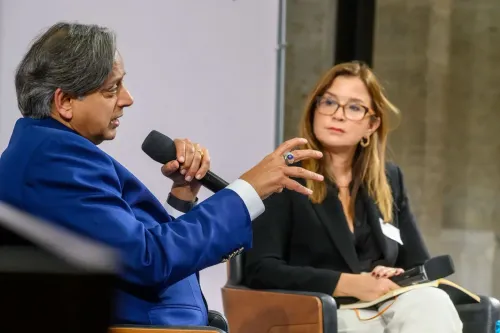
Congress MP Dr. Shashi Tharoor on Friday, June 5, 2026, publicly endorsed a remark by former Foreign Secretary Nirupama Menon Rao, stressing that India must not remain absent from situations where it has a direct stake. The Thiruvananthapuram MP's brief but pointed post on X amplified a position that cuts across party lines in Indian foreign-policy discourse.
Context
Tharoor's post quoted and affirmed Nirupama Menon Rao, a veteran diplomat who served as Foreign Secretary from 2009 to 2011 and as ambassador to both the United States and China. Rao is a regular voice in public debates on Indian diplomacy and strategic affairs. While the specific statement Tharoor was responding to could not be independently verified at the time of publication, his endorsement — 'We must not, indeed cannot afford to, be absent from situations where we are direct stakeholders' — reflects a well-established strand of Indian strategic thinking.
Policy Backdrop
India's doctrine of strategic autonomy and multi-alignment has been a cornerstone of its foreign policy since the 1990s, articulated by successive governments regardless of political affiliation. The principle holds that New Delhi must maintain an active presence in every forum or crisis theatre where Indian interests — economic, security, or diaspora-related — are at play. This thinking underpins India's simultaneous engagement across groupings such as the Quad, BRICS, and the G20, as well as its consistent participation at the United Nations General Assembly.
Tharoor himself brings unusual credibility to this argument: before entering electoral politics, he served as UN Under-Secretary-General, giving him first-hand experience of multilateral diplomacy and the costs of strategic absence. His current role as a Congress MP and a member of parliamentary committees on external affairs keeps him engaged with India's foreign-policy debates from the legislative side.
Stakeholders and Impact
The sentiment resonates widely within India's diplomatic corps and foreign-policy analyst community, who have long argued that selective disengagement — whether from regional conflicts, multilateral negotiations, or emerging security architectures — carries tangible costs for a country of India's size and ambition. Indian diaspora communities in conflict-prone regions and trade partners in volatile theatres add a concrete dimension to the abstract principle of presence.
Critics of strategic over-extension, however, caution that engagement must be calibrated to capacity and to the risk of being drawn into disputes that do not serve core national interests. The debate is not new, but it sharpens whenever a specific crisis or forum tests New Delhi's appetite for active involvement.
What's Next
Attention will now turn to India's posture at the next UN General Assembly session and to any parliamentary debates on external affairs during the forthcoming monsoon session. Tharoor's endorsement of Rao's position adds a cross-partisan note to the conversation, signalling that the argument for proactive engagement enjoys support beyond the ruling dispensation. How the government translates that principle into specific policy decisions — from the Indo-Pacific to the Middle East — will be the real test of India's stated commitment to strategic presence.
Point of View
On a principle the current government also publicly champions. It signals that on the question of strategic presence, the Indian political class speaks with unusual coherence. The post arrives at a moment when India's choices in multiple simultaneous theatres — from the Indo-Pacific security architecture to West Asia — are under close scrutiny. That a former UN Under-Secretary-General is making the argument from the opposition benches adds a layer of institutional credibility that goes beyond routine political posturing.
NationPress
20 Oct 2026
Frequently Asked Questions
What did Shashi Tharoor say about India's foreign policy on June 5 2026?
Tharoor endorsed former Foreign Secretary Nirupama Menon Rao's view that India must not be absent from situations where it is a direct stakeholder, calling such absence something the country 'cannot afford.'
Who is Nirupama Menon Rao?
Nirupama Menon Rao is a retired Indian Foreign Service officer who served as Foreign Secretary from 2009 to 2011 and as India's ambassador to both the United States and China. She is a frequent commentator on Indian diplomacy.
What is India's doctrine of strategic autonomy?
Strategic autonomy is India's long-standing foreign-policy principle of maintaining independent positions and active engagement across competing global groupings — such as the Quad, BRICS, and G20 — rather than aligning exclusively with any single power bloc.
Why does Shashi Tharoor's opinion on foreign policy carry weight?
Before entering electoral politics, Tharoor served as UN Under-Secretary-General, giving him direct experience of multilateral diplomacy. He currently represents Thiruvananthapuram in Parliament and engages with external-affairs debates through parliamentary committees.
What will indicate India's next steps on strategic engagement?
India's posture at the next UN General Assembly session and any parliamentary debates on external affairs during the monsoon session will be key indicators of how New Delhi is translating the principle of strategic presence into concrete policy.