Tharoor Questions Umar Khalid's Six-Year Detention Without Trial

Synopsis
Congress MP Dr. Shashi Tharoor has publicly questioned the six-year pre-trial detention of former JNU student leader Umar Khalid under UAPA, calling for the state to either prove terrorism charges in court or uphold Khalid's right to a fair trial.
Key Takeaways
Shashi Tharoor on June 30, 2026 questioned the legality and fairness of Umar Khalid's continued detention without trial.
Umar Khalid has been in custody for approximately six years since his arrest in September 2020 under the UAPA .
Khalid is accused in the Delhi riots conspiracy case of February 2020 , in which at least 53 people were killed.
The UAPA reverses the standard burden of proof at the bail stage, making bail exceptionally difficult for accused individuals.
Tharoor invoked the constitutional right of every Indian citizen to a fair trial, framing the issue as a fundamental due-process concern.
The case has become a flashpoint in India's broader debate over national security laws versus civil liberties.
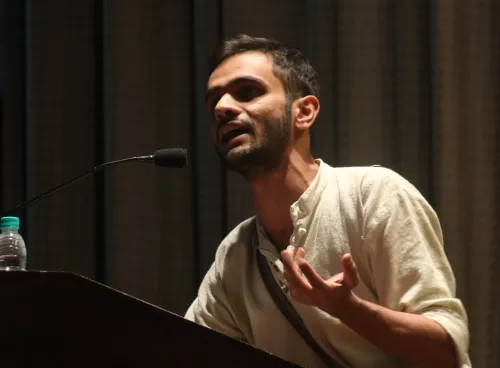
Congress MP Dr. Shashi Tharoor on Tuesday, June 30, 2026, publicly questioned the prolonged incarceration of Umar Khalid, a former Jawaharlal Nehru University student leader, who has spent six years in prison under the Unlawful Activities (Prevention) Act (UAPA) without the conclusion of a trial. Tharoor invoked the fundamental right of every Indian citizen to a fair trial, demanding that the state either prove its terrorism charges in court or grant Khalid bail.
Context
Umar Khalid was arrested in September 2020 in connection with the Delhi riots conspiracy case of February 2020, in which at least 53 people were killed. He was charged under the stringent UAPA, which makes bail exceptionally difficult to obtain. As of June 2026, he has spent approximately six years in custody at Tihar Jail, New Delhi, with his trial yet to reach a conclusion.
Tharoor, responding to what he described as a 'moving article' about Khalid's conditions in prison, posed a pointed question: 'if he really has incited terrorism, why not prove it in a court of law?' The remark encapsulates a wider civil liberties debate about whether the UAPA's bail provisions effectively amount to punishment before conviction.
Policy Backdrop
The Unlawful Activities (Prevention) Act, last significantly amended in 2019, places the burden of proof on the accused at the bail stage — a reversal of the standard presumption of innocence. Courts have repeatedly noted that under UAPA, securing bail is 'an exception rather than the rule,' a principle affirmed by the Supreme Court of India in multiple judgments.
Critics, including several senior lawyers and civil society groups, argue that the law is being used to keep accused individuals incarcerated for years before any judicial determination of guilt. Supporters of the law contend that its stringency is necessary given the severity of terror-related offences and the risk of evidence tampering or flight.
Khalid's case has become a reference point in this debate, with human rights organisations flagging it as emblematic of prolonged pre-trial detention in UAPA cases. Multiple bail applications filed on his behalf have been rejected by courts citing the nature of the charges.
Stakeholders and Impact
Dr. Tharoor, a former UN Under-Secretary-General and sitting Lok Sabha MP from Thiruvananthapuram, carries institutional weight when he raises due-process concerns. His remarks are likely to amplify Opposition pressure on the government to address the pace of UAPA trials and the conditions of undertrial detainees.
For Umar Khalid's family and legal team, the statement from a prominent parliamentarian provides political visibility to a case that has drawn sustained attention from civil liberties advocates. The broader undertrial prisoner population in India — estimated in the lakhs — is also implicated in the systemic question Tharoor raises about access to speedy justice.
The ruling Bharatiya Janata Party (BJP) and the Delhi Police, which filed the chargesheet, have maintained that the charges are serious and evidence-backed, and that the judicial process is taking its natural course.
What's Next
Tharoor's post is expected to renew calls in Parliament and civil society for reforms to UAPA's bail provisions and for fast-tracking of trials in cases involving long-term undertrial detention. The Supreme Court has in recent terms taken cognisance of undertrial delays across the country, and this case may surface again in that context.
If the Delhi trial court does not accelerate proceedings, further bail petitions before higher courts remain a likely avenue for Khalid's defence. The case continues to test the boundaries between national security imperatives and constitutionally guaranteed rights — a tension that will shape India's legal and political discourse well beyond this single case.
Point of View
' he places the burden squarely on the state, echoing a line of reasoning the Supreme Court itself has occasionally signalled in UAPA bail jurisprudence. The statement fits a pattern of Opposition attempts to use high-profile undertrial cases to highlight what they characterise as the misuse of terror laws ahead of legislative and electoral cycles. Whether it moves the needle on Khalid's legal situation is uncertain, but it ensures the case remains in the national conversation.
NationPress
28 Sept 2026
Frequently Asked Questions
Why has Umar Khalid been in jail for six years?
Umar Khalid has been in custody since September 2020 after being charged under the Unlawful Activities (Prevention) Act in connection with the alleged conspiracy behind the February 2020 Delhi riots. The UAPA makes bail extremely difficult to obtain, and his multiple bail applications have been rejected by courts citing the seriousness of the charges.
What did Shashi Tharoor say about Umar Khalid?
On June 30, 2026, Congress MP Dr. Shashi Tharoor questioned why, if Umar Khalid truly incited terrorism, the state has not proven it in a court of law. He called Khalid's prolonged detention without a completed trial a denial of the basic right of any Indian citizen to a fair trial.
What is the UAPA and why is it controversial?
The Unlawful Activities (Prevention) Act is India's primary anti-terror law, last amended in 2019. It is controversial because it reverses the standard presumption of innocence at the bail stage, effectively making bail the exception rather than the rule, which critics say enables prolonged pre-trial detention.
What is the Delhi riots conspiracy case?
The Delhi riots conspiracy case relates to communal violence in north-east Delhi in February 2020 in which at least 53 people were killed. Delhi Police alleged a larger conspiracy behind the riots and filed chargesheets under the UAPA against several individuals, including Umar Khalid.
Can Umar Khalid get bail under UAPA?
Securing bail under the UAPA is extremely difficult because the law requires the court to be satisfied that there are no reasonable grounds to believe the accused is guilty — a threshold courts have interpreted strictly. Khalid's bail applications have been rejected at multiple levels, though his legal team can continue to approach higher courts.